

The Goose & Cuckoo Inn Upper Llanover Pub Walk
'If you know, you know': finally made it to this remote gem.

My first encounter with The Goose & Cuckoo Inn was in winter, a cold, wind‑blasted walk on the Blorenge when the Beacons — Bannau Brycheiniog now — felt bleak and endless.
Then suddenly, this pub with its odd, unforgettable name appeared out of nowhere. No village, no cluster of houses, just a solitary inn perched on the hillside. With light fading and miles to go, I didn’t stop. But I promised myself I’d come back.
Today was the day.
With the Goose & Cuckoo’s reduced opening hours, the walk needed careful choreography — Thursday after 5pm was the plan today — so I began in the valley at Goytre Wharf and followed the Monmouthshire & Brecon Canal through its soft beauty before climbing steadily towards the pub.
Halfway up a narrow lane, a car edged past me: the barmaid heading up to open. A tiny, perfect reassurance that I'd timed it right. And when I arrived, the welcome was exactly what makes this place special.
There’s a quiet camaraderie at the Goose & Cuckoo, the kind that only exists in pubs reached by people who’ve all made the same effort: if you know, you know. It’s one of those rare Welsh pubs where the journey and the destination belong to each other — a pub worth the walk in every sense.
About The Goose & Cuckoo Inn, Upper Llanover
Last visit: April 2026
The Goose & Cuckoo Inn sits high above Upper Llanover on the southern slopes of the Blorenge, a small stone inn that feels perfectly placed on one hand, and slightly improbable on the other. The setting is astonishing. You don’t pass this pub on the way to anywhere — you go to it. Remote, quiet, and beautifully exposed, it’s a pub that rewards the effort it takes to reach it.
Why is it here?
The building began life in the early 1800s as the New Inn, serving a landscape that was changing faster than almost anywhere in Wales. The valley below remained farmland, but above it the Blorenge was becoming an industrial frontier: furnaces at Blaenavon and Nantyglo glowing through the night, tramroads cutting across the hills, and the new Monmouthshire & Brecon Canal (cutting started in 1796) eventually carrying iron and coal down to Newport.
For such a rural area, there were pubs everywhere — small, rough, necessary places where farmhands, hauliers, charcoal burners and furnace men could rest, talk, and warm themselves before the long walk home. The New Inn was one of them, perched on the upland routes used by people who lived and worked between the valley and the iron towns.
I always envisage the world Alexander Cordell’s captured in Rape of the Fair Country when walking here: the Scots Cattle union men slipping through the woods, the ironworkers trudging home along the canal, the sense of a valley caught between old loyalties and new industries.
As well as today's local, brilliant and award-winning landlords, Kyle and Haf Williams, the survival of the Goose & Cuckoo owes something to luck and geography. In the late 19th century, Lady Llanover — fierce, principled, and determined to stamp out drinking — closed every pub on her estate, turning alehouses into chapels and reading rooms. Many vanished. But the New Inn sat just outside her boundary, a few yards of hillside saving it from her temperance crusade. While other pubs disappeared, this one kept its fire burning.
The name itself is a small piece of local folklore: two sisters who ran the pub fell out so spectacularly that one called the other “a silly old goose,” the insult returned with “a silly old cuckoo.” The nicknames stuck, and by the 1880s the pub had embraced them fully. It suits the place.
Inside, the Goose & Cuckoo feels wonderfully unchanged. A low‑ceilinged bar, a real fire, a piano doubling as a noticeboard, and windows layered with decades of Good Beer Guide stickers. CAMRA has long championed it, and in 2024 it was named Gwent Country Pub of the Year — a recognition of its unpretentious excellence and the care taken with its ales.
The location is fabulous. The new terrace, opening out over the valley, is already one of the finest spots in Monmouthshire to sit with a pint on a spring evening, the light softening over the fields and the Blorenge rising behind.
But what made my visit was the welcome. There’s a quiet camaraderie here — the warmth that comes from a pub reached only by people who’ve all made the same effort. The whole place feels like a reward.
The Goose & Cuckoo is a survivor of the industrial age, a refuge for walkers, and a reminder that some pubs keep their character simply by being hard to reach.
Remote, welcoming, beautifully set — it’s a pub worth the walk in every sense.


Pub Key Information
| WEBSITE | https://thegooseandcuckoo.com/ |
| ADDRESS | Upper Llanover, Abergavenny, Monmouthshire, NP7 9ER |
| PHONE | 01873 880277 |
| WHAT3WORDS | ///charts.choice.unloading |
| PARKING | There's parking at the pub. The suggested walk starts at the public parking at Goytre Wharf - see details below. |
| LOCATION | Upper Llanover sits to the south of Abergavenny, off the A4042 road to Pontypool. |
| HANDY FOR | Brecon Beacons; Usk Valley Walk; Monmouthshire & Brecon Canal; Cambrian Way |
Walk Overview
This walk is about the destination – a wonderfully remote, award winning pub on the slopes of the Blorenge overlooking gorgeous Monmouthshire farmland.
It starts out from the public car park at Goytre Wharf, initially following the Monmouthshire & Brecon canal before winding uphill on quiet lanes to reach the pub.
Then a return through woodland with fine views, a steep lane and then fields to return to the car.
I've featured a number of canal walks already on the site, but the section from Goytre Wharf to Bridge 81 to Upper Llanover is magical.


Walk Instructions: Choose what works for you
There are multiple ways to consume the route described below.
- Either follow the online instructions, or download and print a copy of the route.
- If you have the OS Maps app, you can follow a saved route directly in the App.
- Or download the GPX file for use on your chosen GPS-based navigation application.

Walk Key Information
| START/FINISH | Goytre Wharf Canal Visitor Centre, Llanover, NP7 9EW |
| PARKING | Public pay & display car park/parking app. Note that parking is available at the pub if you preferred a short canal walk, then drive to the pub. |
| GRID REFERENCE | SO 311 065 for the canal car park. |
| WHAT3WORDS | ///sudden.buzzards.patting for the canal car park. |
| DISTANCE/TIME | 5.6 miles / 9 km; approx 2.5 hours |
| ASCENT | 874 feet / 270 metres |
| PATHS/TERRAIN | Easy walking along the towpath. Some miles of quiet country lanes, some steep. Woodland walk on well-trodden tracks. A stony farm track & fields might be wet after rain. |
| DIFFICULTY | Moderate, largely due to the steep lane up to the pub. |
| PUBLIC TRANSPORT | Bus service runs between Abergavenny & Newport along the A4042 with a stopping service near Goytre Hall. Access to Goytre Wharf from there along a lane. |
| TOILETS | At the Canal Visitor centre, and at The Goose & Cuckoo. |
| OTHER PUBS TO VISIT | Try The Foxhunter in Nant-y-Derry. The Goytre in Penperlleni is quietly regenerating, re-establishing itself at the heart of the community once again. |
Directions
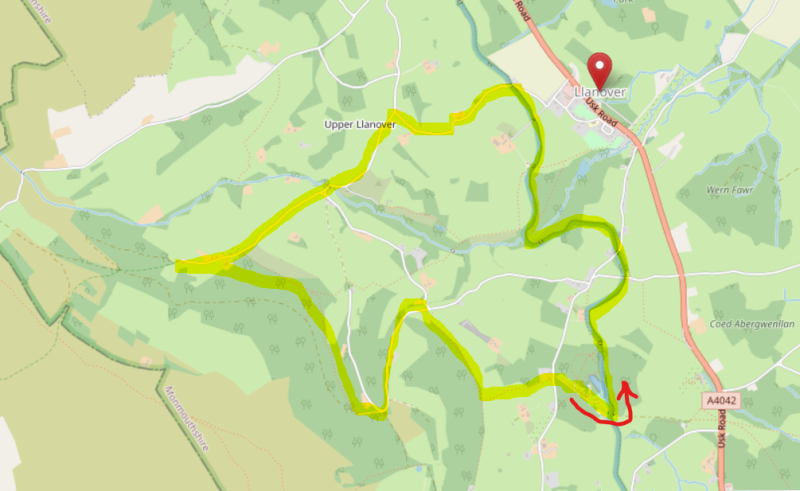
- From the public car park at Goytre Wharf the goal is to cross the canal to walk left on the other side. The path runs under a bridge passing Aquaduct Cottage, alongside a row of line kilns, just below the boat rental shed. It’s the only place to cross over, so easy enough to find using the various ‘you are here’ boards. If you’ve found the café, you’re close – just head downhill.
- Once on the other side from the wharf, head to the left, up a hill on the other side of the bridge to join the towpath on the canal bank. Continue straight ahead with the wharf now opposite you.
- From here, the route along the canal is easy. It’s a superb stretch. You’ll pass a number of bridges, with Bridge #81 the one to watch out for.
- Leave the towpath just before the bridge, to follow the lane over the bridge. This is a quiet lane all the way to the pub!
- At a junction go left. And that’s all the instructions you need. The path drops down into a hollow on a bend as it passes ‘Ty To Maen’ (stone roofed house), and then the uphill effort to the pub kicks in.
- You’ve now earned the refreshment at the Goose & Cuckoo!
- For the return journey, look out for Cuckoo Cottage just below the pub. There’s a bridleway opposite – that’s the path you need.
- Continue on this path all the way through the woodland, until you reach a repeat of the gate you saw at the entrance to the bridgeway near the pub.
- From here, the woodland opens out, and we’re aiming for a lane to the left, the start of the downhill section towards Goytre Wharf.
- The track becomes a tarmac lane and rounds a corner leading to a steep downhill below high banks of beech.
- As the line of beeches ends and the lane opens out, look for the first junction on your left. Immediately opposite is a wide-mouthed footpath slightly uphill. Take this, towards a wooden barrier fence.
- Turn left at the barrier, and follow this track all the way close to the fence. Eventually another path joins from the right. Stay left to reach a stile into a field.
- Follow signs downhill through the fields from here. The car park of Goytre Wharf is in the woodland below. There was a ‘beware of the bull’ sign on one of the gates through this section, and sheep & cattle in various corners of the fields. Nothing troubled me thankfully.
- Leaving the fields behind you join a farm lane for the final short section, emerging over a stile opposite the entrance to the wharf.
Notes
The landscape around the Goose & Cuckoo is closely associated with the work of Alexander Cordell, whose novels are set in this part of south-east Wales during the rise of the iron industry & the industrialisation of South Wales.
In Rape of the Fair Country, he describes the transformation to the west of the Usk valley from quiet farmland into one of the centres of Britain’s ironmaking. His stories follow ordinary families living through that change, as the beauty of the countryside existed alongside the noise, fire, and hardship of the works above.
The Goose & Cuckoo sits right on that divide. From here, you can look out over the peaceful valley toward Abergavenny and beyond, while just behind rise the slopes of The Blorenge, once lit by furnaces of Blaenavon, and shaped by the labour that drove this Revolution.
Cordell’s novels are well worth seeking out. They offer a far richer sense of this landscape during the Industrial Revolution than most straightforward histories—bringing to life not just what happened here, but how it was lived and felt by the people at its heart. It taught me so much more than any history lesson.
Blaenavon, Cwmavon, Nanytglo, Pontypool and the Blorenge mountain were part of an interlinked iron‑and‑coal powerhouse: Blaenavon and its surrounding valleys supplied the raw materials, furnaces, mines, tramroads and workforce that helped make South Wales one of the world’s great industrial engines in the late 1700s and 1800s.
Blaenavon was the centre of gravity. It's easily reached over the hill from the Goose& Cuckoo, 1.5km away.
By the 1790s it had become one of the most advanced ironmaking complexes in the world, with blast furnaces, kilns, workers’ housing, quarries, coal and ore mines, and a primitive railway system all concentrated in one landscape.
The Blaenavon Ironworks, founded in 1789, was among the largest of its era. It produced iron on a scale that helped fuel global industrialisation, and its surrounding hills provided coal, ironstone, limestone and fireclay in abundance.
Taken together, these places formed one of the most complete industrial landscapes of the early Industrial Revolution. Iron from these valleys built railways, engines and factories across continents, while Welsh coal powered steamships and global trade - exported through the docks at Newport, and facilitated by the building of the Monmouthshire & Brecon Canal featured on this walk!
The best pub walks are meant to be shared.
If you’ve followed this route, found a better path, got lost, uncovered a standout pint somewhere else, or simply have a story to tell, I’d be delighted to hear from you.
This site is as much about shared discoveries as it is about the walks themselves.
Add comment
Comments