

The Royal Inn Portishead Pub Walk
The Seaside Story of Portishead

If you want a Portishead pub walk that explains the history of the town as well as showing it off, this one does the job beautifully.
It links the regenerated marina, the Victorian-planted woodland of Woodhill, and the Lake Grounds — three landscapes shaped more than a century apart but all driven by the same instinct: Portishead should face the water.
And sitting at the hinge point of that story is The Royal Inn, built in the 1830s by the old Bristol Corporation — the city’s former civic authority, long before today’s patchwork of North Somerset, Avon and Bristol boundaries existed.
The Corporation had a grand plan to create a genteel seaside escape for Bristol’s residents, and The Royal was its showpiece. Today it’s a relaxed, handsome pub with one of the best coastal terraces in the region, and the perfect full‑stop to a walk that traces Portishead’s evolution from Victorian optimism to modern reinvention.
About The Royal Inn, Portishead
Last visit: March 2026
The Royal Inn is one of those rare pubs where the building itself can tell you more about a town than any plaque or museum panel ever could.
It was built in 1830–31 by something called the Bristol Corporation — the old civic authority that governed the city before modern councils existed. In an era long before “North Somerset” or “Avon” (or whatever else they have planned for us in future), the Corporation decided that Portishead should become Bristol’s genteel seaside escape.
The Royal was the centrepiece of that plan: a purpose‑built cliff‑top hotel, unusually run by the Corporation itself, and one of the very few municipal hotels in the country.
Visitors in those early decades didn’t arrive by train — that came later, in 1867 — but by paddle steamer to the stone jetty below the hotel. From there they wandered up through the newly laid‑out Woodhill walks, a Victorian attempt to create a curated woodland experience with viewpoints, gentle gradients and sea‑air promenading built into the landscape.
As the century unfolded, the civic vision expanded: the Lake Grounds were added as an ornamental promenade; the open‑air pool arrived as a statement of health and leisure; and the railway stitched Portishead more firmly into the region.
Through all of this, The Royal sat above the channel like the anchor of the whole experiment.
The hotel was ambitious from the start. Bristol Corporation invested around £20,000 — a huge sum for the time.
Its position on the cliffs above the Bristol Channel made it the showpiece of the new resort, and that relationship with the sea is still the heart of the place today. Its Grade II listing recognises its Gothic‑styled 1830 architecture, and although it only passed into private hands roughly 35 years ago, it has remained one of Portishead’s defining landmarks.
Recent history adds a neat contemporary flourish: the terrific six‑figure refurbishment in 2023 and the burial of a time capsule — handwritten letters from former owners, a bottle of ale, newspapers, and a photograph of the pub team — placed beneath a tree on the terrace overlooking the water. It’s a small but charming detail that signals continuity between the old civic vision and the tastes of modern day Portishead.
What makes the seaside story of Portishead so satisfying today is how clearly the pattern has returned.
The old jetty is now the guiding entrance to the regenerated marina, a modern echo of those early boat arrivals. The pool has undergone fresh investment this past Winter. And a new railway station is taking shape once again to reconnect Portishead with Bristol — a reminder that the geography here has always been awkward for administrators but obvious for people: a coastal town with a city on its doorstep, forever negotiating where it belongs in the regional story.
And through every shift in boundary, every reinvention of Portishead’s identity, The Royal has remained a constant. Inside, it’s relaxed and unpretentious; outside, the terrace still commands the same sweep of channel and Welsh hills that Victorian visitors marvelled at.
A pub with history in its bones, a view that never gets old, and a front‑row seat on the latest chapter of the town’s long conversation with the sea.


Pub Key Information
| WEBSITE | https://www.chefandbrewer.com/pubs/avon/royal-inn |
| ADDRESS | The Royal Inn, Pier Road, Portishead, BS20 7HG |
| PHONE | 01275 400127 |
| WHAT3WORDS | ///harnessed.multiples.diplomats |
| PARKING | At the pub. |
| LOCATION | Portishead is off the M5 to the West of Bristol, via Junction 19 - the Gordano Services roundabout at Avonmouth Bridge. |
| HANDY FOR | The Gordano Round; King Charles III Coasal Path. |
Walk Overview
In the 1800s, the Bristol Corporation set out to turn Portishead into a seaside resort. Their vision centred on the wooded hillside now known as Woodhill, with its planted walks, viewpoints and gentle gradients.
The woods and walks, The Royal, the Lake Grounds and later the open‑air pool were all part of the same civic idea: a curated landscape where visitors could breathe sea air, wander through designed woodland, and feel they’d arrived somewhere with purpose.
This walk shows exactly what the Corporation was trying to achieve, following the route Victorian day‑trippers once took.


Walk Instructions: Choose what works for you
There are multiple ways to consume the route described below.
- Either follow the online instructions, or download and print a copy of the route.
- If you have the OS Maps app, you can follow a saved route directly in the App.
- Or download the GPX file for use on your chosen GPS-based navigation application.

Walk Key Information
| START/FINISH | The Royal Inn, Pier Road, Portishead, BS20 7HG |
| PARKING | Parking at the pub. |
| GRID REFERNCE | ST 475 775 |
| WHAT3WORDS | ///harnessed.multiples.diplomats |
| DISTANCE/TIME | 3 miles / 5 km; approx 1.5 hours |
| ASCENT | 200 feet / 60 metres |
| PATHS/TERRAIN | Lanes, pavements and public footpaths. |
| DIFFICULTY | Easy walk, some short up-hills but nothing strenuous. |
| PUBLIC TRANSPORT | Regular buses from Bristol and Clevedon/Weston direction. One day the railway will return to Portishead! |
| TOILETS | The Royal & multiple options along the way. |
| OTHER PUBS TO VISIT | Numerous options in Portishead to suite all tastes. The walk passes the Siren’s Calling on the marina. A short walk onto Portishead High Street would introduce The Port, The Settle Inn, The Poacher, the Phoenix Bar and plenty of others nearby. |
Directions
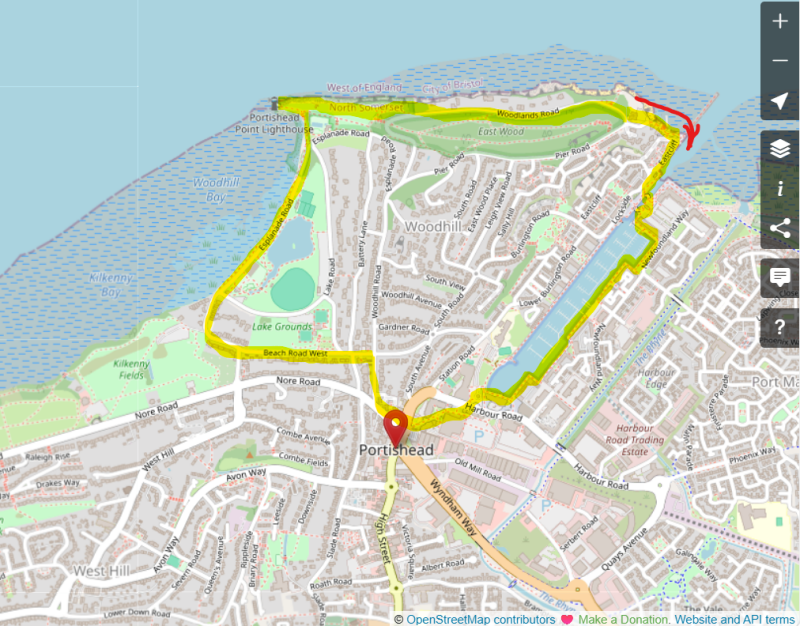
- Start at The Royal, the old Bristol‑Corporation hotel perched above the channel, and drop down the steps opposite the driveway entrance, passing the Dock Master’s House on your right.
- Continue beyond the RNLI station & jetty, to the site of Portishead’s original ‘pier’, where steamers once brought Victorian day‑trippers from Bristol.
- Turn right to follow the edge of the marina, passing the Old Lockhouse (now a rather good Italian restaurant) and cross one of the lock gates to follow the marina on the other side.
- Stroll past Mokoko, whose coffee and pastries are highly recommended.
- Continue straight ahead to pass The Siren’s Calling, a small ale house with a fiercely loyal following.
- Stay on this side of the marina all the way around to the far end, passing Hall & Woodhouse, Aqua, Bottelino’s, and the cocktail‑polished Sidney & Eden.
- Head for the left-hand end of the Leisure Centre, to a pedestrian crossing to cross the road.
- Head straight on, into the ‘precinct’, bearing right so you’re walking away from Waitrose on your left, towards Portishead town.
- The Shell garage is beyond the library. Before reaching the garage, cross Station Road at a pedestrian crossing ahead of you, to follow Cabstand road uphill (past hairdressers on either side of you). Stay on the right-hand side as you ascend.
- Take the first right onto Woodhill Road, then turn left at the end.
- Join Beach Road West, a level lane running above the Lake Grounds, with wide views across the ornamental lake and cricket field.
- Follow the road as it eventually curves right and drops gently to the seafront.
- Walk the full length of the Lake Grounds ‘Esplanade’, passing the cricket pitch, the lake, the tennis courts. Ahead of you is the Portishead Open Air Pool with its excellent volunteer‑run café.
- To the left of the café, climb the steps to Battery Point, where ships bound for Avonmouth pass astonishingly close. Pause at the seafarers’ memorial and the old gun emplacement.
- From here, take the rising path into Woodhill, the long Victorian‑planted woodland created as part of the original resort plan.
- Follow the woodland path uphill – it emerges onto Woodlands Road, a quiet lane lined with some grand Victorian villas, such as Woodlands and Woodside, with glimpses across to the mountains of South Wales.
- Continue along the lane until The Royal comes back into view — a fitting end to a walk that threads together every chapter of Portishead’s seaside story.
Notes
Portishead Marina: From Power Stations to Pleasure Craft
It’s easy, standing on the marina today, to imagine that this waterside world of cafés, restaurants and bars must somehow have been part of Portishead’s original Victorian resort plan.
In truth, it’s the exact opposite.
The Bristol Corporation’s 1830s vision — Woodhill’s planted walks, the cliff‑top hotel, the Lake Grounds — all unfolded over the hill and out of sight, beyond the old pier. What lay on the marina site was never intended to be picturesque back then.
For most of the 20th century this was a heavy industrial estate, dominated by two major power stations:
- Portishead A (coal‑fired, opened 1929)
- Portishead B (oil‑fired, opened 1955)
Together they fed the energy demands of Portishead docks and the industries that clustered around them. Cooling towers, chimneys, sidings, oil tanks, coal conveyors — the whole landscape was shaped for output, not outlook.
The idea that this would one day become the town’s most desirable neighbourhood would have seemed laughable. And yet the marina has become the foundation of modern Portishead, the catalyst for a reinvention every bit as dramatic as the Victorian resort experiment.
When the power stations closed (A in 1976, B in 1982) and the site was cleared, it created a blank canvas on a scale few coastal towns ever get. The result is the Village Quarter and the marina itself — a new part of town built around water, light and leisure rather than smoke and machinery.
What’s striking is how neatly this modern chapter echoes the original 19th‑century ambition. The Bristol Corporation wanted Portishead to face the water; the marina has made that happen again, just in a contemporary idiom.
Today’s yachts, cruisers, paddleboarders, gig rowers and coffee shops are the spiritual descendants of the Victorian promenaders and day‑trippers — even if the industrial century in between makes the connection feel improbable.
The marina didn’t just tidy up a derelict site. It has reoriented the town, given it a new centre of gravity, and quietly completed the circle begun by the Corporation nearly two centuries ago: Portishead, once again, is a place where people come for the water, the air, the views — and, fittingly, a good pub at the end of a walk.
The best pub walks are meant to be shared.
If you’ve followed this route, found a better path, got lost, uncovered a standout pint somewhere else, or simply have a story to tell, I’d be delighted to hear from you.
This site is as much about shared discoveries as it is about the walks themselves.
Add comment
Comments