

The Swan Inn, Rowberrow, near Shipham
An easy woodland pub walk through the 'calamine capital' of the South West, 2 miles

Try this Pub & Walk
"I never knew that".
I set off to write an entry about a tiny Mendip village, three miners’ cottages, a lovely pub with a sunny terrace with a few benches… and before I knew it I'm tracing a line from Saxon Christianity, to Elizabethan industrial policy, to William Champion’s brassworks, to Terry Pratchett’s imagination, to the summer of ’76 and a nation of pink‑blotched children.
Rowberrow is one of those Mendip villages in Somerset that looks like a scatter of cottages until you’re actually on foot. Then the place reveals itself: a combe shaped by geology and graft, where a Saxon church and a nationally important mining hamlet once faced each other across a quiet country lane.
And here’s the twist.
For anyone over fifty, the word calamine tends to summon memories of that scorched summer of 1976 — the chalky pink lotion dabbed onto every sunburnt child in Britain.
But long before it lived in bathroom cabinets, calamine was the zinc ore that shaped Rowberrow’s existence. The miners who lived in the cottages that became The Swan Rowberrow weren’t coal men but zinc men, feeding the brassworks of Bristol and, in their small way, helping England make its own metal.
So for such a short walk, the history here runs deep.
The woods and combes behind the pub still carry the quiet of that older world, and it’s no surprise that Pratchett lived here for more than twenty years. This corner of the Mendips is a place where stories gather — and The Swan sits right at the heart of them.
About The Swan Inn, Rowberrow


Last visit: May 2026
The Swan at Rowberrow (just along the lane from Shipham) is one of those pubs that only makes sense once you understand the village around it — a place shaped not by coal, as people often assume, but by calamine, the zinc ore that once fed England’s early brass industry.
Without that mineral, Rowberrow would have been a quiet agricultural hamlet. With it, the village became part of a national supply chain long before anyone used that phrase.
The pub began life as three calamine miners’ cottages, later knocked through to form a cider house for the men who worked the shallow seams beneath the Mendip slopes. That origin still shows in the layout today: a run of small, self‑contained rooms rather than a single bar, a cottage feel rather than the larger rooms of a typical a coaching inn.
Calamine mattered because, until the 18th century, England couldn’t make brass without it. Brass was essential for the woollen economy — especially for the combs used to straighten out the wool — and the only way to produce it was to heat copper with powdered calamine in the old cementation process.
No calamine, no brass. And without brass, England remained dependent on German imports of it.
That’s why Elizabeth I granted a royal charter in 1568 to the Society of the Mineral and Battery Works, giving it the right to search for calamine and produce brass at home.
Suddenly, the Mendips — Shipham, Rowberrow, Axbridge — became strategically important. Their zinc ores lay close to the surface, workable by small, scattered diggings rather than deep pits. There were many mines in the Shipham area.
By the early 18th century, Bristol brass founder William Champion had taken things further, patenting a method for reducing calamine to produce metallic zinc — “spelter” — on a large scale. His Warmley works, just over the horizon, became one of the most advanced industrial sites in Europe. Much of his ore came from the Mendips.
The miners who lived in those three cottages at Rowberrow were part of that story: zinc men, not coalmen, helping fuel England’s industrial ambitions one barrow‑load at a time.
Rowberrow’s deeper history runs alongside this industrial moment.
Christian worship on the site of St Michael & All Angels Church goes back to around AD 700, and a Saxon carved stone — probably from a cross — on display in the church was uncovered during the Victorian rebuilding of 1865.
The manor belonged to St Augustine’s Abbey, Bristol, and the first recorded rector appears in 1266. The Old Rectory, still the largest building in the village, stands opposite the church as a reminder of the old social order: the rector’s world is out of sight of the cottages!
Life here was hard.
Hannah More, visiting in the late 18th century, described the people of Rowberrow and Shipham as “brutal in their natures and ferocious in their manners” — a harsh judgement, but one that reflects the poverty and danger of mining communities. I've written a blog about Hannah here.
Two surviving artefacts bring that world sharply into focus: a silver wine flagon donated in 1752 by Thomas Hawkins, “Groovier”, and the gravestone of Thomas Ven, killed in a mining collapse in 1812.
And yet Rowberrow has always had a quieter, more contemplative side. The wooded combes of Rowberrow Warren, the heather of Black Down, the Iron Age ramparts of Dolebury Warren — all sit within a short walk of the pub.
It was here, on the edge of this landscape, that Terry Pratchett lived from 1970 to 1993, raising his daughter and writing the books that made his name.
Today, The Swan has evolved into a food‑led countryside inn, its Butcombe stewardship bringing a strong menu, a thoughtful drinks list and a warm, unfussy atmosphere. The beer is excellent but the building’s shape means it’s not a pub for large drinking groups. Instead, it’s a place for walkers, families, small gatherings and people who want a quiet corner after a day on the Mendips. The terrace in front of the pub is lovely, and the extra seating across the road, beside the large car park, gives it a relaxed, open‑air feel on fine days.
For me, The Swan is part of the lived reality of keeping the Mendip paths open. Many of the routes I help maintain lead naturally towards it and, if you fancy extending the walk, it also sits on the route I created for The Crown in Churchill. It’s not a showpiece pub — it’s a true pub of its place, shaped by the land, the labour and the long memory of a village that once supplied the brassworks of Bristol and now offers a quiet pint to anyone who wanders in from the hills.
And that’s exactly why it belongs on Pubs Worth The Walk.
Pub Key Information
| WEBSITE | https://butcombe.com/the-swan-inn-somerset/ |
| ADDRESS | The Swan Inn, Rowberrow Lane, Rowberrow, BS25 1QL |
| PHONE | 01934 852371 |
| WHAT3WORDS | ///thuds.dockers.assume |
| PARKING | Plenty of parking at the pub. Enter your registration at the pub. |
| LOCATION | The Swan Rowberrow is signposted off the A38 beyond Churchill, to the South West of Bristol. |
| HANDY FOR | The Mendips. |
Walk Overview
This is one of the shorter walks that I’ve covered.
By connecting this walk to the walk described in the entry for The Crown at Churchill, your route can be extended to visit the ‘top of the hill’ – the remnants of the Iron Age fort above you at Dolebury Warren.
This is a lovely, easy short walk at the western end of the Mendips, mainly in woodland known as Rowberrow Warren.
The forest here was planted in the 1940s & 50s, so by now there’s little evidence visible of the mining history described in this entry. Take some time at the little church, which can help to reveal some clues to the history of the area.


Walk Key Information
| START/FINISH | The Swan Inn, Rowberrow Lane, Rowberrow, BS25 1QL. 01934 852371 |
| PARKING | Plenty of parking at the pub. Enter your registration at the pub. |
| GRID REFERENCE | ST 451 582 |
| WHAT3WORDS | ///thuds.dockers.assume |
| DISTANCE/TIME | 1.8 miles / 3 km; approx 1 hour |
| ASCENT | 290 feet / 90 metres |
| PATHS/TERRAIN | Quiet lanes, woodland paths, some of which are stoney. Some short uphill sections. |
| DIFFICULTY | Easy |
| PUBLIC TRANSPORT | None to the village of Rowberrow, but bus services serve Churchill from Bristol and Weston-Super-Mare. |
| TOILETS | At the pub. |
| OTHER PUBS TO VISIT | The Crown at Churchill is one of the best pubs in Somerset. It’s covered separately on Pubs Worth The Walk ; The Star on the A38 is doing well after a recent transformation. |
Walk Instructions: Choose what works for you
There are multiple ways to consume the route described below.
- Either follow the online Walk Directions below, or download and print a copy of the route.
- If you have the OS Maps App, you can follow a saved route directly in the OS App.
- Or download the GPX file for use with your chosen GPS-based tracker App, like Strava. Upload the file when you Create a New Route in the App.

Walk Directions
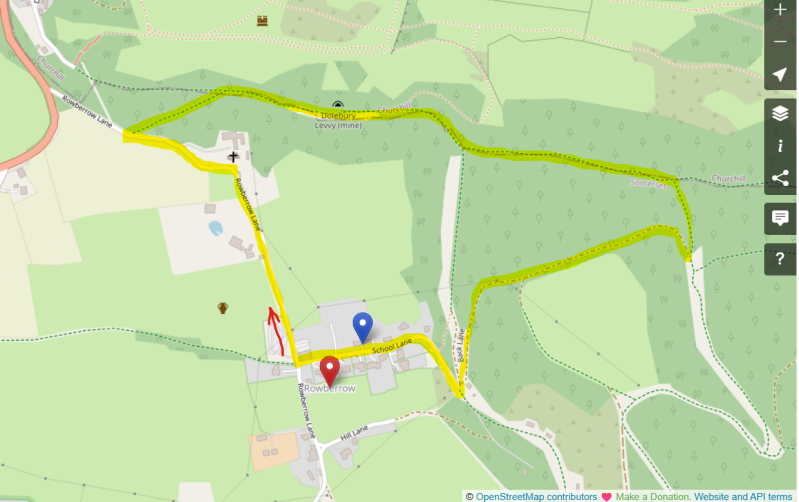
- As you leave the pub car park with The Swan in front of you, head left down the lane. It's not a particularly busy road, but take care. The first landmark is the Church of St Michael & All Angels (I'm not hot on Saints. Apparently, St Michael is the Archangel recognized in Christian tradition as the leader of God’s heavenly army, a protector of the faithful, and a warrior against evil. Fair play.)
- The Church building dates back to the 14th Century, but there's evidence of much earlier worship on this site. Inside the church there's a stone carving believed to be part of an ancient Saxon Cross (so pre-1066) that was dug up in the churchyard in 1865.
- As the road curves around past the church you'll soon see a public bridleway footpath sign into Rowberrow woods. Look out for the Butcombe Trail marker.
- The narrow path downhill through the woods eventually emerges onto a more level, wider track. Turn right. This is one of the key walking & biking routes in the area, and is part of the Limestone Link route that connects The Mendips with The Cotswolds Way. It's also the area where those calamine mines were.
- The path is a gentle uphill slope. Above you to the left is the ancient Iron Age (>550 years BC) hill fort of Dolebury Warren. Continue along the path, ignoring the first right hand path which seems to head over an earthen bank.
- Instead, continue until you see a right hand path with a large Rowberrow Warren sign. Take this path, which is a little narrower than the path you've been on.
- If you're walking this way in the drier months you could imagine that it would be a pretty wet drainage channel in winter. If you're doing it after heavy rain, you'll know it's a pretty wet drainage channel!
- When the path starts to open out again, you'll come to a sharp right hand turn, uphill. Take that and follow the wider forestry track. After a short distance uphill the gradient eases and you pass a field on your left.
- At the end of the field, continue straight on at the next path junction. Lots of chunky loose stones here, so watch your footing as you head downhill around a bend.
- The path straightens as it enters a valley, with a house on the right. Leave the woodland of Rowberrow Warren in front of the entrance to the cottage, to join the lane in front of you. Turn right onto the lane. This is School Lane. After a short, muscle warming distance uphill, the lane levels out and soon arrives back at The Swan.
Additional Notes
William Champion (1709–1789) was a prominent metallurgist known for his significant contributions to the brass industry.
- He established the Warmley Works (south east of Bristol) in 1746, which became the largest metal processing plant in the world, producing zinc, copper, brass, and other metals.
- Champion patented a process to distill zinc from calamine, which was crucial for the development of the brass industry in Britain.
- His innovations led to Bristol becoming Europe's largest producer of brass, and his works at Warmley are recognized for their historical significance in metallurgy and industrial development.
Hannah More (1745–1833) was a Bristol‑based writer and philanthropist who became one of the most influential social reformers of the late Georgian period.
- She and her sisters set up schools across Somerset, including in some of the poorest, roughest villages on the Mendips.
- When More visited the Mendip mining villages in the 1780s and 1790s, she was shocked by the poverty, the lack of schooling, and the hard edge of life in places built around dangerous, low‑paid calamine digging.
-
Her line about Shipham and Rowberrow being “brutal in their natures and ferocious in their manners” wasn’t a casual insult — it was her way of describing communities living on the edge of survival, with no education, no safety net, and no real prospects beyond the next shift underground.
Other Pub Walks to try in Somerset

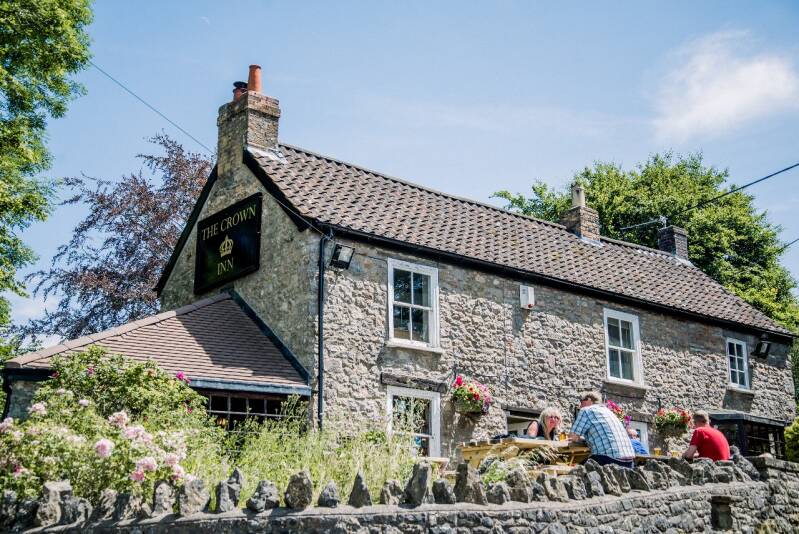
West Mendips Circular Walk to Dolebury Warren & favourite 5 star Churchill pub.
5 miles
