

The Hunter's Inn, Heddon Valley
Challenging Woody Bay & Heddon's Mouth Cleave pub walk via The Hunter's Inn, 8.4 miles

Try this Pub & Walk
This is not simply a walk with a pub on it. It is a journey into one of Exmoor’s most self-contained coastal valleys, where landscape, history and hospitality all converge in a single place.
Walking in the Heddon Valley feels remote even by North Devon standards. Tucked between the popular North Devon beaches around Woolacombe and the cliff-top paths of Lynton and Lynmouth, it is easy to miss on the map and even easier to overlook in favour of more obvious destinations. Yet that is precisely what gives it its character: you come here deliberately, or not at all.
The walk from Woody Bay follows an old Victorian carriageway built for an unrealised resort scheme — a broad, engineered route that slowly draws you down into the valley. It is an unusually gentle introduction to a landscape that quickly becomes dramatic: wooded combes, steep-sided cliffs, and a river cutting its way to the sea at Heddon’s Mouth.
At the centre of it all sits The Hunter’s Inn, a rare survivor of the ambition for this landscape, and an historical accident. What remains today is a place that still feels like a destination in its own right: part walking hub, part retreat, and part echo of a Victorian idea that never quite reached completion.
Walked in full, this is a demanding but richly varied day: coastal cliffs, hidden beaches, wooded climbs, and wide valley views. Shortened, it becomes a gentler exploration of one of Exmoor’s most atmospheric valleys. Either way, the experience is defined less by distance than by descent — into a landscape that feels deliberately removed from the world above.
About The Hunter's Inn, Heddon Valley


Last visit: June 2026
Whether you arrive on foot from the South West Coast Path or make a deliberate journey into Heddon Valley, The Hunter's Inn feels wonderfully tucked away.
Folded into the wooded combes of Exmoor's northern coast, it occupies a valley that seems separate from the busy North Devon holiday destinations surrounding it. While visitors flock to the likes of Woolacombe, Ilfracombe, Lynton and Lynmouth, Heddon Valley remains off the beaten track.
It is easy to imagine why this location appealed to Victorian visitors seeking privacy and escape. Even today, there is a sense of separation from the rest of the world here. Not isolation in a bleak sense, but enclosure.
The visitors I've seen today seem to arrive for many reasons: walkers breaking a coastal stage, families coming for lunch, couples staying overnight, or card carrying National Trust members ticking off Heddon Valley. Whether these folk are here for an hour or a few days, you get the sense that most seem reluctant to hurry away.
The building has earned its history. Local tradition holds that the original thatched cottage at its heart was a regular haunt of James Hannington during his time as curate of nearby Martinhoe in the early 1870s — the same Hannington who, a decade later, became Bishop of Eastern Equatorial Africa and was speared to death in Uganda on the orders of King Mwanga II. It's an unlikely thread to find running through a North Devon coaching inn, but it's there.
By the 1890s the inn had grown into a fashionable retreat with a loyal, affluent following, the kind of regulars who returned, as one contemporary newspaper put it, 'as reliably as the seasons themselves'. Then, on a Saturday afternoon in 1895, fire tore through the building and very nearly finished it — only the newly built dining room came through intact. Colonel Lake, true to form, promised a replacement in time for the following season.
What rose from the fire was the distinctive Swiss chalet building you see today — a deliberate echo of the "Little Switzerland" identity the self-styled "Colonel" Benjamin Lake was building a few miles up the coast at Woody Bay, where his pier and carriage road were, by the late 1890s, the height of fashion. Lake's scheme collapsed within a few years — bankrupt by 1900, his pier barely surviving a couple of winter storms.
The inn he rebuilt in his own image has outlived him by well over a century. The Victorian dream of a resort may have vanished, but the idea of Heddon Valley as a destination has never quite stopped being true.
Pub Key Information
| WEBSITE | https://thehuntersinnheddonvalley.co.uk/ |
| ADDRESS | The Hunters Inn Heddon Valley, Jose’s Lane, Parracombe, Barnstaple, EX31 4PY. |
| PHONE | 01598 763 230 |
| WHAT3WORDS | ///snuggled.surprised.regularly |
| PARKING | Parking at the Inn, roadside and NT car park. |
| LOCATION | Heddon Valley sits 3 miles to the west of Lynton. Look for the Martinhoe exit off the A39 main road at Martinhoe Cross, adjacent to Lynton & Barnstaple Railway’s Woody Bay Station. |
| HANDY FOR | The Inn sits on the South West Coast Path, and in between Combe Martin and Lynton. It's one of the highlights of Exmoor. |
Walk Overview
This walk combines two stunning Exmoor coastal routes that are often walked separately, so you have a choice to shorten the day if you prefer.
Walked together, as described, it’s a challenging walk and relies on clear weather to reward you with fine coastal views. (I was unlucky for the Hunter's Inn to Woody Bay return leg - sea mist!)
There are numerous footpath options in and around the Heddon Valley, including some of the highest sea cliff walking along the South West Coast Path, some steep ascents, as well as rare access to a beach in this area, via a leisurely level path from Hunter’s Inn where you can park, if a less challenging visit to the Heddon Valley is your preference.


Walk Key Information
| START/FINISH | National Trust Woody Bay car park. It’s on Sir Robert’s Path near Martinhoe & Parracombe, to the west of Lynton. Look for the exit off the A39 main road at Martinhoe Cross, adjacent to Lynton & Barnstaple Railway’s Woody Bay Station. |
| PARKING | National Trust Woody Bay car park (no charge) |
| GRID REFERENCE | SS 676 486 |
| WHAT3WORDS | ///kindness.grounded.regrowth |
| DISTANCE/TIME | 8.4 miles / 13.5 km; approx 4.5 hours |
| ASCENT | 2170 feet / 670 metres |
| PATHS/TERRAIN | Stony tracks, narrow, elevated sometimes exposed coastal footpaths, grassy paths, some quiet country lanes, though slightly busier in season. Steep sections. |
| DIFFICULTY | A difficult coastal walk with some long ascents. However, opportunities exist to shorten the walk by returning directly to Woody Bay from Hunter’s Inn. Also, parking is available at Hunter’s Inn for a short, level walk to Heddon’s Mouth. |
| PUBLIC TRANSPORT | Buses run along the A39 Lynmouth to Barnstaple. |
| TOILETS | At Hunter’s Inn and NT toilets before the Inn. |
| OTHER PUBS TO VISIT | In Lynton, the Queens Hotel and The Crown Hotel are worth visiting during your stay in this area of North Devon. In Lynmouth, no visit is complete without sampling The Rising Sun. In Brendon, The Rockford Inn is fabulous. And on the other side of Lynmouth on the road to Porlock is The Blue Ball at Countisbury. |
Walk Instructions: Choose what works for you
There are multiple ways to consume the route described below.
- Either follow the online Walk Directions below, or download and print a copy of the route.
- If you have the OS Maps App, you can follow a saved route directly in the OS App.
- Or download the GPX file for use with your chosen GPS-based tracker App, like Strava. Upload the file when you Create a New Route in the App.

Walk Directions
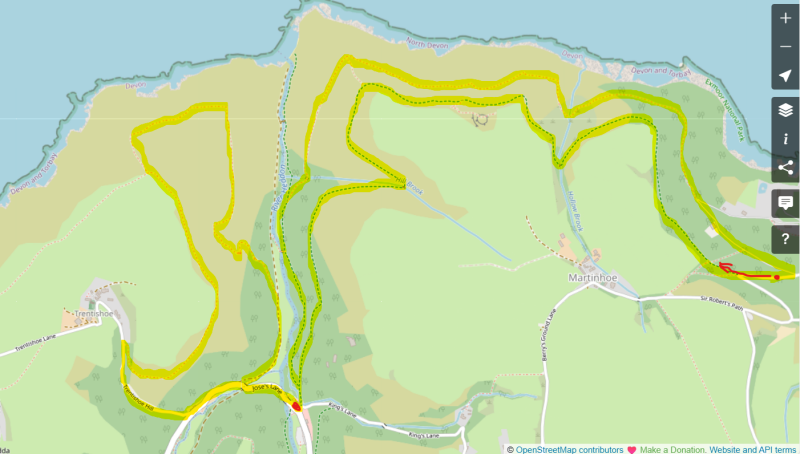
- Park at the NT Car Park above Woody Bay. Walk uphill to a left-hand bend in the road, but continue straight ahead onto a wide stony footpath, signposted for Hunter’s Inn, ignoring the narrow route offered uphill towards Martinhoe Common.
- This wide track runs all the way to Hunters Inn, generally level to begin with, and then a steady downhill as you can see from the gradient map. Known as ‘the carriageway’ it’s one of the developments in the late 1800’s that envisaged the area of Woody Bay rivalling Lynton and Lynmouth as an upmarket resort (see notes).
- The path eventually offers extensive cliff views, including the footpath running around Heddon’s Mouth Cleave that we’ll follow on the second part of this walk.
- The carriageway path emerges onto a road immediately in front of The Hunter’s Inn. (The return journey to Woody Bay along the South West Coast Path later on will follow a route 50m back up ‘the carriageway’ – you could take simply enjoy the Hunter’s Inn and return via this route if you wanted to shorten the walk).
- If you’re continuing to walk Heddon’s Mouth Cleave towards Trentishoe Down, loop around towards the rear of the Hunter’s Inn to cross a road bridge over a stream. Continue along the lane to a smaller stone bridge, and take the footpath signposted to the right, a well-made and level gravel footpath that leads down to the beach.
- After ¼ mile from the road, look for a left-hand finger marker for Combe Martin, guiding you uphill. I found this the toughest part of the walk: a sometimes narrow, slightly overgrown path with some steep sections, and some loose slate and stone in parts to add some excitement. It made for humid walking on a warm day.
- The narrow path eventually levels as it reaches 500 feet, with fine views across the valley of the carriageway you arrived on, and the South West Coast Path (that will be the return journey to Woody Bay) below it. This section of the Coast Path is narrow and elevated – some guide books call it ‘lofty’ - and can be exposed in a gale, but it’s not a cliff edge and I felt safe as I walked around the headland at ‘Peter Rock’ above Heddon’s Mouth.
- After the headland the Combe Martin coast path starts uphill, safely away from the coastline, to reach a finger marker offering a route to the left for Trentishoe Church, 1 mile away. Take this left-hand instruction, although other adventurers might wish to continue a little further along the Coast Path towards Trentishoe Common, before heading inland and back towards Hunter’s Inn.
- The route from the marker follows a grassy track along a fenced boundary. As it curves to the right, to start downhill, fine views of Heddon Valley open up below across an extensive hillside of ferns, and many butterflies. (In fact, this is now a National Trust butterfly walk).
- This route continues downhill to meet a lane below the hamlet of Trentishoe, more accurate might be a farmstead, to the right. (The Church – St Peter’s – is a tiny 15th Century church, ½ mile from the sea, with a chancel built in 1861 and a very small tower. It contains a musicians' gallery, apparently with a hole in the parapet where the double bass needed space beyond the narrow confines of the gallery.)
- Follow the steep lane to the left downhill back towards Hunter’s Inn.
- For the return journey to Woody Bay, head back the carriageway path you arrived on, now on the other side of The Hunter’s Inn. It’s a steady climb out of the valley initially following the river, then the undulating cliff path, before one steep wooded ascent near the end.
- After 20m look for a bridleway sign to the left for Heddon’s Mouth. A footpath soon branches down to the left for Heddon's Mouth beach and the old lime kiln — worth a short detour if you haven't already been, otherwise stay on the coast path as it climbs the side of the combe for Woody Bay.
- The path rises and opens out with views back down to the beach and lime kiln, and across the Heddon Valley to the Combe Martin path around Heddon’s Mouth Cleave that we’ve recently walked.
- At Highveer Point, there are fine views in clear weather. Along the coast to the West is Widmouth Head, near Ilfracombe and to the East is The Foreland, a headland beyond Lynmouth. Below and towards Lynmouth, the cliffs at ‘Wringapeak’ hold a working seabird colony — guillemots, razorbills, kittiwakes, fulmars, and in season, Manx shearwaters.
- From the rocks – Little & Great Burland, the path descends into Hollow Brook Combe, with Hollow Brook below, dropping around 200 metres to the sea in a series of cascades.
- Pass through a gate and continue the steep ascent through West Woody Bay Wood to meet the road, close to where the dead-end lane down to Woody Bay beach branches off to the left. It’s signposted here for the Coast Path to Lynton 3 ½ miles away, to the left, and more importantly, the car park is signposted - up the lane ahead through the trees.
- Reach a hairpin bend at the top to where you left the car in the NT Woody Bay car park.
Additional Notes
The Carriageway you're walking along at the start of this route wasn't built for ramblers. In the 1880s, a London solicitor named Colonel Benjamin Lake bought the Martinhoe estate and set about turning Woody Bay into "Little Switzerland" — a high-society rival to nearby Lynton and Lynmouth, complete with a hotel, a golf course, a bathing pool, and a pier for paddle steamers.
The 16-foot-wide carriage road linking Hunter's Inn to the bay was built to carry well-heeled visitors and their luggage in comfort.
It never quite worked. The pier was too short to be useful and was wrecked by storms within a few years; the railway station that opened at Woody Bay in 1898 came too late to save the scheme. And by 1901, Lake had been convicted of fraud, and the whole venture collapsed with him.
What's left is the road itself — broad, gently graded, and a good deal easier underfoot than the cliff path it loops around. And the magnificent Hunter’s Inn. Victorian ambition, repurposed for an afternoon's walk.
Other Pubs to Try in Devon

Exmoor Circular Walk to Watersmeet along the East Lyn River from Rockford.
3.2 miles

Walk from Saunton Sands to Baggy Point & back via The Thatch & Saunton Down.
7.9 miles