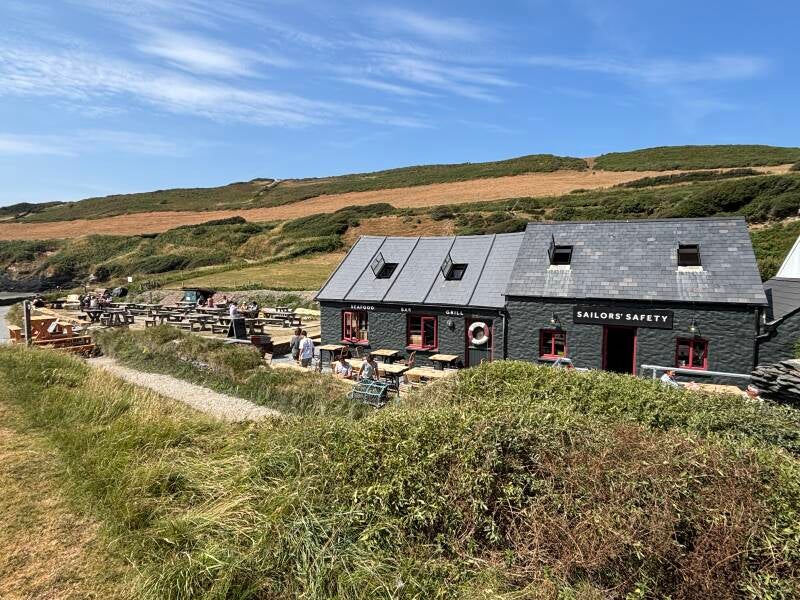
Tafarn Sinc, Rosebush / Rhos y Bwlch
This longer pub walk provides a taste of the Golden Road on the Preseli Hills, 10 miles

Try this Pub & Walk
The people around Rosebush have a habit of saving things.
In 1839, local farmers gathered in a nearby barn to plan the Rebecca Riots, in an effort to save their livelihoods, one of the defining moments in Welsh history. More than 150 years later, when Tafarn Sinc faced closure, another group of local people came together, this time not to protest but to save their pub.
Near the start of this walk into the Preseli Hills you'll pass a simple stone well carrying the inscription 'GAN Y GYMUNED I'R GYMUNED' — by the community, for the community.
At first it seems an attractive village feature marking the Millennium. By the time you return from the Golden Road for a pint beneath Tafarn Sinc's corrugated iron roof, you'll realise those four words explain not just the well, but Rosebush itself.
The walk takes you from quiet country lanes onto one of Britain's oldest routes, the prehistoric Golden Road that follows the spine of the Preseli Hills. Here you'll experience an ancient landscape of rocky tors, open moorland and wide horizons, close to the outcrops now believed to have supplied Stonehenge's famous bluestones.
It's wild, exposed country where weather can change quickly and navigation demands confidence, but the rewards are immense.
Back in Rosebush awaits one of Wales' most remarkable pubs; a Victorian corrugated iron building delivered by train almost 150 years ago, saved first by one determined local family and then by hundreds of people who simply refused to let it disappear.
About Tafarn Sinc, Rosebush


Last visit: July 2026
Tafarn Sinc is the sort of place that makes you stop and think, ‘Well, I didn’t expect that!’ Painted deep red and clad in corrugated iron, it resembles an oversized agricultural building rather than one of Britain’s most celebrated country pubs. But step inside, and the story of this extraordinary building begins to unfold.
Step inside and you'll find sawdust scattered across the floor, old photographs, sporting memorabilia, railway relics and farming artefacts adorning every available surface. Dogs doze beneath tables, conversations drift effortlessly between Welsh and English, and visitors are welcomed with the same warmth as regulars. Nothing feels staged or manufactured; this isn't Welsh culture performed for tourists, it's simply everyday Welsh life, and you're invited to become part of it.
Originally opened in 1876 as the Precelly Hotel, the building arrived in Rosebush by train as a prefabricated kit, commissioned to serve the new railway and the thriving slate quarries. The slate industry faded, ambitious plans to turn Rosebush into a Victorian health resort came to nothing, and the railway itself eventually disappeared. Somehow, the little tin hotel endured.
Its greatest challenge came in the early 1990s. Following the death of long-serving landlady Peg Lewis, the pub closed and was put on the market, with redevelopment considered more likely than reopening. Local businessman Brian Llewelyn saw something worth saving. With his family, they restored the building, repainted it in its distinctive red and gave Rosebush its pub back.
Twenty-five years later, history almost repeated itself.
When the family wished to retire from the pub, conventional buyers struggled to secure finance against such an unusual building. Once again, the community stepped forward. Today Tafarn Sinc belongs to more than 600 shareholders from Pembrokeshire and far beyond, all united by the belief that some places are simply too important to lose. Share application forms still sit on the bar, quietly inviting the next custodian to become part of the story.
That community spirit extends far beyond ownership.
Tafarn Sinc champions local suppliers, provides opportunities for young people, celebrates Welsh language and culture, and hosts an impressive programme of music, heritage and community events throughout the year. It's no surprise that it was crowned Countryside Alliance Wales Champion Pub before going on to be named UK Champion Pub in 2026, a fitting time to be recognised in this its 150th year.
You arrive expecting an unusual tin pub. You leave understanding that what makes Tafarn Sinc remarkable has very little to do with corrugated iron.
Pub Key Information
| WEBSITE | https://tafarnsinc.cymru/ |
| ADDRESS | Tafarn Sinc, Rosebush, Maenclochog, Clynderwen, Pembrokeshire SA66 7QU |
| PHONE | 01437 532214 |
| WHAT3WORDS | ///tucked.scanner.thatched |
| PARKING | In front of the pub, or a public parking area accessed via a lane behind. |
| LOCATION | Off the B4329 Cardigan to Haverfordwest road. The village is North East of Haverfordwest. |
| HANDY FOR | Walking the Preseli Hills; visit to Llys-y-Fran Lake. |
Walk Overview
The opening four miles follow quiet country lanes through rolling farmland, passing the Millennium Well and eventually, the isolated barn at Glynsaithmaen, where local farmers secretly gathered in 1839 to plan what became the Rebecca Riots. It's a fitting introduction to a landscape where communities have long stood together when something mattered.
Before Dan-y-Garn Farm, the route changes dramatically. A waymarked bridleway climbs through increasingly boggy ground onto the ancient Golden Road, a ridge-top route thought to have been used for thousands of years. Navigation becomes more demanding here, particularly in poor visibility, but the sense of space more than compensates.
Foel Feddau provides magnificent views across both north and south Pembrokeshire. To the north lies the coast around Newport; to the south, the rolling countryside stretches towards the distant sea. Somewhere beneath your feet lie the rocky outcrops whose bluestones were transported to Stonehenge over 4,000 years ago, adding another layer of mystery to an already remarkable landscape.
The return follows the edge of Pontmaenog Forest before descending past a small waterfall and the visible scars of Rosebush's quarrying past. As the village reappears below, it's hard not to appreciate how this seemingly quiet corner of Pembrokeshire has played such an outsized role in Welsh history.


Walk Key Information
| START/FINISH | Tafarn Sinc, Rosebush, Maenclochog, Clynderwen, Pembrokeshire SA66 7QU |
| PARKING | In front of the pub, or a public parking area accessed via a lane behind. |
| GRID REFERENCE | SN 075 295 for the car park behind the pub. |
| WHAT3WORDS | ///libraries.ounce.turns for the car park behind the pub. |
| DISTANCE/TIME | 10 miles / 16 km; approx 4.5 hours |
| ASCENT | 1060 feet / 330 metres |
| PATHS/TERRAIN | Walking is along quiet country lanes for the first 4 miles. Then, by contrast, it's onto moorland and boggy ground as you climb uphill to the Golden Road on the Preseli Hills. Wet, muddy and boggy, paths not always clear. Exposed to wind and weather changes on the ridge. |
| DIFFICULTY | Difficult. Suitable for experienced hill walkers who are confident with navigation. |
| PUBLIC TRANSPORT | Infrequent services run from Rosebush to Clarbeston Road for onward connection to Haverfordwest. |
| TOILETS | At Tafarn Sinc |
| OTHER PUBS TO VISIT | Dyffryn Arms at Pontfaen should be top of your list; The Globe Inn, Maenclochog. |
Walk Instructions: Choose what works for you
There are multiple ways to consume the route described below.
- Either follow the online Walk Directions below, or download and print a copy of the route.
- If you have the OS Maps App, you can follow a saved route directly in the OS App.
- Or download the GPX file for use with your chosen GPS-based tracker App, like Strava. Upload the file when you Create a New Route in the App.

Walk Directions
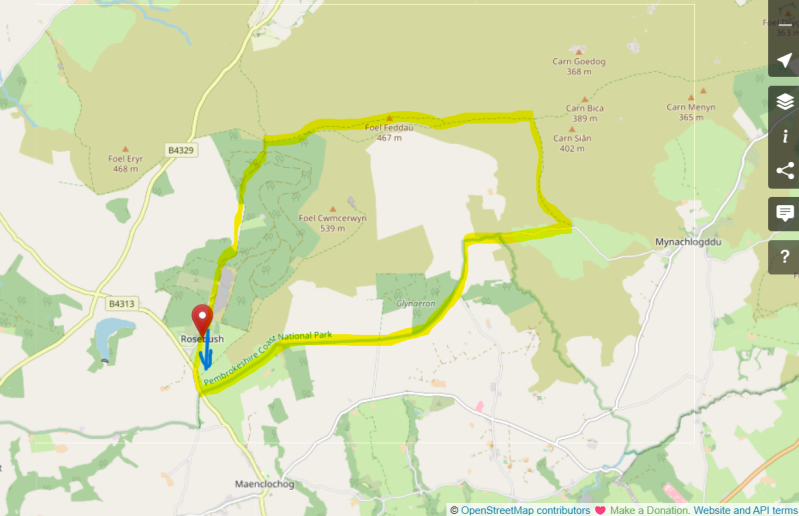
The first section (c.4 miles) of this walk requires some tarmac pounding to get to the point where you can ascend to the Golden Road across the Preseli hills to Foel Feddau (467m), thereby creating a circular route back to Rosebush.
There are numerous paths onto the hills in this area, so use this route as one example of how to experience it.
For example, the highest Preseli peak of Foel Cwmcerwyn (536m) can be reached via an out and back route starting through fields opposite the entrance to the car park in Rosebush, but it’s not on the Golden Road.
This 10 mile route covers around half of the Golden Road itself. There’s a note below to explain its full course.
Please note that this landscape involves exposed, remote walking on boggy (even during dry spells) uplands using paths that can become indistinct, in conditions and visibility that can change quickly. It’s for experienced walkers who are confident navigating in such conditions.
- From the public car parking area, head back up to its entrance at the top of the lane, and turn right. Follow this level road – the old Maenclochog railway route - as it leads out of Rosebush, passing Pantmawr Farmhouse Cheese, until it joins a main road, the B4313.
- Turn left to the ‘Ffynon Fawr’, the great well, built by the community of Rosebush (‘gymuned’) for the community, to celebrate the Millennium. 'Gan y gymuned i'r gymuned' — By the community, for the community really captures the spirit of this place. Cross the road to join a pavement and continue along the B4313.
- Soon pass a house on your right and cross back over then to take a quiet road signposted for Crymych that sets off uphill but soon levels out.
- The lane is quiet with farmland and the occasional farm along its length. It’s a 4 mile route to the point where the ascent into the Preseli Hills begins. Stick with it, ignoring any roads off. Pass the woodland of Glynaeron and look out for crossbills and peregrines.
- Eventually you’ll come across Glynsaithmaen Farm, and a monument to W R Evans.
- The name of the farm, ‘valley of the seven stones’, refers to the number of standing stones and other prehistoric remains located in the fields and moorland in the vicinity, of which 6 are still visible. Glynsaithmaen is reputed to have been one of the meeting places for the Rebecca Rioters who opposed the turnpike tolls in the mid-19th Century.
- The monolith in the foreground was placed as a memorial to W.R.Evans 1910-1991, a bard, teacher and local historian who was born in Mynachlogddu and brought up on this farm. It is polished bluestone of an unusual mottled variety and the inscription in Welsh says 'I shall return as dust, one day to be reunited with the mountain. He stands on behalf of 'Bois y Frenni' to the talent of One who created us.'
- Cross the cattlegrid, and soon arrive at a small parking area on the left at a sharp bend in the road, in front of Dan-y-Garn Farm. (///teamed.erupted.redeeming)
- The route onto the hillside and up onto the Golden Road ridge follows a waymarked bridleway that runs to the left-hand side of a hill in front of you (called Carn Sian). The route starts clearly but becomes difficult where boggy ground interrupts the direction of the path. You are ultimately aiming for a route marker at the top of the ridge at SN 1218 3228
- Head left. Pick your way along hardly visible paths, sometimes boggy, climbing towards Foel Feddau. On clear days there are fine views towards Newport and the coast to the North/North East and South Pembrokeshire the other way.
- The route improves as you approach the stony peak of Foel Feddau, and relatively easy to follow as you proceed West from the summit. You’ll see a forestry area ahead of you – Pontmaenog Forest - and the path eventually runs along its fence, on one side and then the other.
- At a signpost, turn left to follow directions on forestry tracks back towards Rosebush.
- After a short distance, bear left as the route you’re on joins a wider track. Then after a further 100m go right again. Pass a wooden bench that overlook a stream and small waterfall, then after c. 200m as the path splits, drop down to the right to follow a fence – the quarrying past of Rosebush starts to become more evident now, as is the village that is visible in the distance.
- Keep on this route all the way back to Rosebush, eventually passing the cottages that would have once lined the railway route.
Additional Notes
The Golden Road
Few paths in Britain capture the imagination quite like the Golden Road. Stretching for around seven miles along the spine of the Preseli Hills, it runs from Llanbainal, on the road between Crymych and Mynachlog-ddu, to Foel Eryr at the western end of the ridge. Most walkers tackling the full route use the parking area at Bwlch-y-Gwynt, a short distance beyond Foel Eryr, making it a convenient start or finish for this classic crossing of the Preselis.
Its evocative name has prompted several explanations. The most widely accepted is that it refers to the golden gorse that blazes across the hillsides in spring and early summer, although others suggest it reflects the route's long-standing importance as a prized highway across the Preselis.
Whether it was ever a true "road" is another matter. Archaeologists generally agree that people have followed this natural ridge since prehistoric times, perhaps for more than 5,000 years. Along its length lie an extraordinary concentration of standing stones, burial cairns and other prehistoric monuments, while nearby outcrops provided many of the bluestones used to build Stonehenge. Some researchers have suggested the ridge formed part of the route by which those stones began their remarkable journey to Salisbury Plain.
Definitive answers remain elusive. Was it a trading route, a drovers' road, a ceremonial pathway, or simply the easiest line across the hills? The answer is probably all of these, at different times in its long history. Whatever its origins, walking the Golden Road today is to follow in the footsteps of countless generations who crossed the Preselis long before there were maps, milestones or modern footpaths.
Stonehenge's Bluestones
Research increasingly supports the view that many of Stonehenge's famous bluestones originated in the Preseli Hills. Whether carried entirely by human effort or aided by glacial action, their journey from these hills to Salisbury Plain remains one of Britain's great archaeological stories.
Rosebush Slate Quarries and the Maenclochog Railway
Rosebush owes its existence to slate. During the nineteenth century, the nearby Rosebush and Bellstone quarries became important producers of roofing slates and building stone, their products travelling far beyond Pembrokeshire. Among the projects said to have used Rosebush slate was the rebuilding of the Palace of Westminster following the devastating fire of 1834.
Getting the slate to market was another matter. In response, railway entrepreneur Edward Cropper financed the Maenclochog Railway, an eight-mile line linking the quarries with the Great Western Railway at Clynderwen.
When the railway reached Rosebush in 1876, it brought with it something rather unexpected: a prefabricated corrugated iron hotel, delivered in sections by train and assembled beside the station. That building opened as the Precelly Hotel, created to serve quarrymen, railway passengers and the visitors Cropper hoped would be drawn to the healthy mountain air of the Preselis. Today, it survives as Tafarn Sinc.
Neither the slate industry nor the railway enjoyed lasting success. As demand declined, the quarries closed and the railway eventually disappeared, leaving only traces in the landscape. Yet the flooded excavations have found a remarkable new purpose. Their crystal-clear waters are now among Pembrokeshire's favourite wild swimming spots, where towering slate cliffs provide a dramatic backdrop for a very different kind of visitor.
Rebecca's Barn
A short distance from the route stands Glynsaithmaen Barn at the farm of the same name, where local farmers met in June 1839 to organise the protests that became the Rebecca Riots. Their campaign against oppressive tolls transformed Welsh politics and remains one of the defining episodes in the nation's history.
It's a story that adds another fascinating layer to this remarkable landscape. The novel, 'Hosts of Rebecca', by Alexander Cordell, brilliantly captures the struggles of the working class at this time, and the impact of government policy on their lives.
Other Pubs to try in Pembrokeshire

Gwaun Valley woods and fields around Pontfaen, on the way to Bessies.
3.3 miles

Ffynone Falls, Celtic mythology and a link to Buckingham Palace in Newchapel
5 miles