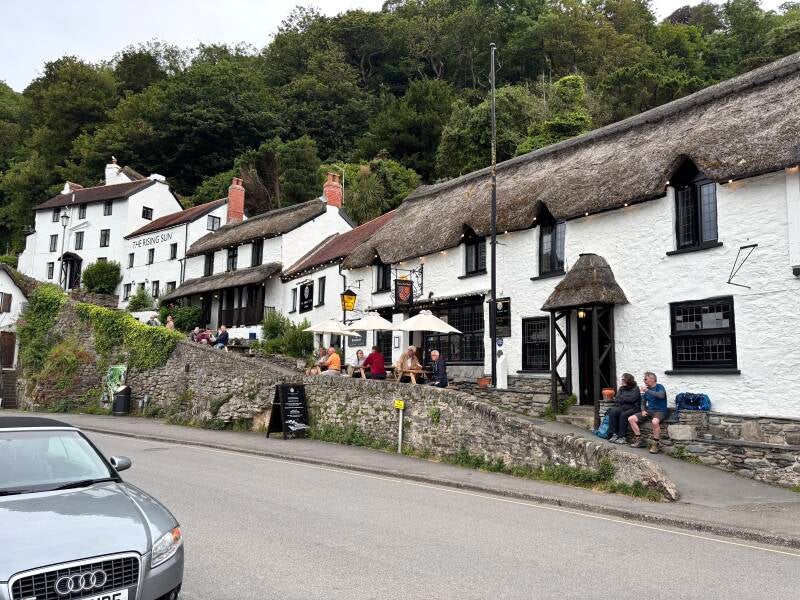
The Ship Inn, Porlock Weir (Bottom Ship)
The Walk: Exmoor’s Coastal Sanctuary: Ada Lovelace’s Terraces, & England’s Smallest Church at Culbone, 5.3 miles

Try this Pub & Walk
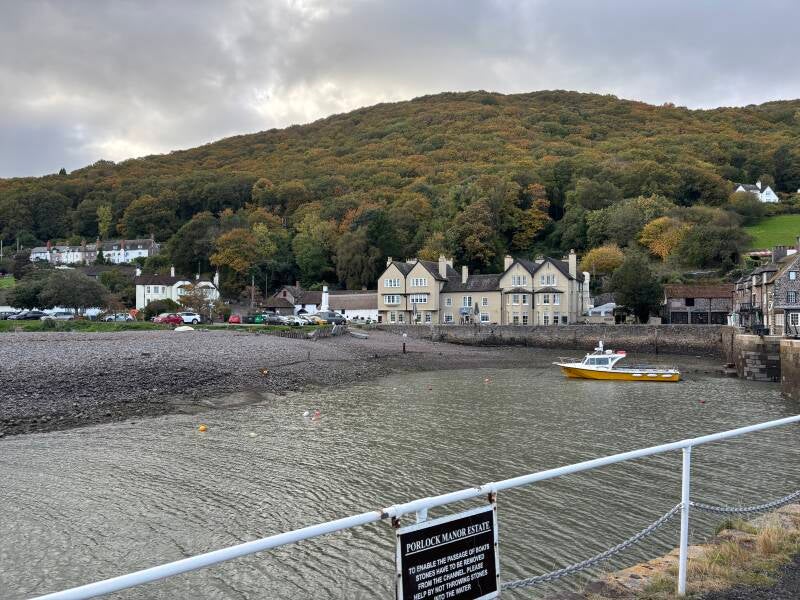
Porlock Weir is one of those places that rewards a little exploration. Tucked beneath the wooded slopes of Exmoor, this tiny coastal hamlet has a thousand-year maritime history, a working harbour and a wonderful outlook across Porlock Bay towards Bossington Hill. It is also the starting point for a walk that takes you into some rather fascinating corners of the Exmoor landscape.
The outward journey follows the South West Coast Path through the atmospheric woodland of Ashley Combe, once the summer home of Ada Lovelace, the mathematician and computing pioneer whose work helped lay the foundations of modern computing. The terraces, stone archways and tunnels that you encounter along the way are remnants of the extraordinary estate she shared with her husband, William King, Earl of Lovelace.
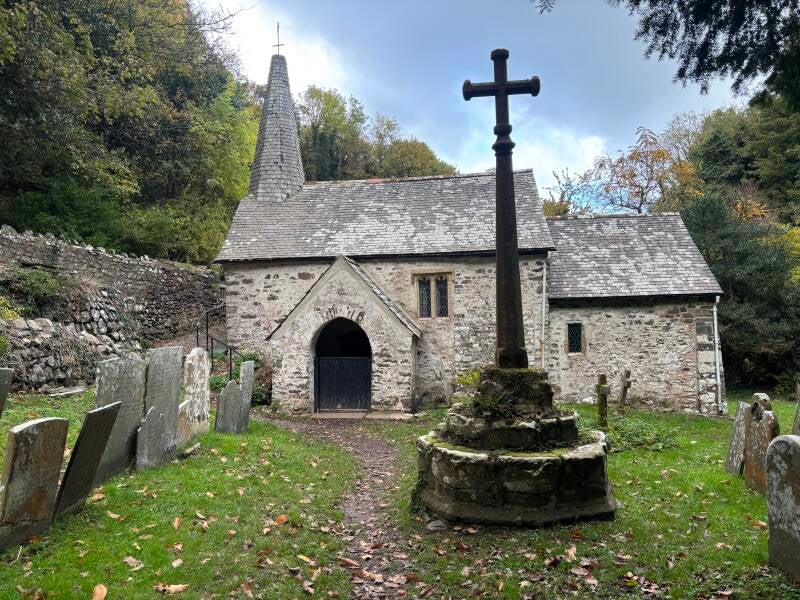
Your destination is Culbone Church, a remarkable little place of worship hidden in a secluded woodland combe. Often described as the smallest complete parish church in England, it has an extraordinary history and an atmosphere that makes the journey worthwhile in its own right.
The return route takes you through quiet farmland and woodland, joining the Coleridge Way before descending towards Porlock Weir.
And then there's The Ship Inn. Not the better-known Ship in Porlock village, but its coastal namesake, affectionately known as the 'Bottom Ship'. A fabulous thatched pub with a warm welcome, an excellent selection of real ales and ciders, and a particularly good reason to linger.
This is a walk that combines coastal scenery, fascinating history and a proper Exmoor pub. What's not to like?
About The Ship Inn, Porlock Weir


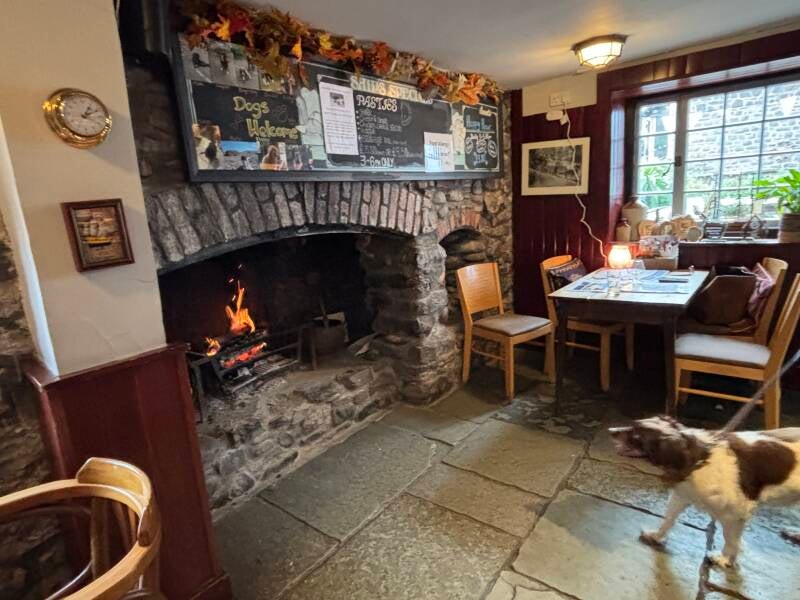

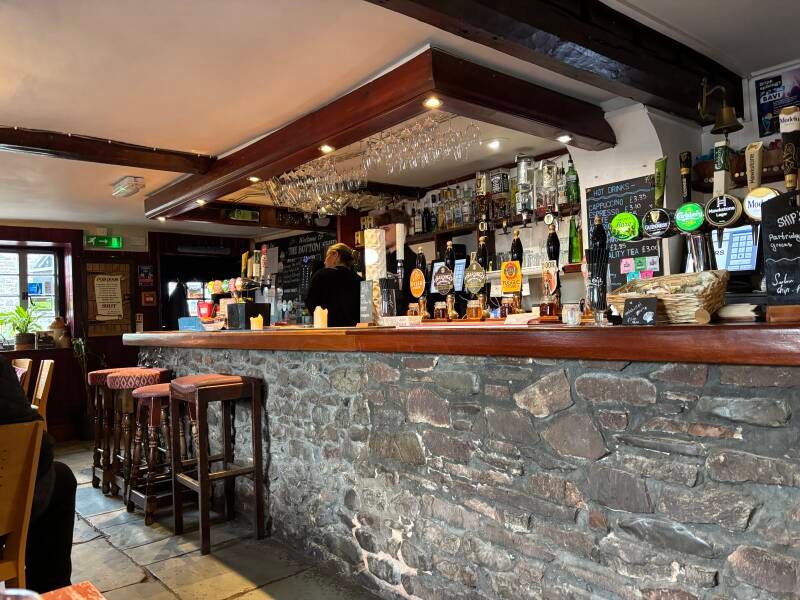

Last visit: November 2026
There are two Ship Inns in this part of Exmoor, and it's worth making the distinction. Arguably the better-known establishment in Porlock village is the 'Top Ship', while this one, alongside Porlock Weir harbour, is affectionately known as the 'Bottom Ship'. They're about a mile and a half apart, and both have their attractions. Having visited both, though, I have a particular affection for the one by the coast.
The Bottom Ship is a lovely old building, with a thatched roof, whitewashed stone frontage and a history stretching back several centuries. It's the earliest surviving building on the harbour quayside. Its low ceilings, traditional character and prominent fireplace make it feel entirely at home in this historic little harbour community.
It's a lovely setting, right beside the harbour and within easy reach of the beach, galleries, cafés and workshops that make Porlock Weir such an appealing place to visit.
A large BAR sign guided me towards the entrance, while another offered a timely reminder to MIND YOUR HEAD as I ducked through the ancient, low doorway. The welcome was immediate and enthusiastic, with friendly young staff setting things off on exactly the right footing.
Inside, a huge fireplace was throwing out plenty of heat on a bright November day, doing its best to disguise a rather chilly wind outside. I was grateful for it. But it was the range of real ales that really caught my attention.
Otter and Exmoor's Classic are familiar favourites, but there was plenty more to explore. Hardings Best and Golden Bitter, and ciders from Bason Bridge Brewery in Highbridge, and Fugglestone from Wiltshire's Hop Back Brewery. It's particularly pleasing to see a pub supporting smaller regional breweries, and the team clearly have a real enthusiasm for their beers.
The beer selection is no accident. This is a pub with a longstanding commitment to real ale and cider, and its annual beer festival, which has featured up to 50 ales, is another reason for enthusiasts to make the journey.
The selection was sufficiently tempting to make me investigate the B&B prices, which were pleasantly surprising. I must remember to pack an emergency overnight bag next time! The food looked excellent too, although my own packed lunch rather got in the way of that particular opportunity.
The Ship is doing a superb job of welcoming visitors to Porlock Weir. And if you're wondering which of the two Ships deserves your attention, I'd make the detour to the harbour.
My verdict: a characterful coastal pub, with a warm welcome, a genuine commitment to regional beers and ciders, and a setting that makes it well worth seeking out.
Pub Key Information
| WEBSITE | https://www.theshipinnporlockweir.co.uk/ |
| ADDRESS | The Ship Inn, Porlock Weir, near Minehead, Somerset, TA24 8PB |
| PHONE | 01643 863288 |
| WHAT3WORDS | ///captures.sampling.clerk |
| PARKING | Public car park at Porlock Weir, opposite The Ship |
| LOCATION | The A39 runs close to the north coast of Somerset. Porlock sits between Minehead and Lynmouth, with Porlock Weir 1.5 miles away right on the coast. |
| HANDY FOR | Exmoor; Dunster; Lynmouth & Lynton; Valley of the Rocks; South West Coast Path; Coleridge Way; |
Walk Overview
This is a varied walk, with a demanding initial climb, some lovely woodland walking and a rewarding mix of coastal, historic and rural scenery.
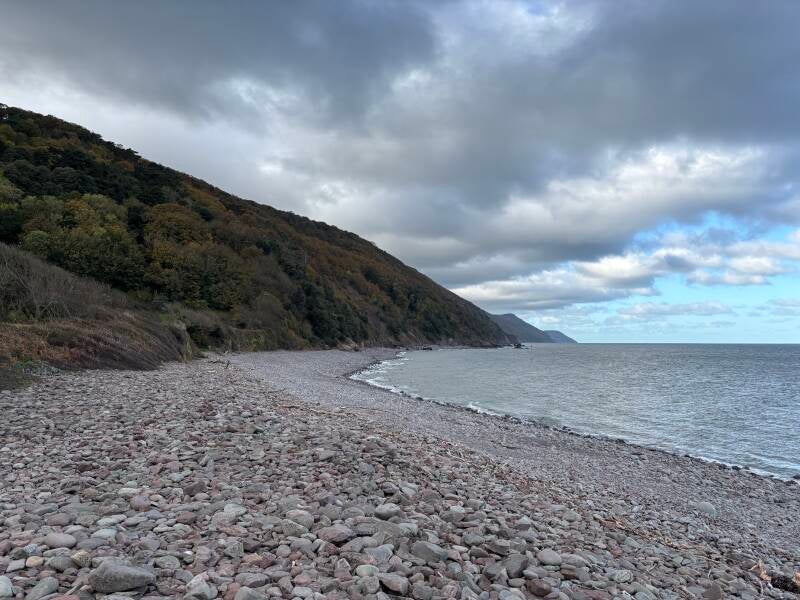
From the harbour at Porlock Weir, the route heads west towards Gore Point before joining the pebble beach. This is a particularly atmospheric start, with the Bristol Channel ahead and the wooded slopes of Exmoor rising behind you.
The footpath to Culbone Church leaves the beach and climbs steadily through woodland. It is a substantial ascent, with some steep sections, but the route is well established and frequently signposted. Along the way you'll pass the remains of Ashley Combe, where terraced gardens, stone archways and tunnels offer tantalising glimpses of the estate created by the Lovelace family in the nineteenth century.
The church itself is a wonderful reward for the climb. Tucked away in its secluded combe, it feels a world apart from the coastal activity at Porlock Weir.
The return takes a different route, heading through Withy Combe and up towards Silcombe Farm, before following quiet lanes and sections of the Coleridge Way.



Walk Key Information
| START/FINISH | The Ship Inn, Porlock Weir, near Minehead, Somerset, TA24 8PB |
| PARKING | Public car park at Porlock Weir, opposite The Ship |
| GRID REFERENCE | SS 860 484 |
| WHAT3WORDS | ///captures.sampling.clerk |
| DISTANCE/TIME | 5.3 miles / 8.5 km; approx 3 hours |
| ASCENT | 1400 feet / 430 metres |
| PATHS/TERRAIN | Pebble beach; woodland paths; quiet lanes; farm tracks |
| DIFFICULTY | Moderate. 2 miles of uphill to start, 1400 feet ascent |
| PUBLIC TRANSPORT | Bus stop at The Ship Inn, Porlock Weir. |
| TOILETS | Public toilets at Porlock Weir car park. |
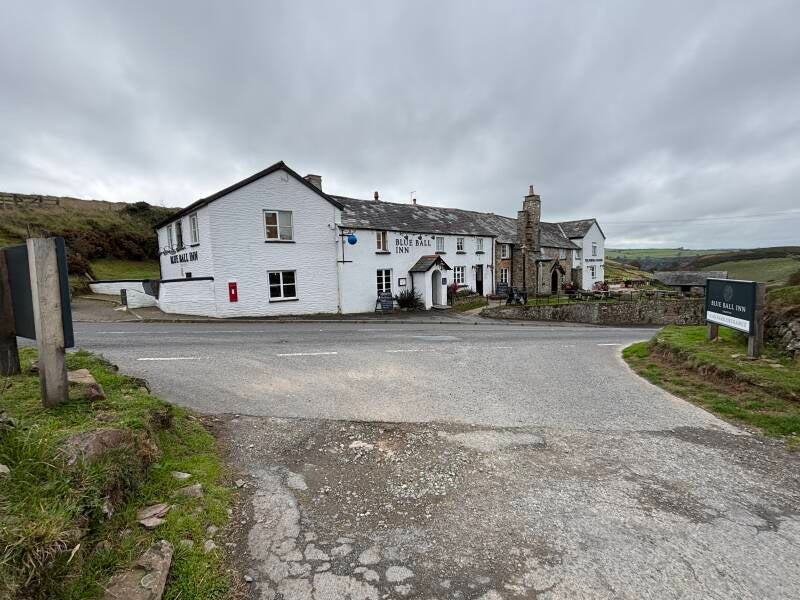
| OTHER PUBS TO VISIT | The Ship Inn at Porlock Weir is known as locally as the Bottom Ship. The Ship in Porlock village, 1.5 miles away, is known as the Top Ship. Both are excellent! Also try The Blue Ball on the A39 outside Lynmouth at Countisbury; and seek out The Rockford Inn near Brendon on the East Lyn river. |
Walk Instructions: Choose what works for you
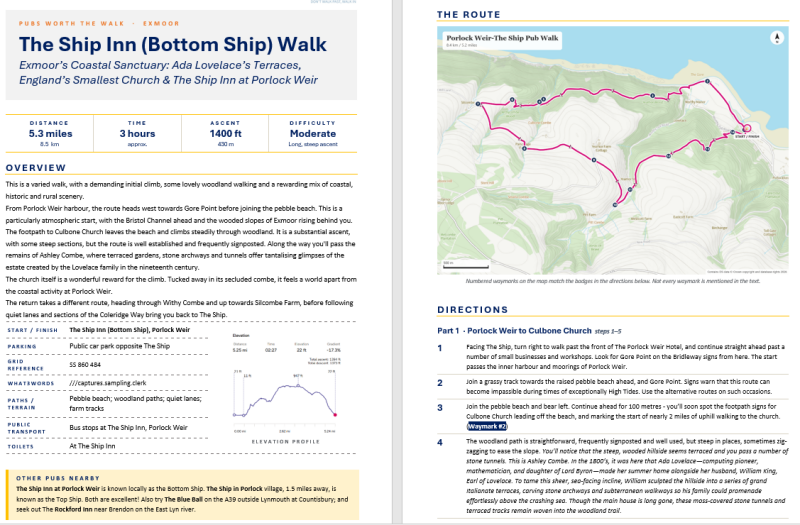
There are multiple ways to consume the route described below.
- Either follow the online Walk Directions below, or download and print a copy of the route.
- If you have the OS Maps App, you can follow a saved route directly in the OS App.
- Or download the GPX file for use with your chosen GPS-based tracker App, like Strava. Upload the file when you Create a New Route in the App.
Walk Directions

- Facing The Ship, turn right to walk past the front of The Porlock Weir Hotel, and continue straight ahead past a number of small businesses and workshops. Look for Gore Point on the Bridleway signs from here. The start passes the inner harbour and moorings of Porlock Weir.
- Join a grassy track towards the raised pebble beach ahead, and Gore Point. Signs warn that this route can become impassible during times of exceptionally High Tides. Use the alternative routes on such occasions.
- Join the pebble beach and bear left. Continue ahead for 100 metres - you’ll soon spot the footpath signs for Culbone Church leading off the beach, and marking the start of nearly 2 miles of uphill walking to the church. (Waymark #2)
- The woodland path is straightforward, frequently signposted and well used, but steep in places, sometimes zig-zagging to ease the slope. You’ll notice that the steep, wooded hillside seems terraced and you pass a number of stone tunnels. This is Ashley Combe. In the 1800’s, it was here that Ada Lovelace—computing pioneer, mathematician, and daughter of Lord Byron—made her summer home alongside her husband, William King, Earl of Lovelace. To tame this sheer, sea-facing incline, William sculpted the hillside into a series of grand Italianate terraces, carving stone archways and subterranean walkways so his family could promenade effortlessly above the crashing sea. Though the main house is long gone, these moss-covered stone tunnels and terraced tracks remain woven into the woodland trail.
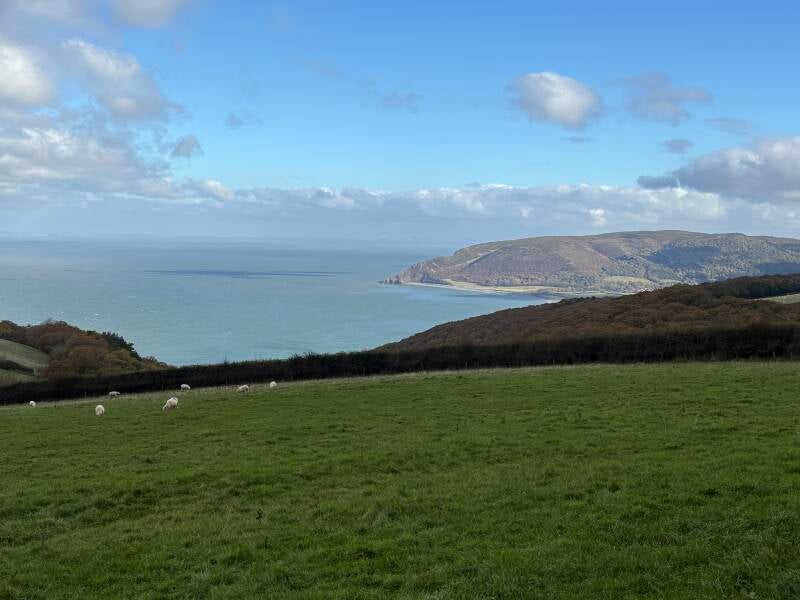
- Continue uphill, following signs all the way. (#3) Eventually, the path opens up a little offering views of the Heritage Coast of Glamorgan across the Bristol Channel. A wider gravel path on a welcome downhill section finally leads towards the Church, with views below you through the trees. (#4) There are 7 houses in the community of Culbone, with the electoral roll recording only 7 people here. The first Rector of the Grade I Listed Church is recorded as 1329, although in the Assizes Rolls of 1280 it is recorded that Thomas, the chaplain of Cattenor (Culbone), was indicted ‘for that he had struck Albert of Esshe (Ash) on the head with a hatchet, and so killed him’. Church services are still held regularly for the (now friendly) congregation.
- Having visited the Church, proceed to the far end of the churchyard to pass through a small wooden gate next to the stream. (#5) Follow the footpath in the direction of Silcombe Farm, through the archway ahead. The path soon returns to the woods, climbing uphill once again as you make your way out of Withy Combe.
- Just beyond an ageing wooden gate, the path seems to fork (the leaf fall of Autumn obscuring the path a little in places). Bear left, and soon reach a farm track, where you break clear of the woodland. (#6) Turn left here and follow it all the way to the road at Silcombe Farm (#7) where the route joins The Coleridge Way (yellow leaf emblem sign).
- When you reach this very quiet road, turn left and follow the lane for around 1 mile past a number of farm entrances – Parsonage, Ash and Yarner. At Yarner Farm, follow the sign for Porlock Weir (#9), and again at a sharp left-hand bend at the Pitt Farm junction. (#10) This road is the Worthy Toll Road which offers drivers an alternative to the 1:4 of Porlock Hill on the A39. Tolls are collected at an archway of Ashley Combe Lodge, at what was once the entrance to Ashley Combe House.
- A few hundred yards ahead, look for a path to the right into Worthy Wood in Worthy Combe, signpost Porlockford. (#11) The path rises gently initially, and once over the crest, look for the Coleridge Way yellow emblem sign to the left, on a narrower track downhill. (#12)
- Drop onto a wide stony track, and continue straight ahead. This section is loose stone underfoot, so take care after the initial downhill part where the route becomes steeper. Thankfully, it soon levels out.
- After a short distance of level walking beyond the steepest part, look for a Bridleway sign on your left for Porlock Weir (#13). Continue on a narrow track downhill. The rhododendrons here encroach over the path and as you get closer to Porlock Weir, the narrow track runs behind gardens as it continues towards a lane. (#14) Take care as you join it – it’s the Toll Road again.
- On the lane, turn right downhill, then left to reach to reach The Ship at the bottom of the lane.
Additional Notes
Ada Lovelace, Ashley Combe and the birth of computing
Augusta Ada King, Countess of Lovelace (1815–1852), is widely regarded as a pioneer of computer science. The daughter of the celebrated Romantic poet Lord Byron and Annabella Milbanke, she was born into a world of aristocratic privilege, but her intellectual interests took her in a rather different direction.
Her mother encouraged an education in mathematics and science, partly in reaction to Byron's poetic temperament. Ada was fortunate to receive tuition from some of the leading mathematical minds of the day, including Augustus De Morgan, and was introduced to Charles Babbage in 1833 by the mathematician Mary Somerville.
Babbage was developing his proposed Analytical Engine, a mechanical device intended to perform complex calculations. It was an extraordinary concept, anticipating many of the principles of the modern computer, although the machine was never completed during his lifetime.
Ada understood that its potential went far beyond arithmetic.
In 1835, aged just 19, she married William King, whose family owned Ashley Combe. Their honeymoon was spent at the property, and they became so attached to the area that it developed into their summer retreat. William became Earl of Lovelace in 1838, giving Ada the title by which she is now best known.
The Lovelaces spent considerable time at Ashley Combe, generally around two months each summer. William invested heavily in transforming the property, developing the original house into an Italianate villa and creating an elaborate landscape of terraces, paths, archways and tunnels on the steep hillside.
The tunnels were not simply decorative. They provided routes through the difficult terrain, connecting different parts of the gardens and estate, including access towards the coast. Some became known as fairy tunnels.
And this is where the story becomes especially interesting for our walk.
Ada continued her mathematical and scientific interests while at Ashley Combe. Her correspondence from the estate includes letters to Charles Babbage and the scientist Michael Faraday in 1843. Her connection with the local scientific community extended beyond correspondence, too: she visited Andrew Crosse at Fyne Court in the Quantocks to discuss his experiments with electricity.
Her most significant contribution to computing came in 1843, when she translated an Italian account of Babbage's Analytical Engine, written by Luigi Federico Menabrea. Ada added extensive notes of her own, which were considerably longer than the original article.
Among these was an algorithm for calculating Bernoulli numbers, designed for the proposed machine. It is widely recognised as the first published computer program. More importantly, she understood that such a machine might eventually manipulate symbols, letters and even musical notation, rather than simply numbers.
That was a remarkable insight for someone writing nearly a century before electronic computers became a reality.
Ada died of cancer in 1852, aged just 36. William survived her by more than 40 years, dying in 1893.
Ashley Combe itself had a longer afterlife. The property was subsequently occupied by other members of the Lovelace family, became a Dr Barnardo's children's home in 1939 and briefly operated as a country club from 1950. Eventually it fell into disrepair and was demolished in 1974.
The surviving landscape features are now a rather wonderful legacy. The terraces, tunnels and stonework encountered on the path towards Culbone provide a tangible connection with Ada and William's extraordinary summer home.
One particularly interesting detail is that Ashley Combe Lodge, where the Worthy Toll Road passes the old estate entrance, survives. It is a listed building.
Culbone Church – a little church with a remarkable history
There are plenty of small churches in remote corners of Britain, but Culbone is something rather special. Often described as the smallest complete parish church in England, it is Grade I listed and sits in a secluded wooded combe, accessible only on foot.
Its usual name is St Beuno's, although historical records have also referred to it as St Culbone's. The dedication is not entirely certain, but St Beuno was a sixth-century Welsh saint whose missionary work extended across Wales and the border country. Local tradition associates him with the church.
The church is recorded in the Domesday Book of 1086, which documents a church and 50 acres of pasture at Culbone. Its origins are thought to be older still, with elements possibly dating from the Saxon period.
At approximately 35 feet long, it is tiny by almost any measure. The nave and chancel together accommodate a congregation of around 40 people.
Yet there is an extraordinary amount to discover.
The church contains a number of architectural features that are particularly noteworthy:
-
The Norman font: a substantial stone font, traditionally dated to around 800 years old, which has served generations of the local community.
-
The medieval rood screen: thought to date from around 1400, separating the nave from the chancel.
-
The Lovelace family pew: a large box pew used by the family from Ashley Combe House. It is a reminder of the close relationship between the estate and this tiny church.
-
The north-side window: an unusual two-light window carved from a single piece of stone, with a carved face between the openings. Its precise date is uncertain, and although traditionally associated with Saxon work.
-
The church roof: the nave retains an impressive wagon-style roof, with much of its fabric dating from the fifteenth century.
The church has survived against considerable odds. Its isolated position meant that the small congregation had to maintain the building with limited resources, and the surrounding community was largely self-sufficient for much of its history.
The records provide some fascinating glimpses of life here. In the Assize Rolls of 1280, Thomas, chaplain of Cattenor (the former name associated with Culbone), was indicted for killing a man called Albert of Esshe with a hatchet. It is a rather brutal reminder that medieval rural communities were not always as peaceful as their surroundings might suggest!
The church also has a connection with the wider history of the Lovelace family, and its location makes it easy to understand why it became such a favourite destination for walks from Ashley Combe.
There is something quite remarkable about finding a working place of worship of this age, tucked away in a wooded valley, with no road leading to its door. It feels as though very little has changed here, even when you consider the many centuries of history contained within its walls.
Research sources: Charles G. Layley, the Exmoor Historic Environment Record, Historic England and the National Churches Trust.
Porlock Weir – a harbour with a thousand-year history
It would be easy to treat Porlock Weir as a picturesque starting point for a walk, but its history deserves a little attention of its own.
The harbour has existed for more than a thousand years and was once an important maritime connection for this remote stretch of the Somerset coast. In an area where the steep slopes of Exmoor made overland travel difficult, the sea offered a practical means of moving people and goods.
The name Porlock Weir is thought to derive from the fishing weirs established here, which are recorded from the fifteenth century.
One of its most interesting features was the development of a floating harbour, controlled by sluice gates. Built in the seventeenth century, it allowed vessels to be loaded and unloaded even when the tide had receded. The gates could also be opened to release large volumes of trapped water, helping to flush away the shingle that threatened to block the harbour entrance.
The harbour supported a surprisingly extensive trading network. Coal and limestone came across from South Wales, while manufactured goods arrived from Bristol. Local exports included wool, leather goods, herrings, butter, bricks, bark for tanning and pit props destined for the Welsh coal mines.
Oysters were also an important export, with consignments finding their way to Bristol.
Maritime trade continued well into the twentieth century, with vessels carrying coal, livestock, foodstuffs and timber until the 1920s.
Today, the harbour has a rather different character, but it hasn't lost its sense of purpose. Workshops and small businesses still occupy many of the old buildings, alongside galleries, cafés and places to eat. There is a small museum too, helping to tell the story of the harbour and its community.
The views across Porlock Bay towards Bossington Hill are wonderful, while the South West Coast Path and Coleridge Way offer easy access to the wider Exmoor landscape.
It is a lovely place to spend time before or after a walk, and perhaps one of the reasons why I would encourage visitors not to rush straight through Porlock village without making the detour.
Other Pubs to Try - just across the border in Devon
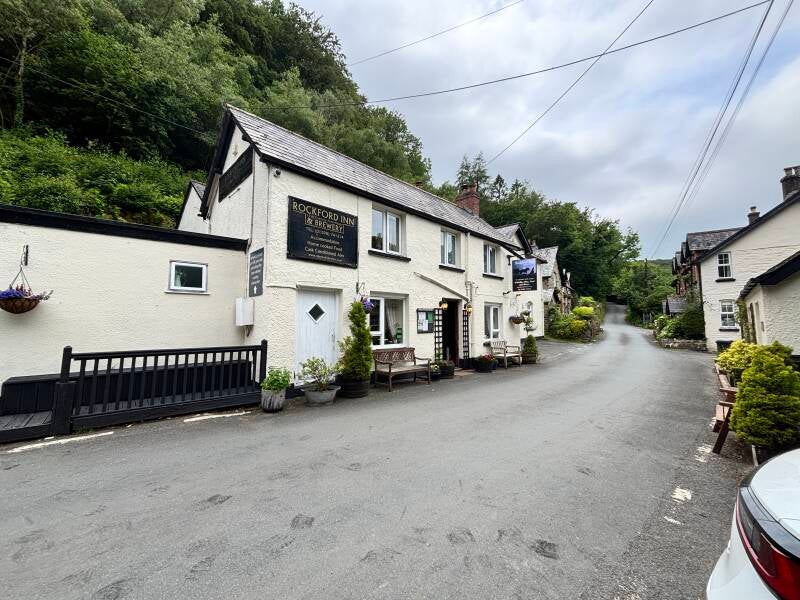
Exmoor Circular Walk to Watersmeet along the East Lyn River from Rockford.
3.2 miles