

The Rising Sun, Lynmouth
Memorable pub walk to Exmoor's iconic Valley of the Rocks near Lynton, 2.5 miles

Try this Pub & Walk
There are pubs you seek out because they’re brilliant, and pubs you end up in because they’re part of the landscape. The Rising Sun in Lynmouth is firmly in the second category — and that’s not a criticism.
It’s a harbour inn with centuries in its bones, a building that has watched fishermen, smugglers, poets, tourists and walkers come and go for more than six hundred years. Nobody comes to this part of North Devon and misses The Rising Sun!
It sits at the foot of Mars Hill, where the river meets the sea, in a row of old fishermen’s cottages that once opened straight onto the harbour. The thatch, the limewashed walls, the crooked staircases and sloping floors all tell the same story: this place grew out of the coastline long before guidebooks and postcards existed.
Shelley lived and wrote here in the 1810s; R.D. Blackmore stayed half a century later while shaping Lorna Doone. (The Royal Oak at Withypool claim he was writing it there too!) The Coleridge Way passes through the town. Up the coast, Ada Lovelace — daughter of Byron and pioneer of computing — spent her summers at Ashley Combe. Lynmouth is thick with literary weather, and the Rising Sun is part of that atmosphere.
And then there’s the walk, an Exmoor classic.
You can drive up to Lynton and park near the cricket pitch to visit the Valley of Rocks. But you'd miss the 500 feet climb from sea level at Lynmouth to the cliff‑top, one of the great walking achievements on the South West Coast Path.
The route is a steep zig‑zag past the Cliff Railway (which you could also take!), a pause at Poets Corner, then out onto the open cliff path with the Bristol Channel falling away beneath you. The valley itself is a geological oddity — a dry riverbed perched above the sea — and the views west towards Lee Abbey and the jagged 'rock towers' are unforgettable in any weather.
About The Rising Sun, Lynmouth


Last visit: June 2026
The Rising Sun is the pub everyone photographs when they come to Lynmouth.
It sits in a row of old fishermen’s cottages on the steep lane above the harbour, part thatched and whitewashed, with the river on one side and the Bristol Channel on the other. If the Valley of Rocks is the postcard of Exmoor, the Rising Sun is the postcard of Lynmouth.
Step inside and you’re in a warren of low beams, sloping floors and thick stone walls — the sort of interior that only centuries of coastal life can produce. The one room bar is certainly atmospheric, and must have been serving beer to fishermen, smugglers and walkers since long before the Cliff Railway was even conceived.
This is a Hall & Woodhouse pub, and that’s worth knowing before you arrive. If you’re familiar with their beers, you won’t find surprises here, and on my visit the one ale I was hoping for had just reached the end of the barrel. The staff were friendly but a little stretched, and the service had the slightly unhurried air of a place that knows its location will keep the tables full. This isn’t a locals’ pub in the traditional sense; it’s a coastal inn that has been welcoming travellers for centuries, and it behaves like one.
And what a setting. On a warm evening, the benches along the sloping lane are the place to be, with the harbour below you, the cliffs rising behind, the sound of the river mixing with the sea. You'll understand why Shelley chose it for a honeymoon, why Blackmore found his words here, and why no visit to Lynmouth is complete without at least pausing at the door.
You can't not go in.
Pub Key Information
| WEBSITE | https://www.risingsunlynmouth.com/ |
| ADDRESS | Harbourside, Lynmouth, Devon, EX35 6EG |
| PHONE | 01598 753223 |
| WHAT3WORDS | ///cringe.plans.unloading |
| PARKING | Some parking on the roadside along the Harbourside. Public parking areas are available at either end of the town. |
| LOCATION | Lynmouth (harbour) & Lynton (cliff top) are on the North Devon coast, close to the border with Somerset. Together they are the largest coastal 'resort' within the Exmoor National Park. The A39 is the main coast road to Lynmouth & Lynton, running between Bridgwater and Barnstaple. |
| HANDY FOR | Exmoor; Watersmeet; Two Moors Way; Coleridge Way; Valley of the Rocks; Heddon Valley; the Doone Valley |
Walk Overview
There are landscapes in Britain that feel as though they’ve been over‑described, photographed to exhaustion, and pinned to too many postcards — and then there is the Valley of Rocks, which somehow remains astonishing every single time you see it.
The climb from sea‑level Lynmouth to the cliff‑top is a short, sharp transition from harbour life to something altogether wilder: a dry river valley perched improbably above the sea, flanked by jagged rock towers and opening westwards to a sweep of coastline that feels ancient, exposed and elemental. It’s a place that looks as though it should belong in a myth, and yet it’s right here, a few minutes’ walk from the Cliff Railway and the churchyard in Lynton.
Stand on the upper path and you understand why this view would make any list of Britain’s “must‑see” places.
The Bristol Channel drops away beneath you; the rock pinnacles rise like weathered sentinels; the cricket pitch sits neatly in the valley floor as if placed there by a mischievous hand; and the toll road curves towards Lee Abbey with a kind of quiet inevitability. On a clear day you can see the coast of Wales; on a stormy one you feel the full force of Exmoor’s weather. It is brutal and beautiful in equal measure — a landscape that doesn’t need interpretation boards or superlatives because it speaks for itself.


Walk Key Information
| START/FINISH | The Rising Sun, Harbourside, Lynmouth, EX35 6EG |
| PARKING | Some parking on the roadside along the Harbourside. Public parking areas are available at either end of the town. |
| GRID REFERENCE | SS 722 497 |
| WHAT3WORDS | ///cringe.plans.unloading |
| DISTANCE/TIME | 2.5 miles / 4 km; approx 2 hours |
| ASCENT | 563 feet / 175 metres |
| PATHS/TERRAIN | Pavements and tarmac footpaths, some slippy, some very steep. Short section of road walking. Choice to clamber and scramble over cliffs at valley of the rocks at your own risk! |
| DIFFICULTY | Moderate. It's a relatively short walk, but a steep climb. A trip up the cliff to Lynton via the Cliff Railway would make the route to Valley of the Rocks accessible for most. |
| PUBLIC TRANSPORT | Buses serve Lynmouth from both the Barnstaple and Minehead directions. |
| TOILETS | Multiple options in the hospitality businesses of Lynmouth & Lynton. |
| OTHER PUBS TO VISIT | In Lynton, the Queens Hotel and The Crown Hotel are worth trying. Further afield, seek out The Rockford Inn along the East Lyn Valley, up river from Watersmeet. To the West, The Hunter's Inn at Heddon Valley is recommended too. |
Walk Instructions: Choose what works for you
There are multiple ways to consume the route described below.
- Either follow the online Walk Directions below, or download and print a copy of the route.
- If you have the OS Maps App, you can follow a saved route directly in the OS App.
- Or download the GPX file for use with your chosen GPS-based tracker App, like Strava. Upload the file when you Create a New Route in the App.

Walk Directions
-
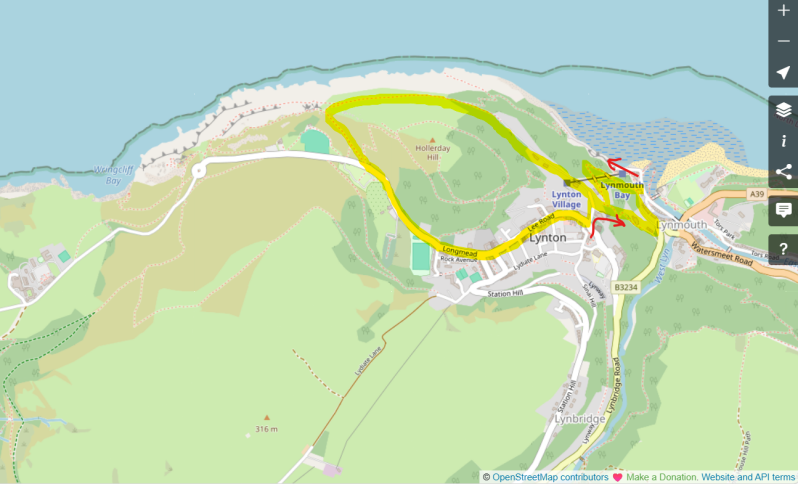
From The Rising Sun, turn the corner towards the Cliff Railway. Pass the Information Centre; to its side is a set of steps leading to the zig‑zag path up the hillside. Look out for 'The Walker' sculpture across the road before you start the climb, marking the confluence of The Two Moors Way, The Coleridge Way and the South West Coast Path.
-
The steep path snakes beneath the Cliff Railway on a series of short footbridges, climbing quickly towards Lynton.
-
At the top of the zig‑zags you reach Poets Corner, a small terrace with a bench and a fine first view back over Lynmouth. Join the lane here and bear right past The North Cliff Hotel.
-
The gradient eases and the path levels out, giving you wonderful views over Lynmouth, now far below, and across the Bristol Channel to the South Wales coast. The path ahead is shady and wooded.
-
After a wooden gate, the landscape opens dramatically. You join the tarmacked cliff path that reflects the sheer volume of visitors who come to this part of the coast. Here the paths split:
-
Right: beneath the Valley of Rocks along the South West Coast Path
-
Left: up onto the dramatic rock‑tops — the classic postcard view, with the Bristol Channel plunging away on one side and the old dry valley on the other, complete with its famous cricket pitch and the toll road towards Lee Abbey
Take the left‑hand option for the full Valley of Rocks experience.
-
-
Rather than descending the valley, return towards Lynton on the tarmac path that leads from the cliff‑top. This becomes pavement as you enter the town.
-
In front of Lynton’s parish church (whose graveyard has one of the best views in the area), turn down Church Hill, beside the Valley of the Rocks Hotel. This brings you back to Poets Corner.
-
Retrace your steps down hill, but after 100 metres, at the junction to take you back on to the zig zag section, continue straight ahead following signs for Lyn Gorge. This steep, sometimes slippery footpath drops to meet the main road through Lynmouth.
-
Join the main road for a short distance, steeply downhill. There is a pavement on the opposite side, but the footpath you need is on the town side of the road: a public footpath running along a lane behind the buildings.
-
Follow this lane as it curves right. Directly ahead is the steep harbour lane that runs past The Rising Sun, returning you to your starting point.
Additional Notes
The company you keep on Exmoor
Exmoor has always drawn writers, but it's only when you stop and picture them here that the whole thing becomes faintly ridiculous.
We imagine the Romantic poets striding across the moors in search of Xanadu, or some ancient mariner, or a line of verse that might change the world. But they weren't following waymarked trails, kissing gates and National Trust footbridges. They were trudging through mud, rain, bracken and sheep poo, probably lost half the time, and almost certainly arguing about whose idea it was to come this way.
And yet — they came. Again and again.
Coleridge and Wordsworth walked these cliffs in the 1790s, dreaming up the Lyrical Ballads. Shelley lived in Lynmouth in 1812–13, launching political pamphlets in hydrogen balloons from the cliffs. R.D. Blackmore wandered Exmoor half a century later, gathering the raw material for Lorna Doone before returning to Teddington to prune his plums. And just up the coast, at Ashley Combe, Ada Lovelace — daughter of Byron and pioneer of computing — spent her summers looking out over the same Bristol Channel.
It's an extraordinary cast for such a small stretch of coast.
What's striking is how ordinary their movements would have been. Shelley didn't glide romantically along the cliff path; he scrambled up it. Coleridge didn't float across the moor in a haze of inspiration; he sweated like I did this morning. Blackmore didn't sit in a picturesque window seat with a quill; he jotted notes in a battered notebook and went home to check on his fruit trees. Ada Lovelace didn't gaze wistfully at the sea thinking of Byron; she was probably thinking about algorithms.
And imagine them here today. Coleridge with a Silva compass he can't quite read and promises to go on a navigation course. Shelley in Gore-Tex, complaining about the humidity. Blackmore stopping every ten minutes to adjust the wrong coat. Ada Lovelace striding ahead with walking poles, an OS Maps app open on her iPhone, quietly confident she could design a better version.
And this, really, is where I find myself in their company. The thing that brought them to Exmoor, and brought them back, is exactly the same thing that brings me. You develop a passion for the place, and a pride in being privy to a kind of secret: the combinations and contrasts that make this landscape so compelling.
The Rising Sun just happens to sit in the middle of it all — a harbour inn folded into the cliffs, a place where people have paused for centuries before heading back out into the weather.
Today isn’t about the beer at the Rising Sun. It’s about Exmoor — a quiet, private loyalty to a brutal, beautiful landscape that envelops you and settles into your bones. And once it takes hold, you're done for.
Other Pubs to Try in Devon

Exmoor Circular Walk to Watersmeet along the East Lyn River from Rockford.
3.2 miles
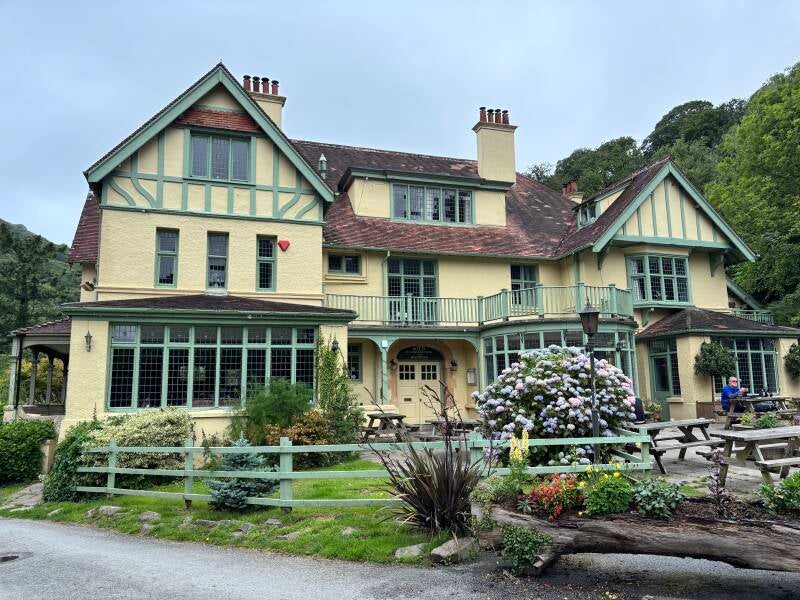
Challenging Woody Bay & Heddon's Mouth Cleave walk via The Hunter's Inn.
8.4 miles

Walk from Saunton Sands to Baggy Point & back via The Thatch & Saunton Down.
7.9 miles