

The Castle Inn, Cardigan / Aberteifi
Riviera Cymraeg! Coast Path walk towards Gwbert via Cardigan's Netpool, 5.5 miles

Try this Pub & Walk
There are few better places to experience the story of Cardigan than The Castle Inn.
This circular walk follows the River Teifi from its historic quays through Netpool, once one of Wales' busiest shipbuilding centres, before tracing the beautiful Teifi Estuary towards Gwbert. Returning through quiet woodland, farmland and country lanes, it finishes where Cardigan's story began – beneath its magnificent castle.
Appropriately, the pub sits immediately across Cardigan Bridge opposite the castle, in neighbouring Pembrokeshire. The River Teifi may divide two counties, but for centuries it has united the communities on either bank through trade, fishing, ferries and shipbuilding.
This is more than simply a lovely riverside walk.
It's a walk through the rise, decline and remarkable renaissance of one of Wales' most distinctive market towns, ending with a pint in the pub that now perfectly reflects Cardigan's renewed confidence.
About The Castle Inn, Cardigan / Aberteifi


Last visit: July 2026
The Castle Inn has always relied on its location.
Standing immediately across Cardigan Bridge from Cardigan Castle, it enjoyed decades of prosperity from two reliable streams of customers. On Mart Mondays, livestock buyers and farmers from the neighbouring cattle market packed the bar. On Sundays, when pubs in Ceredigion were prohibited from opening, locals simply crossed the bridge into Pembrokeshire where The Castle Inn could legally serve them.
When Sunday licensing laws changed and, later, the cattle market closed, the pub lost much of the trade that had sustained it for generations. Like many traditional pubs, its future looked uncertain.
Thankfully, Cardigan itself was beginning to rediscover its confidence.
A small army of local volunteers had heroically driven the restoration of Cardigan Castle, the Prince Charles Quay was regenerated, and the arrival of ambitious independent businesses transformed perceptions of the town. Among those helping to shape this new chapter were James Lynch and Sian Tucker, founders of Fforest.
Having already transformed the historic quayside warehouses opposite into The Albion Aberteifi, they brought the same thoughtful approach to The Castle Inn.
Rather than reinventing the pub, they're allowing us to rediscover how it was.
Today it remains unmistakably a proper Welsh pub, full of warmth and character, while offering the quality, attention to detail and hospitality that have become synonymous with the Fforest brand.
The outdoor terrace is one of its greatest assets. Sitting beside the River Teifi with Cardigan Castle reflected across the water, it's difficult to imagine a finer place to end a walk.
On my visit, the welcome matched the surroundings. Ollie looked after everyone with effortless friendliness and genuine enthusiasm. By the time I left, he felt less like a member of staff and more like someone I'd known for years.
If I'd never left West Wales, I suspect this would have become my local.
Pub Key Information
| WEBSITE | https://www.castle.pub |
| ADDRESS | The Castle Inn, 1 Castle Street, Cardigan, SA43 3AB |
| PHONE | 01239 615513 is the number of The Albion Hotel across the road, which runs The Castle Inn. |
| WHAT3WORDS | ///breath.knees.meant |
| PARKING | Nearest pay parking is at Quay Street Car Park on the other side of the bridge. Follow the one way uphill to the side of the castle and take first left near the top onto Quay Street. Some free parking along Station Road, first left past The Castle Inn. |
| LOCATION | Cardigan, known as Aberteifi in Welsh, is the initial bridging point of the River Teifi. It sits on the border between Pembrokeshire to the South of the river, and Ceredigion to the north of the river which accommodates the main element of the town. The A487, the coast road running up & down much of the West coast of Wales, runs through the town. The Castle Inn is a footbridge walk across the river - the first building on the Pembrokeshire side! |
| HANDY FOR | The Coast Path of Wales; the start of the Pembrokeshire Coast Path at Poppit Sands; Teifi Marshes Nature Reserve; Dolphin spotting in Cardigan Bay; some of the best beaches in Wales are on the doorstep. |
Walk Overview
The walk begins at the Quay Street car park in Cardigan then heads towards the Wales Coast Path, via an area of the town known as Netpool. This was a significant boat building location in the 19th century.
The walk follows the coast path above the River Teifi, beyond Old Castle Farm, to the picturesque mouth of the river near Gwbert, an area known locally as Patch.
The route then leaves the River and Coast Path to head inland, on woodland paths in the direction of Ferwig before returning via quiet lanes and roads towards Cardigan.
Just outside the town, the route heads through the fields of Trebared Farm to join quiet lanes back into the town. A trip along the High Street back towards the river brings you to the main event - Cardigan Castle and Prince Charles Quay, before crossing the River Teifi to The Castle Inn.


Walk Key Information
| START/FINISH | The route describes a start from the car park at Quay Street in Cardigan. Should you park elsewhere, navigate back to Quay Street. The finish is at The Castle Inn. |
| PARKING | Nearest pay parking is at Quay Street Car Park on the other side of the bridge. Follow the one way uphill to the side of the castle and take first left near the top of the hill onto narrow Quay Street. Some free street side parking might be available along Station Road, first left past The Castle Inn. |
| GRID REFERENCE | SN 176 460 for Quay Street Car Park |
| WHAT3WORDS | ///devotion.appeal.marathons for Quay Street Car Park |
| DISTANCE/TIME | 5.6 miles / 9 km; approx 2.5 hours |
| ASCENT | 680 feet / 210 metres |
| PATHS/TERRAIN | Some tarmac and pavements; woody tracks and fields; farm tracks. Some gates. |
| DIFFICULTY | Generally easy. The first half of the route follows the way marked Wales Coast Path. Some woodland walking and tarmac lanes on the return leg. |
| PUBLIC TRANSPORT | Cardigan is one of the hubs for bus travel in the area, with towns such as Carmarthen, Aberystwyth, Fishguard and Haverfordwest connecting with Cardigan. Taxi services are available in Cardigan. |
| TOILETS | At Quay Street, at rear of Cardigan Guildhall (on the return leg, close to the finish) and then various public houses around Cardigan on the way to The Castle Inn. |
| OTHER PUBS TO VISIT | The Castle Inn is part of Albion Aberteifi, a hotel across the road. They have a small bar and cafe https://www.albionaberteifi.co.uk/and are preparing for the Abeerteifi beer festival in August. Across the bridge is the Grosvenor looking out over Prince Charles Quay. In St Dogmaels, The White Hart is one of the pubs featured in Pubs Worth The Walk. The Ferry Inn further on in the village is also excellent, as is the relatively new Teifi Waterside Hotel close to Poppit Sands. For something a bit different, give The Mason Arms a try in Cilgerran, locally called The Rampin. |
Walk Instructions: Choose what works for you
There are multiple ways to consume the route described below.
- Either follow the online Walk Directions below, or download and print a copy of the route.
- If you have the OS Maps App, you can follow a saved route directly in the OS App.
- Or download the GPX file for use with your chosen GPS-based tracker App, like Strava. Upload the file when you Create a New Route in the App.

Walk Directions
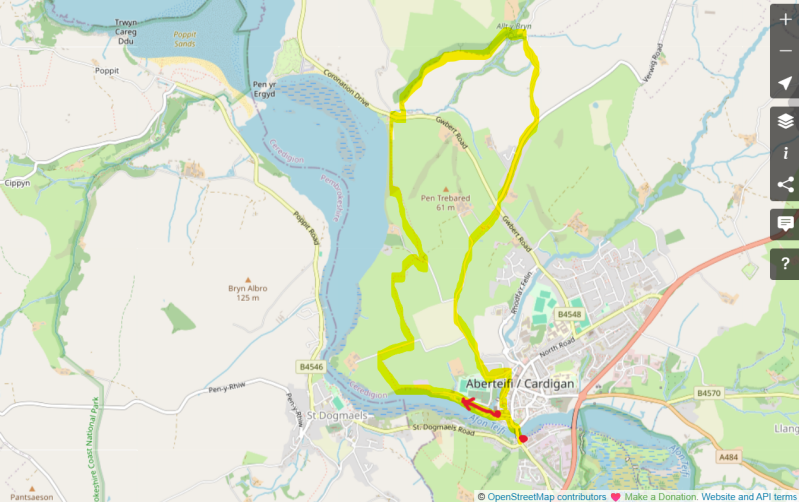
- From Quay Street car park, head toward the far end, towards the ‘ark’ looking boat, a floating restaurant called Shampam. You’ll spy signs here for the coastal path, up a path to the right in front of the restaurant’s deck.
- Follow along the road past the cottages at the riverside area along the River Teifi known as Netpool, the ship building capital of Wales two centuries ago.
- Moving swiftly past the town’s treatment works, the Coast Path enters woodland, and then through a metal gate into fields ahead. Walking is easy, paths are clear and well signposted.
- Join the lane at Old Castle Farm, site of the first castle on the River Teifi, built in the 11th Much later, the Old Castle Ferry used to cross a further downstream, to the Ferry Inn in St Dogmaels. Turn right up the lane, then turn left onto the first farm track.
- Pass through a gate into a field with views now of the Teifi Estuary towards Gwbert. Follow the hedge on the right, and then in the next field, follow its boundary gently uphill. Follow signs to drop down to another gate and cross a small footbridge to advance to the next field.
- Follow a distinct path around the field, ignoring the white post marker, a remnant of a now defunct route. Curve around the field quite a way – you’re looking for a metal kiss gate.
- Cross the lane of Bryn y Mor house, then follow footpath signs ahead. Eventually you’ll reach a boatyard, passing in front of it then round to the right to meet the main road (B4548). Our route is slightly to the right, but take some time to visit the area known as Patch to the left, in the direction of Gwbert.
- Turn right from the boatyard exit and follow the pavement for 25m. Look for a bridleway sign through a gap in the hedge. Cross carefully.
- This next bit feels like you’re invading the privacy of someone’s home, but it’s a public right of way! Pass through a wooden gate and walk straight ahead passing in front of the house, then up to another wooden gate over a bridge slightly to the left. Now bear to the right to pick up a grassy path that leads into woodland in front of a cottage. Now back to carefree walking!
- This shaded bridleway path runs gently uphill before levelling, and opening up to show views back across the fields towards the Teifi. It’s heading in the general direction of Ferwig.
- Eventually, leave the wooded bridleway at a metal gate onto a farm lane, there’s a house & outbuildings to the right. Continue down the lane away from the house. At the end of the lane, bear right, then uphill to join the Cardigan to Ferwig road. Turn right here in the direction of Cardigan. It’s not a busy road, but be aware of traffic.
- Reach a junction with a slightly wider road (Cardigan to Mwnt) and turn right to proceed gently downhill. There’s no pavement initially, but safe space to step away from the tarmac in case of traffic. Then a pavement on the other side of the road lower down.
- At the next junction cross the B4548 Cardigan to Gwbert road to a gravel farm track of Trabared Farm, running uphill in front of a house called Tegryn. This brings back memories of our school cross country route!
- At the top of the lane, there’s a house immediately in front of you, and to the side of it, a path to the left. It looks like there needs to be a footpath gate there, or a better sign to give us more of a clue!
- The short path along the boundary of the house does lead to a footpath gate, into a field. Continue straight ahead, following the field’s boundary hedge on the left. Join a track, and follow it into the next field. More great views of the Teifi from here as we head back towards the town.
- This farm track exits onto a lane. Follow it all the way back into Cardigan. Continue ahead until you reach Cardigan’s theatre, Theatr Mwldan.
- Turn right to proceed up the hill to reach the High Street. Turn right. Follow the High Street all the way to the Castle, Prince Charles Quay and the River Teifi.
- Take the footbridge across the river, and as soon as you land, cross the road to The Castle Inn.
Additional Notes
A castle, a cattle market, and a bridge between two counties
Cardigan Castle's decline had a very specific, very human shape to it, and Barbara Wood wasn't quite the isolated figure she can seem in the story's shorthand — the castle had passed through the Davies family from the mid-1830s until 1924, before being sold on to Barbara Wood's own family in 1940. She lived there for very nearly sixty years, initially with her mother.
Without the money or the will to maintain a medieval scheduled monument, the place fell into serious disrepair; by 1984 the house itself was formally declared unfit for human habitation, and rather than leave, Miss Wood moved into a caravan in the grounds and stayed there for over a decade, without electricity, gas or running water, refusing every offer of help that came with any loss of control over her own home.
She finally left for a nursing home in 1996, by which point the castle's outer walls needed steel props simply to keep from collapsing — the "ugly steel buttresses" that greeted every visitor crossing the bridge into town for the best part of thirty years. She died in that nursing home in 2009, aged 91.
The rescue began before she'd even left. Glen Johnson, a local schoolboy with a passion for the castle's history who'd met Barbara Wood in 1984, helped found the Cardigan Castle Volunteers the following year, in 1985 — long before he'd go on to become a respected local historian in his own right.
By 1999 the Cadwgan Building Preservation Trust had been formally established to fight for the site's future. The Tivy-Side Advertiser ran its own "Castle in Crisis" campaign in 2001 and gathered a 4,000-signature petition. Miss Wood put the castle up for private sale that same year, facing years of nursing costs with no other means to pay them; Ceredigion County Council bought it in 2003 — the same year it featured on the BBC's Restoration series — and leased it to the Trust, who oversaw a £12 million restoration funded substantially by the Heritage Lottery Fund, including one of the largest single HLF awards ever made in Wales.
Momentum built steadily rather than overnight: the Prince of Wales and Duchess of Cornwall visited in person in 2006 to lend their support, nearly a decade before the castle finally reopened to the public in 2015, complete with holiday accommodation, a heritage centre, a restaurant, and space for exactly the kind of civic and cultural life the town had been missing for a generation — appropriately enough, given the castle is also the site of the very first National Eisteddfod, held here in 1176.
The pub's own fortunes were tangled up with something far more mundane than a castle, but just as historically specific.
The Sunday Closing (Wales) Act 1881 shut every pub in Wales on the Sabbath. When it was finally repealed in 1961, individual counties and districts were left to hold their own referendums on whether to stay "dry" on Sundays or go "wet." Ceredigion held out longer than almost anywhere else in Britain, staying dry until 1989 — which meant that for well over a century, the short walk across Cardigan Bridge into Pembrokeshire was the only legal route to a Sunday pint for anyone drinking in the town.
Add in the passing trade of Cardigan's cattle mart next door, and the Castle Inn had two entirely artificial, entirely reliable sources of custom that had nothing to do with the pub itself. When Sunday closing ended and the mart later closed for good, both vanished within a few years of each other, and the pub's decline mirrored the castle's almost exactly.
The pub's revival, though, came from an entirely separate direction.
Where the castle was saved by a heritage trust and a county council, the Castle Inn's rescue arrived via private hospitality investment: Fforest, the outdoor-hospitality business founded by James Lynch and Sian Tucker, who left careers in London to buy a derelict farm at Cilgerran in 2004 and have since built it into a small local empire of glamping, restaurants and, more recently, proper hotels.
Their most striking piece of work is the Albion, opened across two Grade II-listed former quayside warehouses directly opposite the Castle Inn — buildings that had been, in their most recent working life, a tractor tyre-fitting garage, having once handled the cargo of Cardigan's own shipping trade.
The Albion takes its name, and its whole maritime design language, from the brig Albion, which sailed 27 families — around 180 people in total — from Cardigan to Saint John, New Brunswick in 1819, founding the first Welsh settlement in Canada; the hotel's third floor still carries original 19th-century pencil graffiti of tall ships, sketched by hands that may well have worked the same harbour.
Having transformed the warehouses, Fforest acquired the Castle Inn itself and restored it in the same spirit — an entirely unrelated act of restoration to the castle's, but one drawing on the same underlying appetite for sympathetic, historically-minded renewal, arriving from the opposite bank at roughly the same moment.
A note on Netpool
Passed early on during the walk, Netpool deserves a line of its own. Cardigan's shipbuilding industry was centred here from the late 18th century, and at its peak — the golden age ran roughly 1792 to 1866 — around 140 to 200 ships were built in local yards, part of a port so significant that in 1815 alone 314 vessels were registered here, seven times as many as Cardiff and three times as many as Swansea.
Silting up of the River Teifi and the arrival of the railway in 1886 - Station Road is behind The Castle Inn - finished the trade within twenty years; by the early 20th century Netpool, once loud with shipwrights and ropemakers, had already become simply a pleasant place to walk.
Other Pubs to try in Pembrokeshire
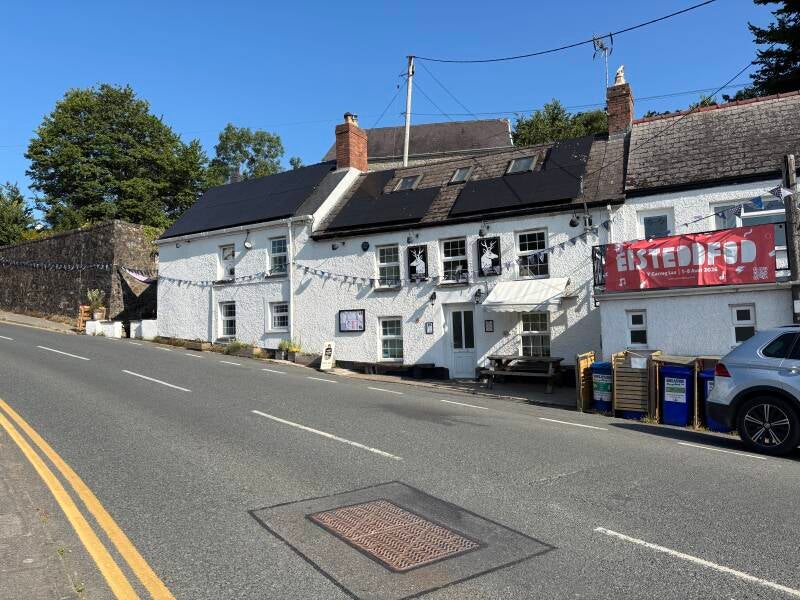
Tour of St Dogmaels Abbey, village & Poppit Sands-Pembs National Park
6.2 miles
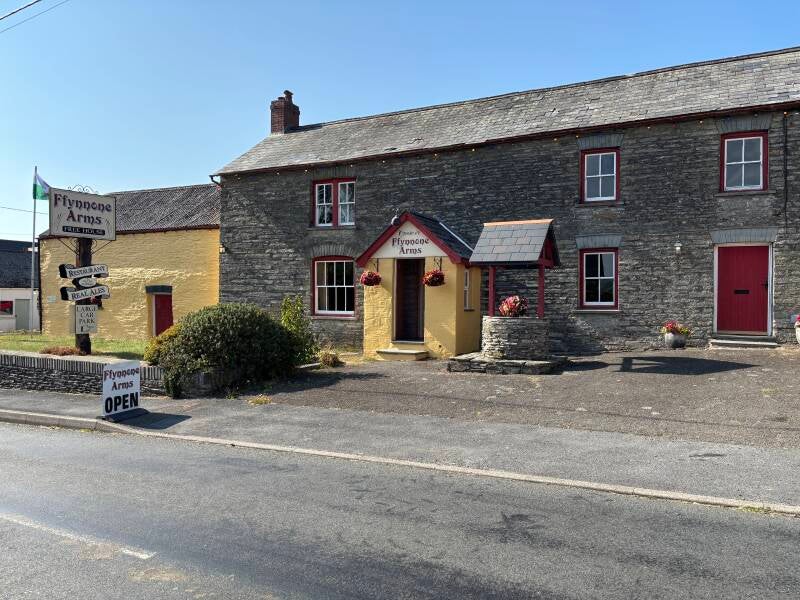
Ffynone Falls, Celtic mythology and a link to Buckingham Palace in Newchapel
5 miles
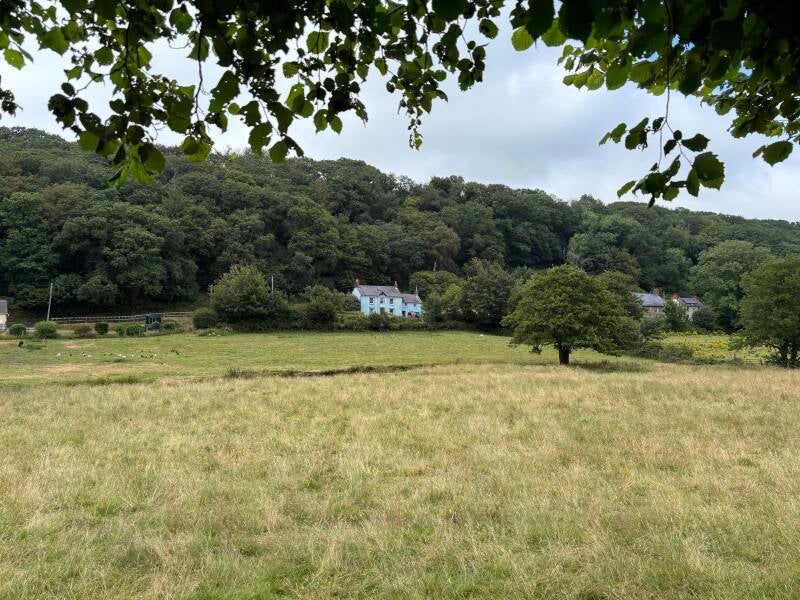
Gwaun Valley woods and fields around Pontfaen, on the way to Bessies.
3.3 miles