

The Carew Arms, Crowcombe
The Walk: The Carews, Deer and Dead Woman's Ditch: Quantock Tales from Crowcombe, 5.3 miles
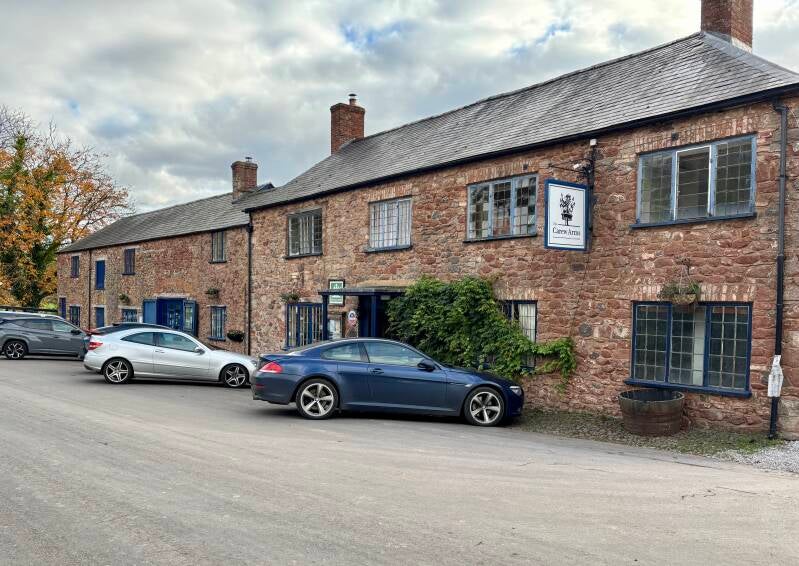
Try this Pub & Walk
Many Somerset villages have a fine church. Others have a notable manor house, an ancient monument or a good pub. I suspect few can match Crowcombe for the sheer concentration of history packed into one small corner of Somerset, or indeed one end of a village street.
The village sits beneath the Quantock Hills, yet its story reaches far beyond them. The Carew Arms takes its name from the Carew family, a powerful landowning dynasty whose origins can be traced to Carew Castle in Pembrokeshire, one of the great castles of medieval Wales. Through marriage, inheritance and ambition, the family came to dominate Crowcombe, leaving their mark on the church, manor, estate and ultimately the village inn itself.
The walk climbs quickly from the village into classic Quantock scenery, visiting Hurley Beacon, Black Hill, Wilmot's Pool and Dead Woman's Ditch before returning through a remarkable collection of historic buildings that includes one of Somerset's finest churches, a sixteenth-century church house, ancient crosses, a medieval pound and the magnificent Crowcombe Court.
Waiting at the finish is The Carew Arms, a pub that remains deeply woven into village life, serving local Black Bear ales, excellent food and one of the warmest welcomes on the Quantocks.
About The Carew Arms, Crowcombe


Last visit: November 2026
I first visited The Carew Arms because the name caught my attention. Having grown up in West Wales, and with my best man living in the Pembrokeshire village of Carew, I knew there was likely to be a story behind it. What I didn't appreciate at the time was quite how closely the threads would connect.
The inn takes its name from the Carew family, whose origins can be traced to the village and castle of the same name in Pembrokeshire. The family acquired the Crowcombe estate through marriage in the 16th century and went on to shape the village for centuries, leaving their mark on Crowcombe Court, the Church of the Holy Ghost and ultimately the village pub itself. The inn had previously been known as The Three Lions before becoming The Carew Arms in 1824.
So I arrived half-expecting a special welcome for the Welsh. Instead, I discovered something better. This is a pub that seems to offer a welcome to everyone. And a space for everyone too.
In many ways, a feeling of belonging is the first thing you notice about the place.
Many visitors will walk through the front door, stick their head round the first door - the public bar off to the left, recognise it as the locals' space, and then head on to find a spot elsewhere.
That public bar is clearly the social heart of the building for this community. Not because it is exclusive or unwelcoming, quite the opposite, but because it is obviously already occupied by people who belong there. I got the sense that some of the conversations taking place in that room have been continuing for generations. Farmers, tradesmen, neighbours and work colleagues whose parents and grandparents knew one another before them. A congregation that gathers together more naturally here than at the Church of the Holy Ghost round the corner.
The more I explored, the more the pub revealed itself.
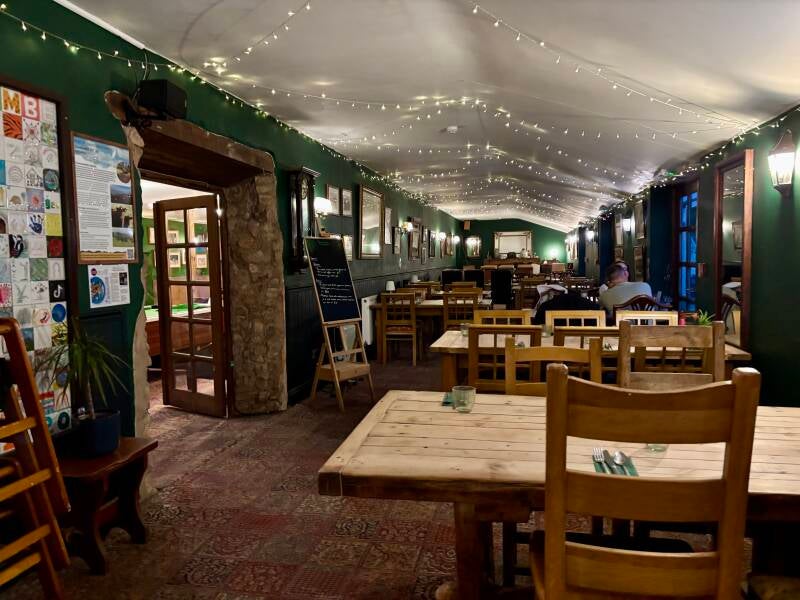
There are dining rooms tucked into what looks like stable stalls, complete with leather saddles hanging over the rails. A private dining room that I'd happily book for a special occasion. A long dining space that hints at just how busy this place must become. A skittle alley and darts area. Church pew seating beside a piano. Outdoor tables. Accommodation. Every space seems to have found a purpose and none of it feels contrived.
The phrase I kept coming back to during my visits was simply: "something for everyone".
The Carew Arms manages to cater for locals, walkers, diners, families and overnight guests without losing its identity as a village pub. The variety of spaces inside mirrors the menu, which offers a wide choice of food at sensible prices rather than chasing the latest dining trends. It feels confident in what it is, and that confidence is one of its greatest strengths.
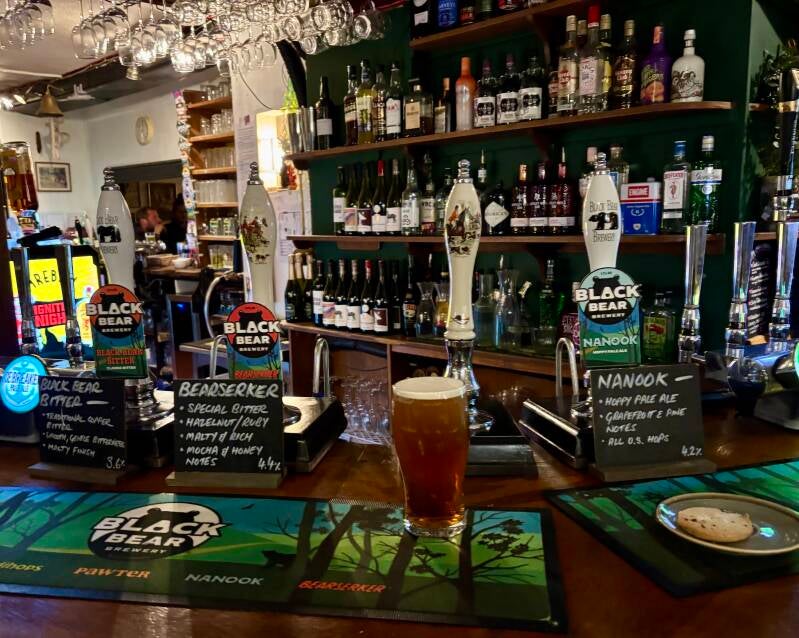
The beer deserves a mention too. The pumps are devoted to Black Bear Brewery of nearby Wiveliscombe, one of Somerset's best small breweries. I always enjoy finding pubs that make a point of supporting local brewers, and here it feels entirely in keeping with the character of this place.
I noticed that some online reviewers have occasionally described the pub as dated. I understand what they mean. But this is also a pub recognised for its historic interior, with flagstone floors, traditional room divisions and features that have survived precisely because generations of landlords resisted the temptation to modernise everything beyond recognition. There is a difference between tired and historic. The Carew sits firmly on the historic side of that line.
By the time I leave, I'm always reminded that the best pubs aren't necessarily the smartest, trendiest or most fashionable. They're the ones that remain connected to the communities around them. In Pembrokeshire they might say something like: Gan y gymuned i'r gymuned - by the community, for the community.
The Carew Arms feels exactly that sort of pub.
A place where walkers, visitors and villagers can all find their own corner, while the community life of the village quietly carries on around them.
Pub Key Information
| WEBSITE | https://www.thecarewarms.co.uk/ |
| ADDRESS | The Carew Arms, Crowcombe, near Taunton, TA4 4AD |
| PHONE | 01984 618 631 |
| WHAT3WORDS | ///zinc.nothing.cried |
| PARKING | At the front or rear of the pub. |
| LOCATION | On the slopes of the Quantock Hills, off the A358 Taunton to Minehead road. |
| HANDY FOR | The Quantocks; Exmoor; Somerset Coast; West Somerset Railway. |
Walk Overview
This rewarding circular route combines some of the best walking on the Quantock Hills with one of the most historically fascinating villages in Somerset.
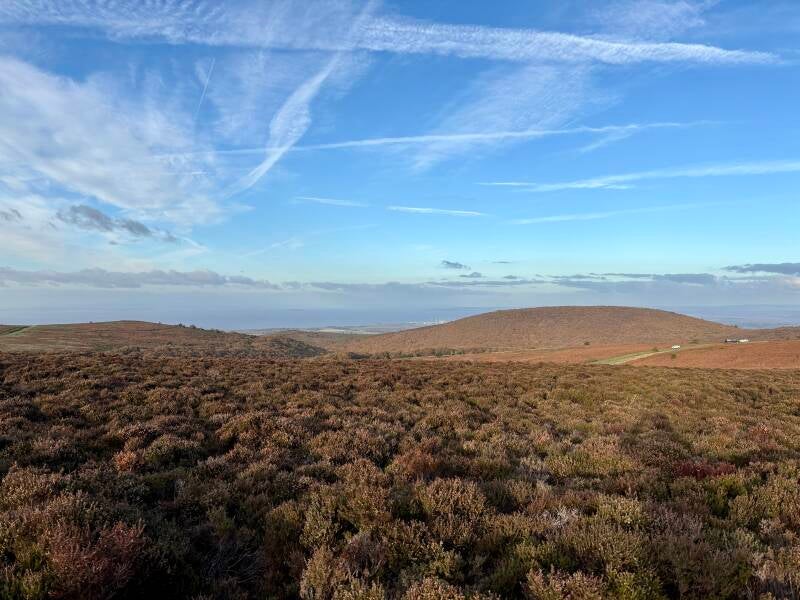
Leaving Crowcombe, the route climbs through fields above the village steadily towards open moorland, where huge views stretch across West Somerset towards Exmoor, the Brendon Hills and the Bristol Channel. Hurley Beacon, Black Hill, Wilmot's Pool and Dead Woman's Ditch all feature along the way, while red deer are often seen amongst the heather, woodland and combes.
The return is equally rewarding. As the Quantocks fall away behind you, Crowcombe reveals itself as far more than a picturesque village. Within a few hundred yards lie monuments to centuries of wealth, faith, landownership and community life, culminating in a visit to one of Somerset's most characterful pubs.





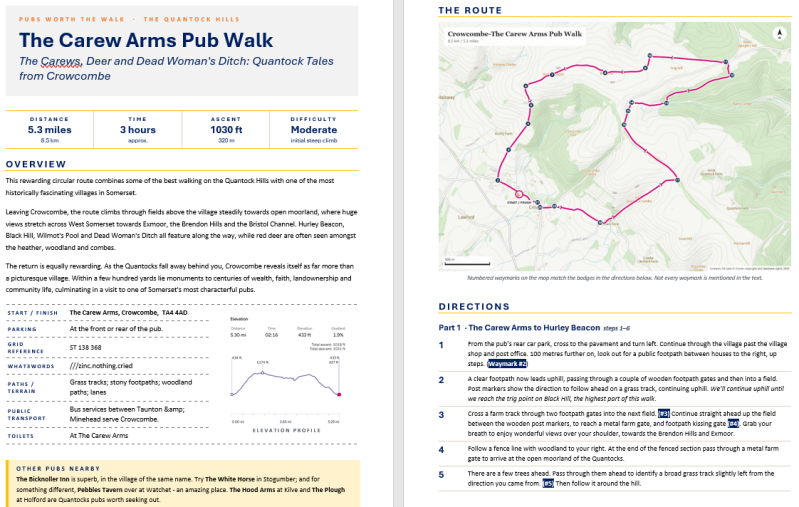
Walk Key Information
| START/FINISH | The Carew Arms, Crowcombe, near Taunton, TA4 4AD |
| PARKING | At the front or rear of the pub. |
| GRID REFERENCE | ST 138 368 |
| WHAT3WORDS | ///zinc.nothing.cried |
| DISTANCE/TIME | 5.3 miles / 8.5 km; approx 3 hours |
| ASCENT | 1030 feet / 320 metres |
| PATHS/TERRAIN | Grass tracks; stony footpaths; woodland paths; lanes |
| DIFFICULTY | Moderate - long ascent to Hurley Beacon. |
| PUBLIC TRANSPORT | Bus services between Taunton & Minehead serve Crowcombe. |
| TOILETS | At pub. |
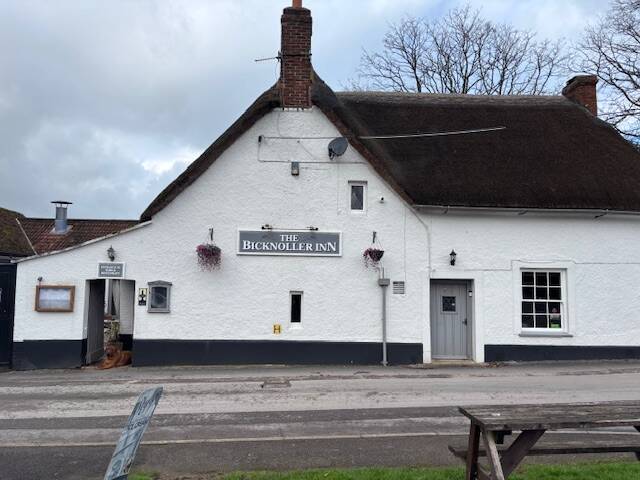
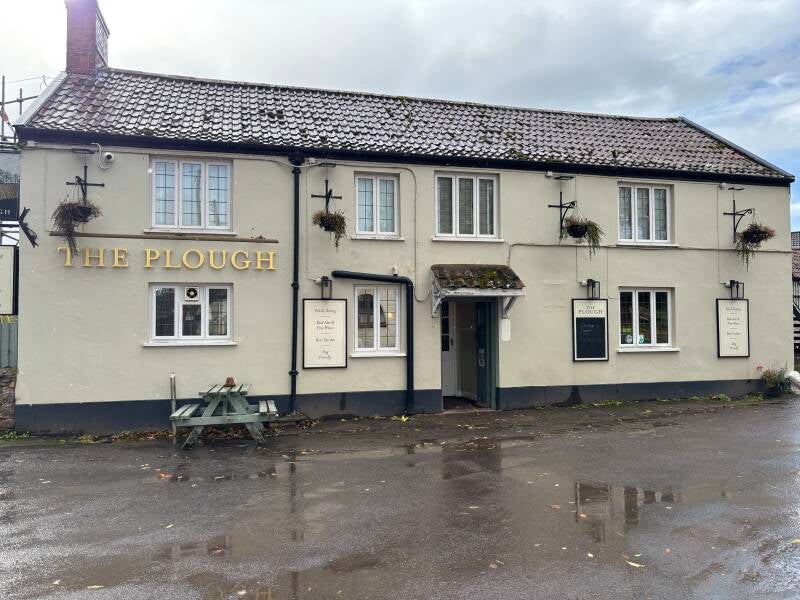
| OTHER PUBS TO VISIT | The Bicknoller Inn is superb. Try The White Horse in Stogumber; and for something different, Pebbles Tavern over at Watchet - an amazing place. The Hood Arms at Kilve and The Plough at Holford are Quantocks pubs worth seeking out. |
Walk Instructions: Choose what works for you
There are multiple ways to consume the route described below.
- Either follow the online Walk Directions below, or download and print a copy of the route.
- If you have the OS Maps App, you can follow a saved route directly in the OS App.
- Or download the GPX file for use with your chosen GPS-based tracker App, like Strava. Upload the file when you Create a New Route in the App.
Walk Directions
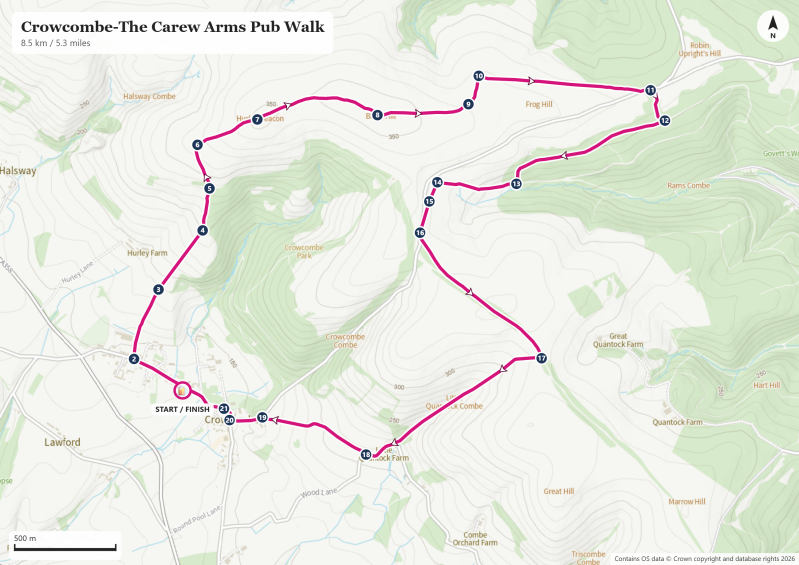
- From the pub’s rear car park, cross to the pavement and turn left. Continue through the village past the village shop and post office.
- 100 metres further on, look out for a public footpath between houses to the right, up steps. (Waymark #2)
- A clear footpath now leads uphill, passing through a couple of wooden footpath gates and then into a field. Post markers show the direction to follow ahead on a grass track, continuing uphill. We’ll continue uphill until we reach the trig point on Black Hill, the highest part of this walk.
- Cross a farm track through two footpath gates into the next field. (#3) Continue straight ahead up the field between the wooden post markers, to reach a metal farm gate, and footpath kissing gate (#4). Grab your breath to enjoy wonderful views over your shoulder, towards the Brendon Hills and Exmoor.
- Follow a fence line with woodland to your right. At the end of the fenced section pass through a metal farm gate to arrive at the open moorland of the Quantocks.
- There are a few trees ahead. Pass through them ahead to identify a broad grass track slightly left from the direction you came from. (#5) Then follow it around the hill.
- At a path crossroads, (#6) turn right onto a clear grassy track that advances more directly uphill towards one of the two peaks on this walk. Continue until you reach the rocky crest of Hurley Beacon. There are over 100 monuments like this across the Quantocks. (#7)
- Continue straight ahead towards a gate ahead of you. As you continue , the full expanse of the Quantocks, and the Somerset Coast opens out in front of you. The scale of the Hinkley Point Nuclear Plant is obvious from here too. Cross the stile by the Hurley Beacon information board and carry on ahead, crossing straight over a broad gravel track (it’s the Macmillan Way, one of the main routes across the top of the hills).
- Continue ahead towards the trig point of Black Hill that will soon become visible in front of you (#8) and then bear slightly left of it to take a green track towards Wilmot's Pool (#9).
- Follow a track to the left of the pool until you reach a rutted vehicle access track which leads up to the road to the right. There’s rough grassy parking to the left. This is a parking area called Wilmot’s Pool or Withyman’s Pool, popular on Autumn days like this for spotting the Red Deer rut. Go straight across this rough access track and pick up a broad footpath heading off slightly to the right, at an angle from the vehicular route. (#10) If you’re familiar with this area, we’re heading in the direction of the car park at Dead Woman’s Ditch, an ancient earthwork that is often (incorrectly) associated with the murder of Jane Walford by her husband in 1789.
- Continue straight ahead on this level, easy footpath, keeping your eyes peeled for red deer in the undergrowth. A squadron of Redwing took to the air for me – they seem to love the holly berries on the Quantocks. Proceed to the road and cross to the Dead Woman’s Ditch car park (#11).
- As you enter the car park, follow its right-hand boundary along the tree line into the woods – the ditch of Dead Woman fame runs along this right-hand boundary. It’s visibly unremarkable if you ask me!
- A broad trail opens up in the trees, and sweeps to the left where there’s a distinct gap in the beech bank ahead. Pass through the gap, and turn right (#12) to follow a clear trail with the beech bank on your right and a fenced-off fir tree forest to the left. Follow this wonderful woodland walk, watching for deer still – I saw a number of female red deer here – as it eventually turns sharp left and drops down to a forestry gate. (#13)
- Here, turn right to walk away from the gate into an open green space through a gap in the beech bank, to follow a distinct route that soon starts to head uphill, gently at first and then more steeply as it heads towards the (Dead Woman’s Ditch/Crowcombe Gate) road at the top. The road is the only route that crosses the Quantocks and can be busy with local traffic at the start and end of the day, and at weekends too.
- As you approach the road, (#14) follow a grass track curving to the left. The target is Crowcombe Combe Gate. You’ll recognise it as the point where the traffic seems to leave the open common land and head back to beech trees and hedges as it prepares to head down the combe to the village.
- Very briefly join the road (#16) and immediately go left away from the road again, passing a wooden field gate. You’ll see bridleway signs for Triscombe – continue on the obvious broad avenue ahead in that direction on a wooded track, initially muddy, with beech banks on either side.
- Eventually a gap appears to the right in the beech bank (#17). Pass through a footpath gate into an area of moorland. Go slightly right in the direction of the telegraph poles and make your way down Little Quantock Combe, soon following the right-hand boundary hedge all the way to the bottom.
- Pass through metal gates into the farmyard of Little Quantock Farm, and continue straight ahead to join a lane. Bear right on the lane (#18) to pass the farm. Round a corner and where the road forks off to the left, continue straight ahead.
- The lane is quiet and narrow, and eventually drops down steeply to meet the lower part of Crowcombe Combe. At the junction, (#19) turn left to navigate the final 200m downhill along the combe road – take immense care here as traffic comes down the steep hill quickly.
- When you reach the bottom in Crowcombe, turn right past Glebe House. (#20)
- This is an ancient part of Crowcombe, with the outstanding, medieval Church of the Holy Ghost, the 16th Century Crowcombe Church House (an ale house and brewery!) and stately home of Crowcombe Court to be found here. The old village Pound too (#21).
- Continue along the road carefully into the village along a wall, then drop onto a footpath to your left that provides safety from the traffic before the approach to The Carew Arms.
Additional Notes
Crowcombe: The Carews, Crowcombe Court and a Village of Unusual Importance
Crowcombe's church, manor house, church house and inn are not separate stories. They are chapters of the same one.
At the centre of that story stands the Carew family.
Today their name survives most visibly above the door of the village pub, but the family's influence extends across almost every significant historic building in Crowcombe.
Their origins lie not in Somerset but in Pembrokeshire, where the family took its name from the village and castle of Carew, one of the most impressive medieval strongholds in Wales. The family traces its descent through the lineage of Gerald de Windsor and the Welsh princess Nest ferch Rhys, figures whose descendants became prominent landowners across Wales, south-west England and Ireland.
The Somerset branch arrived in Crowcombe through marriage. In 1568, Thomas Carew acquired the manor through his wife, Elizabeth Biccombe, heiress of the local manorial family. From that point onward, the Carews became the dominant influence on village life for centuries.
The Church of the Holy Ghost
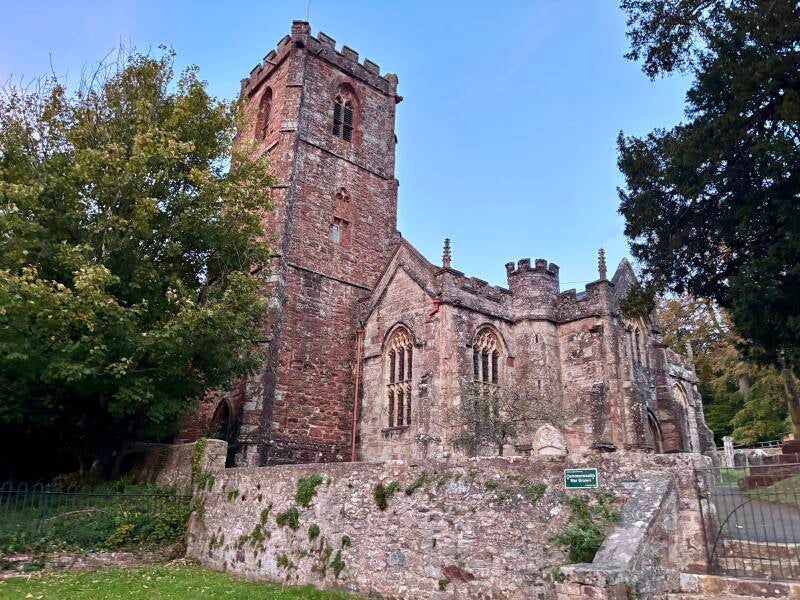
The Church of the Holy Ghost is among the finest parish churches in Somerset.
Its unusual dedication is notable, maybe even unique, but the building itself is even more remarkable. Parts date from the fourteenth century. Architectural historian Nikolaus Pevsner described the south aisle as "sumptuous", while Historic England highlights one of the finest collections of bench ends in the county. The church also contains an outstanding medieval font and an early eighteenth-century screen.
More importantly for understanding Crowcombe, the church is filled with evidence of the Carews. A private Carew chapel was added in the seventeenth century and remains connected to the family. Family monuments, heraldry, hatchments and memorials reveal both their status and their long association with the village.
This was not merely the parish church. It was the spiritual heart of an estate community shaped by one family for generations.
Crowcombe Court
The grandeur of the church is matched by Crowcombe Court next door.
A manor existed here from at least the late thirteenth century, but the present house is largely the creation of the Carews' ambition during the Georgian period. After inheriting the estate in 1719, Thomas Carew demolished the old manor and embarked on an extraordinary rebuilding project. The resulting house, completed in 1739, was designed by Nathaniel Ireson and funded through the sale of six manors.
This was no modest country residence. Crowcombe Court was conceived as a statement of wealth and status, surrounded by formal gardens, terraces, pleasure grounds and landscaped parkland. Archaeological investigations have recently rediscovered elements of these lost gardens, including pavilions, walls and evidence of elaborate eighteenth-century design.
Its architectural significance is considerable. Nikolaus Pevsner described Crowcombe Court as "the finest house of its date in Somerset south of the Bath area."
That is not praise he dispensed lightly apparently.
The Church House
Standing across the road from the church is another clue to Crowcombe's former importance. The sixteenth-century Church House served as a focal point for community life and parish administration and was historically associated with brewing and the sale of ale to raise church funds.
Long before walkers were returning to the Carew Arms for a pint, ale was already helping support the life of the parish.
Pub, Church and Manor
What makes Crowcombe special is the way these stories remain connected.
Many villages preserve fragments of their past. Crowcombe preserves a system.
Walk through the village and it is still possible to understand how power, faith, farming, hospitality and community life once worked together. Few places tell that story so clearly, and fewer still have a pub quite so perfectly placed from which to explore it.
Other Pubs to Try Nearby
Discover the Quantocks on this fine circular walk from Bicknoller.
7 miles
Red Deer (maybe), Wooded Combes & Wordsworth - A Quantocks Shortcut
4.5 miles
Dunster to Watchet walk along the King Charles III Coast Path on a cider hunt.
5.7 miles