

The Ring of Bells, Cheriton Fitzpaine
Time-travelling in Devon - a pub walk around Cheriton Fitzpaine, 4.6 miles

Try this Pub & Walk
For me, this was a walk that only came alive once I started reading the OS map as part of the landscape. The lanes are gentle, the fields are quiet — but the names on the map are a thousand years old, and once you start joining the dots, the once isolated and self-sufficient Devon village of Cheriton Fitzpaine becomes a place you can time‑travel through.
It was the ‘Fitzpaine’ suffix that first set me off. The Greyhound at Staple Fitzpaine appears in the Somerset section of this site, and the name is a clue that this tucked‑away village once belonged to a Norman family whose presence still clings to the place.
And then there’s The Ring of Bells — a 17th‑century thatched house turned award‑winning village pub, sitting right in the medieval core beside the church, the Almshouses and the old thatched school.
The current owners have transformed it into a contemporary destination without losing the feel of a proper pub, and it’s the sort of place you’re genuinely pleased to end up in after a wander.
In truth, the walk the pub promotes on its website is a little too country lane‑heavy for my taste, but that’s exactly what made it interesting: it became an opportunity to learn how to read the history of this fascinating place through the map.
Once you start spotting the clues — Barton names, watercourses, mill sites, ancient lanes — the whole village opens up to you. What begins as a simple leg‑stretch before a good lunch became a quietly rewarding two‑hour ramble through a thousand years of settlement, ending with a pint in one of Devon’s most characterful pubs.
About The Ring of Bells, Cheriton Fitzpaine


Last visit: June 2026
I loved this place. The Ring of Bells sits exactly where a village pub ought to sit: in the ancient part of Cheriton Fitzpaine, pressed up against the churchyard wall, with the Almshouses and the old thatched school just a few steps away.
This is the medieval core of the village — the place where the narrow lanes converged, where the bells peeled the rhythm of each day. The pub occupies a long, low, 17th‑century thatched house, now Grade II listed, and it still feels like the natural gathering point of the village.
Step inside and you find a pub that has managed something rare: it’s both a proper village local and a modern destination. The building’s age is unmistakable — thick walls, beams, the sense of rooms flowing into each other over centuries — but the atmosphere is bright, confident and contemporary.
The current owners have created something special here, and the result is a pub that appears in all the right guides for all the right reasons. It’s the sort of spot where you can drop in muddy‑booted for a pint, or book a table for a long, celebratory lunch, and both feel entirely natural.
It’s no surprise the Ring of Bells has collected awards and glowing write‑ups in the Guides next to my table; what’s more impressive is that the pub still feels totally rooted in this village. And you’re made to feel part of the family.
And that’s the pleasure here. You finish your walk — a quiet, map‑led ramble through a thousand years of settlement — and return to a pub that has been part of the village story for at least 150 years, in a building that has stood for more than 300.
The Ring of Bells is not just a good pub in a pretty village. It’s the living heart of Cheriton Fitzpaine.
Pub Key Information
| WEBSITE | https://www.theringofbells.com/ |
| ADDRESS | The Hayes, Cheriton Fitzpaine, EX17 4JG |
| PHONE | 01363 860111 |
| WHAT3WORDS | ///cashiers.atom.donation |
| PARKING | No dedicated car park. The Hayes is a narrow lane. Find safe, courteous street-side parking where you can! |
| LOCATION | In East Devon, the village sits above the A3072 connecting Tiverton and Crediton. |
| HANDY FOR | Exe Valley |
Walk Overview
This is a gentle, mostly lane‑based loop that becomes far more interesting once you start reading the village and landscape through the OS map.
The route leaves the medieval core of Cheriton Fitzpaine, slips past Poole Barton and its fields, and wanders through quiet Devon lanes, orchards and small hamlets before returning to the village.
It’s not a dramatic walk, but it’s a revealing one: a chance to notice how watercourses, field boundaries, old farmsteads and ancient lanes still shape this once isolated and self‑sufficient village.
Think of it as a slow, pre-lunch two‑hour ramble through the clues that made Cheriton Fitzpaine what it is.


Walk Key Information
| START/FINISH | The Ring of Bells, The Hayes, Cheriton Fitzpaine, EX17 4JG. 01363 860111 |
| PARKING | No dedicated car park. The Hayes is a narrow lane. Find safe, courteous street-side parking where you can! |
| GRID REFERENCE | SS 867 061 |
| WHAT3WORDS | ///cashiers.atom.donation |
| DISTANCE/TIME | 4.6 miles / 7.4 km; approx 2.5 hours |
| ASCENT | 705 feet / 220 metres |
| PATHS/TERRAIN | Mostly very quiet tarmac lanes in a farming area. Some fields and farm tracks. |
| DIFFICULTY | Easy |
| PUBLIC TRANSPORT | The village is surprisingly well served with a number of bus services running between Tiverton, Crediton, Witheridge and Exeter all passing through the village. |
| TOILETS | At The Ring of Bells |
| OTHER PUBS TO VISIT | The Half Moon, also in Cheriton Fitzpaine, has an historic pub interior. The next pub to visit when I’m next in this area is Cadeleigh Arms, a Community Owned pub in the village of Cadeleigh. |
Walk Instructions: Choose what works for you
There are multiple ways to consume the route described below.
- Either follow the online Walk Directions below, or download and print a copy of the route.
- If you have the OS Maps App, you can follow a saved route directly in the OS App.
- Or download the GPX file for use with your chosen GPS-based tracker App, like Strava. Upload the file when you Create a New Route in the App.

Walk Directions
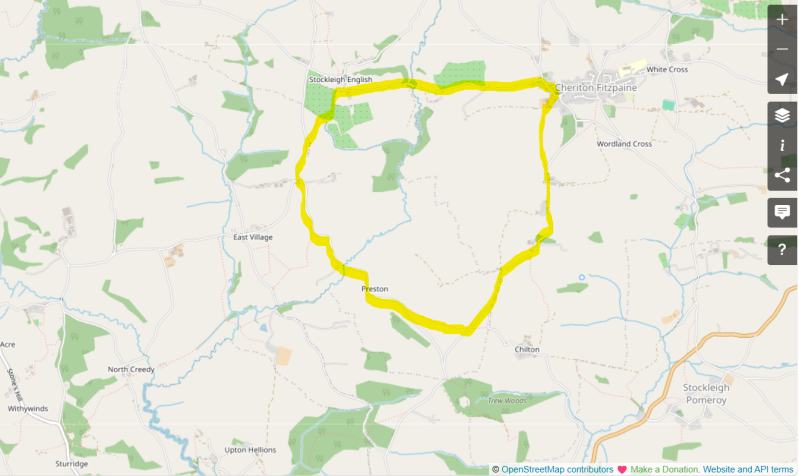
- Leaving the Ring of Bells, turn right, slightly uphill, passing Scut’s 1717 Almshouses and the old thatched school. At the school, turn right towards St Matthew’s Church. Just beyond the church entrance, look for the waymarked footpath across the road, guiding you left through the farmyard of Poole Barton. It was wonderful to see the lime render being refurbished on this Grade II listed manor, one of the most significant buildings in the village. Notice the old horse‑mount at the front gate.
- Enter the farmyard and follow the footpath sign through a gate into the field ahead. This is a stock field, with an electric fence keeping walkers and livestock apart. When I visited, the fence sat rather close to the hedge, making it something of a squeeze — I slipped underneath it when required.
- At the top of the field, a kissing gate leads into a series of fields. Aim for the farm gate in the top‑left corner. The first field had been left to grass (wet boots on a sunny morning after rain); the next was under crops. The route is waymarked.
- Go through the gate to join a quiet lane, descending past Poole Cottage. This lane undulates gently — Perry Hill, Dover’s Hill, Farringdon Hill — and you follow it for roughly a mile.
- The lane winds between fields with few dwellings, though you’ll spot a “Grand Designs”‑style project at one corner. Shortly after this, ignore a left‑hand fork and continue right. Soon afterwards, look for footpath markers leading into fields on both sides of the lane.
- Take the right‑hand path into an arable field, keeping the boundary hedge on your right. This is where the route deviates from the pub’s suggested walk, cutting out several miles of tarmac and shortening the loop by around three miles. When I visited, the field had been ploughed and planted close to the margins, making the grassy footpath a little uneven underfoot.
- Go through a farm gate to join Preston Lane, turning right towards the hamlet of Preston. Pass a small stables, noting the modern-day pallet-based take on a horse mount. After about a mile, reach a junction at East Village and turn right, signposted Cheriton Fitzpaine.
- After a short uphill stretch, pass Forge Garage and a small cluster of houses. Immediately after the last house, take the footpath on the right through a farm gate into a field. Cross diagonally to the gate opposite; as you go, you’ll see further footpath gates in the distance — these are your next targets.
- The next field is partly arable. The stile lies directly across the planted area; follow the field boundary to reach it.
- Enter a commercial orchard and keep right, walking past the “columns” of apple trees until you reach Column A, where a gravel track leads uphill. Follow this track until it meets a lane in the hamlet of Stockleigh English.
- St Mary’s Church is just to the left, with origins in the 1300s and later memorials to the Bellew family, who owned Stockleigh Court in the 1700s.
Additional Notes
Reading Cheriton Fitzpaine
I didn't arrive here intending to do any historical detective work.
It began with a simple curiosity: the cluster of ancient buildings pressed together around the slightly raised ground at the heart of the village. The church sits on the high spot, as churches tend to, and gathered around it are the almshouses, the old thatched school, the manor houses and the lanes that have converged here for centuries.
It felt like the old centre of something — and the OS map confirmed it.
The name had already caught my attention. Fitzpaine isn't a common village suffix, and I'd encountered it before without pausing to think about what it meant — I'd written an entry for The Greyhound at Staple Fitzpaine in Somerset, another village carrying the same Norman family name. Seeing it again made me look more closely.
Fitz comes from the Norman fils — son of — a naming pattern brought over after 1066. FitzPayn simply means son of Payn, a Norman family who held land across the West Country in the centuries after the Conquest. When a village carries a family's name, it usually means they were the medieval lords of the manor. The name is the first clue, and once you've spotted it, the rest starts to follow.
The Barton names on the map were next.
Cheriton Barton, Poole Barton — Barton comes from the Old English bere-tun, barley enclosure, and by the medieval period it meant the home farm of the manor. Not decorative names, in other words, but working ones: the places where the FitzPayns' land was farmed, stored and managed. Once you know to look for them, they mark the manorial economy as clearly as any document.
Then the water: Holly Water runs around the village, and the map is dotted with names that hint at what once stood beside it — Waterhouse Cross, Cheriton Mill Cross, Pool Wood. The remnants of a water-powered landscape, mill leats and managed flows feeding the same economy, most of it invisible on the ground now but preserved in the names as faithfully as if someone had written it down.
What struck me most, though, was the density of Cross-names within a mile of the village — Tower Hill Cross, Chapel Hill Cross, Rectory Hill Cross, White Cross, Wordland Cross, and more. These mark the old road network: the lanes that pre-date enclosure, pre-date printed maps, and in some cases pre-date the Norman Conquest itself. Walk them and you feel their age — narrow, sunken in places, oddly indirect in a way that I suppose lanes shaped by the medieval landscape must have been.
And then you come back to the Ring of Bells.
Sitting in the pub with a pint after the walk, I skimmed a copy of Cheriton Fitzpaine: A Sense of Community by Elly Babbedge, which was on the shelf. It filled in some of the human detail: Thomas Reynold in the 16th century, a Catholic who promoted tolerance and education during the Reformation; John Harris in the 17th, the Lord of the Manor who donated buildings to house the poor and created income to support them. Their names don't appear on the OS map, but their instincts explain something about why the village still feels as it does — cared for, coherent, a place with a long moral memory.
The pub's address is The Hayes.
It comes from the Old English hæg — a hedged or enclosed piece of land — and it tends to survive only where the earliest field boundaries have stayed put.
A reminder, if it wasn't already clear, that the lanes around the Ring of Bells are old, and that the pub sits exactly where the oldest part of the village has always been. Not an add-on to the walk. The natural end point of the story the map tells.
Other Pubs to Try in Devon

Fingle Bridge, Teign Gorge & Castle Drogo on the edge of Dartmoor.
5.8 miles
From Saunton Sands to Baggy Point & back via The Thatch and Saunton Down.
7.9 miles
