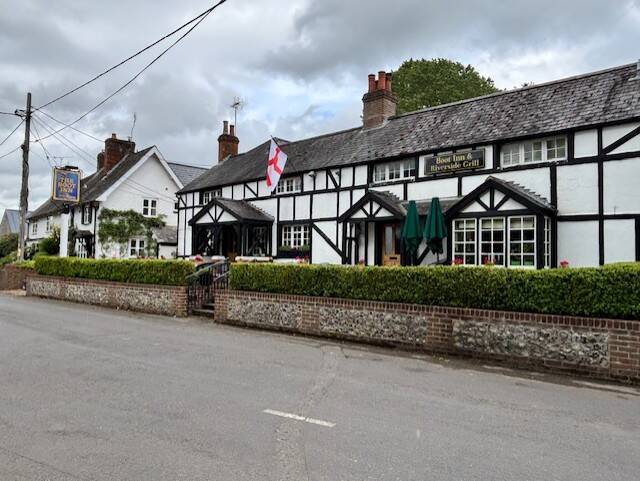
The Three Cups Inn, Stockbridge
Wonderful River Test pub walk around Stockbridge Common Marsh, 2.5 miles

Try this Pub & Walk
Leaving The Three Cups Inn on Stockbridge High Street for this easy walk, it takes only a matter of minutes before the town dissolves into water meadows, reed beds and the quietly moving channels of Hampshire's famous River Test.
That transition is part of what makes Stockbridge so special.
Few places in England allow you to step so quickly from the warmth of an old inn into one of the country’s most celebrated and carefully protected river landscapes. The National Trust’s Stockbridge Common Marsh provides rare public access to the floodplain of the River Test — a chalk stream internationally admired for its crystal-clear water, wild trout and extraordinary ecology.
The walking itself is beautifully gentle throughout. Flat grassy paths drift through open grazing marsh beneath enormous Hampshire skies, while clear carriers and side-streams slide silently through reeds and sedge beside the route. Brown trout hover almost motionless in the current. Swans move lazily along the channels. In spring and summer, kingfishers flash low across the water while warblers chatter unseen from deep within the reeds.
What makes the route particularly memorable, however, is not drama or difficulty but proximity.
Much of the River Test remains hidden behind private fishing beats and country estates, making direct access surprisingly rare. Here, walkers can simply stand beside the water and watch one of England’s most famous rivers move quietly through the valley at its own unhurried pace.
And throughout it all, Stockbridge never feels separate from the landscape around it.
The River Test does not merely pass the town by; it flows through its identity entirely. Small carriers weave behind cottages, gardens, pubs and old High Street buildings, including a charming stream running directly through the garden of The Three Cups itself.
This is not wild or heroic walking.
It is something arguably rarer now: a deeply civilised wander through one of England’s most precious river landscapes, beginning and ending beside the beams, fires and easy atmosphere of a proper old Hampshire inn.
About The Three Cups Inn, Stockbridge


Last visit: May 2026
At first glance, The Three Cups Inn looks exactly as a great Hampshire inn should.
Sitting proudly on the High Street in Stockbridge, beneath centuries-old timbers and surrounded by independent shops, galleries and fishing outfitters, it immediately feels part of the fabric of the town rather than a polished imitation of it. And in many ways, it sits at the very centre of what makes Stockbridge so unusual.
Because this is not simply a village pub.
Stockbridge is one of the world’s great fly-fishing destinations.
That fact initially sounds faintly absurd until you spend time here. Then you begin to understand the almost mythical status of the River Test and the chalk streams that define this valley. Anglers travel from across Britain, Europe and North America to fish these waters, drawn by the extraordinary clarity of the river, the history of dry-fly fishing pioneered here, and the careful environmental stewardship required to preserve such a delicate ecosystem.
And when those anglers arrive, they don’t just visit the river. They inhabit Stockbridge itself.
Its pubs, hotels and inns seem to have become part of the wider experience and tradition surrounding the Test. You can imagine how each has evolved its own distinct identity over decades (and centuries). The Grosvenor Hotel has become a beautifully refined hotel destination. The Greyhound on the Test enjoys an excellent culinary reputation. The White Hart carries the atmosphere of an old coaching inn now comfortably settled within the Fuller's family.
But The Three Cups Inn somehow combines the best qualities of them all.
Dating back to the 15th century, the inn manages to feel simultaneously historic, welcoming, characterful and deeply lived-in. On my visit, local Young Farmers gathered around the bar while visitors drifted in from riverside walks and fishing excursions. Conversations moved easily between locals, regulars and travellers.
At one point I found myself chatting with a retired couple from New York State who had travelled specifically to experience fly fishing on the River Test. They spoke with remarkable detail and enthusiasm about the river’s global reputation, the ecological management of the chalk streams and the unique opportunity to learn from local guides using some of the latest fly-fishing equipment without needing to haul their own tackle across the Atlantic.
And suddenly the wider significance of Stockbridge became obvious.
The River Test is not merely a local river. It is an international destination.
The Three Cups understands this instinctively. It provides exactly what people hope to find when they arrive in a place like Stockbridge: warmth, authenticity, history and the comforting sense that the inn genuinely belongs to the landscape and community around it.
Part of that atmosphere comes from the building itself. Part comes from the gentle network of Test tributaries and side-streams flowing beside the High Street properties, including the charming little stream running through The Three Cups’ garden where ducks drift through the garden, nature's lazy river adventure.
But most of all, the atmosphere comes from the family behind it.
The current custodian, Lucia Martinez, grew up inside the inn after her parents took ownership in 1978 following an extraordinary family journey that began in Spain, passed through London and Australia, and eventually settled in rural Hampshire.
It is a story almost perfectly suited to an old English inn: courage, migration, family sacrifice, relentless hard work and quiet perseverance unfolding beneath beams that have already witnessed six centuries of human life.
Lucia describes polishing cutlery before school, stripping beds, clearing tables and effectively growing up inside the business itself before eventually taking ownership at just twenty years old. Her father brought discipline and generations of hospitality tradition from Spain; her mother brought warmth and calm. Together they created something increasingly rare — an inn that still genuinely feels family-run in the best possible sense.
And perhaps that is why The Three Cups works so well.
Despite its history, international visitors and enviable location in one of England’s most celebrated river valleys, it never feels performative or self-conscious. It still feels like a proper inn: somewhere walkers, anglers, locals and travellers naturally gather beneath ancient beams at the end of the day.
Which, in truth, is probably exactly what a place like this should be.
Pub Key Information
| WEBSITE | https://the3cups.co.uk/ |
| ADDRESS | High Street, Stockbridge, Hampshire, SO20 6HB |
| PHONE | 01264 810527 |
| WHAT3WORDS | ///fortunate.herbs.variation |
| PARKING | Car park at the side/rear of The Three Cups. |
| LOCATION | Stockbridge is a "hub" village between the spokes of Salisbury & Winchester (A30) and Andover & Romsey (A3057). |
| HANDY FOR | The Test Way; The Clarendon Way. |
Walk Overview
Beginning in the attractive market town of Stockbridge, the route quickly escapes into the open flood meadows of Stockbridge Common Marsh — a rare publicly accessible stretch of the River Test floodplain owned by the National Trust.
The River Test flows beside the route in clear, gliding channels, its famously pure water threading through reeds, wildflowers and grazing marshland that support an extraordinary range of birdlife and aquatic species.
In many places along the Test Valley, access to the river is surprisingly restricted, hidden behind private fishing beats and country estates. Here, walkers can stand directly beside the water’s edge, watching brown trout holding steady in the current while swans, moorhens and dragonflies move quietly through the reeds.


Walk Key Information
| START/FINISH | The Three Cups Inn, High Street, Stockbridge, Hampshire, SO20 6HB. 01264 810527 |
| PARKING | Car park at the side/rear of The Three Cups. |
| GRID REFERENCE | SU 354 351 |
| WHAT3WORDS | ///fortunate.herbs.variation |
| DISTANCE/TIME | 2.5 miles / 4 km; approx 1 hour |
| ASCENT | 10 feet / 3 metres: it's essentially flat! |
| PATHS/TERRAIN | Some pavements, then grassy tracks, likely to be muddy in wet weather: the flood plain of the River Test. |
| DIFFICULTY | An easy walk |
| PUBLIC TRANSPORT | Infrequent local bus services. Nearest taxi firms are based in Andover, which can make local short journeys expensive. |
| TOILETS | Public toilets close to the Three Cups. Suggest holding on until you get there! |
| OTHER PUBS TO VISIT | I've suggested a route that takes you past The White Hart at the gateway to Stockbridge. It's a really good Fullers pub. The Boot Inn at Houghton is excellent, and in Broughton the Tally Ho! and The Greyhound are good too. The Mayfly is right on the River Test at Fullerton, a brilliant spot, and just a few miles from Stockbridge. |
Walk Instructions: Choose what works for you
There are multiple ways to consume the route described below.
- Either follow the online Walk Directions below, or download and print a copy of the route.
- If you have the OS Maps App, you can follow a saved route directly in the OS App.
- Or download the GPX file for use with your chosen GPS-based tracker App, like Strava. Upload the file when you Create a New Route in the App.

Walk Directions
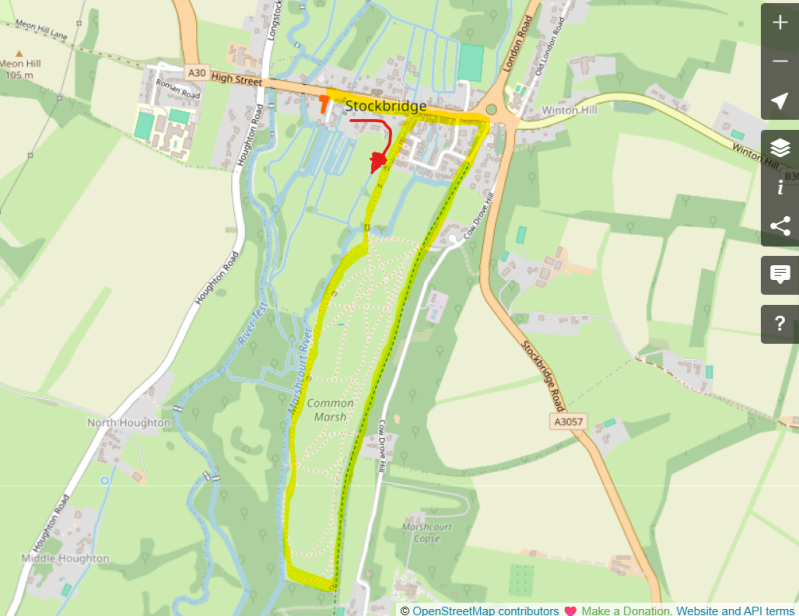
-
This is one of the gentlest and most quietly rewarding walks in Hampshire. Begin at The Three Cups, turning right on to the High Street in the centre of Stockbridge, one of Hampshire’s most attractive small towns, and perhaps the capital of the River Test valley. The High Street itself is worth slowing down for before setting off, lined with independent shops, cafés, galleries and fishing tackle shops.
-
After c.200m you’ll see a stream running close to the pavement, and a footpath for the Common to the right, just before (at the time of writing) The Little Whisky Shop. Follow the path towards the Common along the side of the Little Whisky Shop.
-
This is the approach to Stockbridge Common Marsh, a popular walk from the town. Owned by the National Trust, this peaceful stretch of wet meadow and riverside marshland provides one of the rare opportunities to properly experience the River Test at walking pace — close enough to watch trout holding motionless in the current, kingfishers flashing downstream and the river’s famously clear water sliding through beds of ranunculus and reed.
-
The bridge that accesses the marsh from Stockbridge was built in the 1950s by soldiers doing their National Service. If you look closely, you can see where the men made their mark on the bridge while the concrete was still wet.
-
After the bridge, remain on the National Trust riverside path. This is the finest section of the walk.
The path hugs the River Test through open meadow, with uninterrupted views of the clear chalk stream flowing beside you. Trout, grayling and occasional salmon can be seen in the clear waters. The characteristic chalk stream plant life and the fast-running flow over gravels offer the perfect conditions for these fish to live. Many trout anglers visit the River Test from across the globe during the spring and summer, providing a vital source of income for the valley.
-
Continue south along the riverbank path through grazing land and marsh. Livestock often graze here as part of the long-established commoning tradition that still shapes the marsh landscape today. The area’s ecology depends heavily on this gentle management approach, a tradition that has been in place since the 1300’s.
After around a mile along the riverside, the path gradually bends away from the water's edge into open meadow.
-
After a short distance of around 175 yards/160m, you will come to the Common Marsh boundary fence. Go through the pedestrian gate onto the Test Way, turning left along the footpath and cycle route.
The route straight ahead now offers wider views across the Test Valley, with the marsh stretching away beside you and Stockbridge gradually reappearing ahead. Depending on the season, the meadows may be filled with buttercups, floodwater, grazing cattle or mist rising from the river.
The walking remains beautifully easy throughout.
-
As you approach the National Trust Lions Den Car Park on your right, rather than flowing around to the left and back the way you came into town, follow the car park exit route. This will take you towards a road called Trafalgar Way, and emerges at a roundabout at the top end of Stockbridge High Street.
Before turning left to begin your return along the High Street to the Three Cups, consider visiting The White Hart on the roundabout, a lovely pub with excellent staff!
-
And there you have it: no steep climbs, no navigational drama, no exhausting mileage — simply one of England’s loveliest rivers experienced slowly, quietly and properly on foot.
Additional Notes
Understanding the Test Way: A Gentle Word of Advice
Walkers often arrive in Stockbridge assuming the Test Way is a classic source‑to‑sea river trail — the sort of long‑distance path that hugs the water from its first trickle to its tidal end. It’s an easy assumption to make. The name invites it afterall. The River Test is famous. And this stretch across Stockbridge Common Marsh is exactly the kind of open, accessible riverside walking people hope for.
But the Test Way isn’t really a river path at all. It’s Hampshire's Test Council long‑distance route, designed to showcase a broad sweep of downland, villages, and valley landscapes. So think 'Test Council Way' rather than 'River Test Way'.
The river appears, disappears, reappears, and often stays hidden behind private fishing beats. In truth, access to the Test is limited along much of its length — not because the river is unfriendly, but because it flows through one of the most intensively managed chalk‑stream environments in the world.
None of this makes the Test Way a lesser walk. It simply means it’s best understood for what it is: a county‑shaped journey, not a river‑shaped one.
If you want the river story, you can absolutely have it — you just need to approach it differently.
1. A walk that starts at the real source
While the Test Way starts at Inkpen Common, it's nowhere near the source of the River Test. The true source of the Test lies near Ashe and Overton. So a satisfying river‑focused walk could look like:
Ashe → Overton → Laverstoke → Whitchurch → Longparish where the Test Way actually meets the River Test.
This route follows lanes, permissive paths, and riverside sections that feel far more intimately connected to the Test than the early miles of the official Test Way. From Longparish you can either continue downstream on local paths or join the Test Way where it finally settles into the valley proper.
It’s the closest you’ll get to a genuine “birth of the river” experience.
2. Places where the River Test is accessible
Despite its reputation for exclusivity, the Test does offer some superb public access points — places where the river is open, visible, and part of the landscape rather than tucked away on private land.
Here are the best of them:
• Stockbridge Common Marsh (National Trust): A rare stretch of open chalk‑stream wetland where the river meanders, and sparkles in full view. Perfect for gentle walking, birdwatching, and understanding the Test as a living system.
• The Mayfly, Fullerton: One of the great riverside pubs of southern England. The Test runs directly beneath the decking, clear enough to watch trout holding in the current. A superb place to appreciate the river’s character.
• Chilbolton Cow Common: Wide, open access land where the Test flows through meadows and shallow channels. A favourite with families, naturalists, and anyone who likes a river they can actually see!
• Mottisfont Abbey (National Trust): Beautiful riverside paths, historic water meadows, and some of the most photogenic stretches of the Test open to the public.
• Romsey: The river widens and slows as it approaches the town, with accessible paths, bridges, and glimpses of the Test at its most gentle.
A final thought
The Test Way is a fine long‑distance path — varied, scenic, and full of quiet Hampshire character. But if you walk it expecting a continuous riverside trail, you may spend more time wondering where the river has gone than enjoying the journey.
Treat it instead as a valley‑and‑downland route with occasional, beautiful encounters with the Test, and it becomes exactly what it was designed to be.
And if you want the river itself? Start at the source, follow the water where you can, and make time for the places — like Stockbridge Common Marsh and The Mayfly — where the Test reveals its full, clear, chalk‑stream magic.
Other Pub Walks to try in Hampshire

North Hampshire circular with fine views from the highest point in the County.
6.5 miles