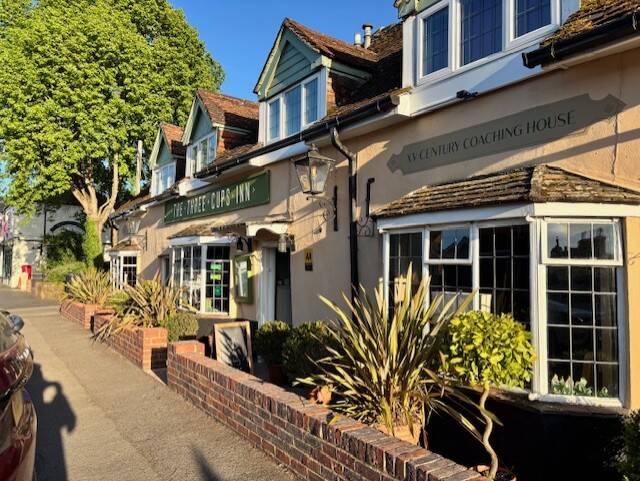
The Jack Russell Inn, Faccombe
North Hampshire circular pub walk with fine views from the highest point in the County, 6.5 miles

Try this Pub & Walk
The Jack Russell Inn sits deep in the North Hampshire Downs near Faccombe, hidden among rolling chalk hills, deer parks, estate cottages and winding lanes that seem determined not to hurry anywhere. This marvellous place feels absolutely English — a pub reached not by high street traffic but by ridgelines, lanes, woodland edges and enormous skies.
For a few years, this was my occasional escape from London.
Before retirement, when work regularly dragged me into the city for several days at a time, I began quietly rebelling against the routine. Instead of enduring another chain hotel and another anonymous, expensive London evening, I started looking just beyond the City for somewhere that transformed the experience completely.
The maths became simple: if warm summer evenings in the Hampshire countryside, a proper inn, excellent food and the feeling of actually being somewhere could be achieved while being less than an hour from London, then it was worth every minute.
The Jack Russell became one of those places.
An easy rail connection from Newbury somehow opened the door to another world entirely. One where evenings meant sitting beside the pond with a pint while swallows skimmed the water, or watching deer move across the estate as the sun dropped behind the downs. Work trips stopped feeling like work trips.
Returning during another glorious early-summer heatwave reminded me why the place stayed with me. This time I walked with a great friend from those work days, and the route delivered everything that makes this area special: huge views across the North Wessex Downs, ancient tracks, woodland, rolling pasture and one of the finest pub settings in southern England waiting at the end.
But Faccombe has another layer too.
Behind the immaculate Faccombe Estate scenery lies one of the strangest modern stories in rural England — involving Oman, intelligence operations, aristocratic wealth, royal connections, private security teams, vast estates and a man once described as a latter-day Lawrence of Arabia.
It gives the landscape an unusual sense of mystery, as though this quiet corner of Hampshire has spent decades politely hiding secrets in plain sight.
And somehow, at the centre of it all, sits a magnificent country inn welcoming muddy walkers for lunch.
That’s why this walk matters.
About The Jack Russell Inn, Faccombe


Last visit: May 2026
Hidden within the Faccombe Estate beneath the rolling chalk downs near the Hampshire–Berkshire border, The Jack Russell Inn occupies one of the most beautiful pub settings anywhere in southern England.
There’s a pond in front, immaculate estate cottages nearby, deer moving quietly across surrounding fields and an overwhelming sense of calm that arrives almost immediately after stepping out of the car or off the footpath.
Inside, it manages the difficult balance that so many countryside pubs fail to achieve. It is unquestionably smart — polished without being sterile — but still feels entirely welcoming to walkers arriving dusty and sunburnt after hours on the downs. Dogs sleep beneath tables, locals drift through the bar, and diners settle into one of the best food destinations in the area without any sense of ceremony or exclusivity.
The inn’s reputation has steadily grown over the years, particularly for game and estate-influenced dining, and it now comfortably occupies that rare middle ground between serious restaurant and genuinely atmospheric country pub. You can absolutely come here for a special meal, but it still works brilliantly as the reward at the end of a long walk.
And then there’s the setting itself — because Faccombe is no ordinary country estate village.
For decades the surrounding estate was owned by the enigmatic Brigadier Timothy Landon, the British military officer and fixer whose extraordinary life in Oman helped inspire comparisons with Lawrence of Arabia.
Landon’s world mixed royalty, oil wealth, intelligence circles, immense landholdings and near-legendary secrecy. Stories still linger locally of security patrols, guarded entrances and blacked-out Range Rovers sweeping through the estate lanes.
The estate’s modern story occasionally drifts into public view in unexpected ways. Arthur Landon — son of the enigmatic Brigadier — became part of the wider orbit of Princes William and Harry, with Faccombe itself quietly entering royal folklore when Prince Harry reportedly held his stag celebrations at The Jack Russell ahead of his 2018 wedding.
Somehow it fits the atmosphere perfectly: this hidden Hampshire valley, wrapped in estate roads and rolling chalk hills, always feels as though it exists slightly adjacent to ordinary life.
Even today, that hidden-world atmosphere quietly lingers around Faccombe.
Yet somehow none of it overwhelms the simple pleasure of the place: a superb inn in glorious countryside, perfectly positioned for one of Hampshire’s finest walks.
Pub Key Information
| WEBSITE | https://www.thejackrussellinn.com/ |
| ADDRESS | Netherton Hill, Faccombe, Andover, SP11 0DS |
| PHONE | 01264 737315 |
| WHAT3WORDS | ///engraving.tamed.pheasants |
| PARKING | Parking opposite the pub. Overflow parking a little way down the lane. |
| LOCATION | Faccombe feels a little like it's in a world of its own! West of the A34, it's south West of Newbury, north of Andover, close to the northern part of Hampshire as it borders both Berkshire and Wiltshire. |
| HANDY FOR | Highclere Castle is nearby. This area is a walking route honey pot: Pewsey Vale Circular Walk; Mid Wiltshire Way; Wayfarer’s Walk; Test Way and the Brenda Parker Way are all nearby. |
Walk Overview
This is classic North Wessex Downs walking : wide chalk tracks, sweeping ridgeline views, quiet valleys and enormous skies in this Area of Outstanding Natural Beauty.
Along the way the landscape constantly shifts between exposed chalk escarpments, woodland edges, estate farmland and ancient trackways threaded through surprisingly remote countryside.
One of the highlights is the approach towards Pilot Hill — the highest point in Hampshire at 286 metres — where the sense of space becomes extraordinary on a clear day - offering panoramic views stretching towards Highclere, Newbury and Mick Jagger's old recording studio at Stargrove Manor.
The walk also intersects with several long-distance routes including the Brenda Parker Way and the Wayfarer’s Walk, reinforcing the feeling that this landscape has drawn walkers for generations.
Despite the grandeur of the scenery, the walk remains deeply peaceful. Even on warm weekends the downs absorb people effortlessly, and long stretches feel wonderfully isolated.


Walk Key Information
| START/FINISH | The Jack Russell Inn, Netherton Hill, Faccombe, Andover, SP11 0DS. 01264 737315 |
| PARKING | Parking opposite the pub. Overflow parking a little way down the lane. |
| GRID REFERENCE | SU 390 579 |
| WHAT3WORDS | ///engraving.tamed.pheasants |
| DISTANCE/TIME | 6.5 miles / 10.5 km; approx 3 hours |
| ASCENT | 900 feet / 275 metres |
| PATHS/TERRAIN | Quiet lanes, chalky farm tracks & field edges. |
| DIFFICULTY | The walk visits Hampshire's 'County Top', the highest part of Hampshire. A few steep climbs. |
| PUBLIC TRANSPORT | There's no services into Faccombe. However, the A343 corridor is served by Stagecoach route 7 (Newbury ↔ Andover). It's c.3 miles from the A343. |
| TOILETS | At the Jack Russell Inn. |
| OTHER PUBS TO VISIT | There are some terrific pubs in this area, albeit fewer these days. The Crown & Garter at Inkpen Common is superb, and waiting for its own Pubs Worth The Walk feature! The Red House at Highclere is combined with Ellie's Deli next door. Definitely worth a visit. |
Walk Instructions: Choose what works for you
There are multiple ways to consume the route described below.
- Either follow the online Walk Directions below, or download and print a copy of the route.
- If you have the OS Maps App, you can follow a saved route directly in the OS App.
- Or download the GPX file for use with your chosen GPS-based tracker App, like Strava. Upload the file when you Create a New Route in the App.

Walk Directions
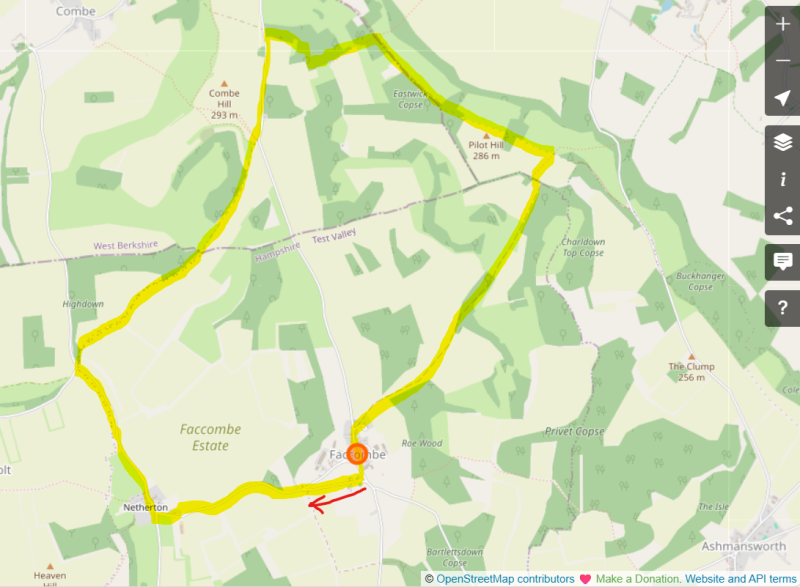
- From the car park of The Jack Russell Inn, turn left in the direction of the hamlet of Netherton. Follow Netherton Lane downhill to the junction, turning right in front of Netherton House onto Netherton Road. This area has connections to the ancestors of George Washington.
- The lane meets a junction with Upton Road running to the left. On the right is a footpath running uphill on a track. Follow this track. There has been forestry work in this area disrupting the established footpath route a little, but continue on the line you started on, making for the fringe of the copse of trees ahead to eventually join a flat path through woodland.
- The path emerges onto a stony farm track uphill, with trees to the left and some of the vast tracts of fields of the Faccombe Estate on the other side of the fence to the right. This uphill section is carrying you to one of the higher parts of the walk.
- The track starts to level out as the farm track emerges onto Rooknests Lane. Continue ahead on the lane. You crossed the Hampshire border into Berkshire on that last climb, and to your left is Combe Hill. At 293 metres it's higher than the county top of Hampshire still to come.
- As the lane starts to descend you'll see a wide-mouthed path/track to the left that's heading up to Combe Hill, and beyond. To the right is a narrower path in front of a gate. Take this one, following it as it curves between hedges and copses.
- Go left across the lane and onto a grassy path by the side of fields. There's a steep uphill here, levelling out a little as you enter the woods above the fields, then turning right to join the Wayfarer's Walk.
- This is where the walk really shows itself off. As you gain elevation towards the summit of Pilot Hill, back in Hampshire, the views to your left are superb, some of the best in Southern England. See if you can spot Stargrove Manor. To the right of this vista is Highclere.
- As this route along the ridge starts to level and start downhill, look for footpath markers. One path leads down to the left off the ridge. This is where we also leave the Wayfarer's Way, heading right towards the fields - on Brenda Parker Way.
- Head across the field to the hedge, then left hand turn to the next hedge boundary, and a right hand turn.
- It's a straight run back to Faccombe from here, initially downhill on a stony track and then up the other side on a smoother track on the approach to the village.
- Continue on to Faccombe Road where you'll turn left passing the church. St Barnabas’ Church is a 19th‑century estate church that carries the inherited history of the earlier medieval parish at Netherton. Local tradition describes it as an ‘ancestral church of George Washington’, reflecting the Washington family’s historic roots in this part of southern England, even though the present building dates from 1866.
- On the left you'll pass Faccombe Manor, once the seat of the Butler‑Henderson family (of steam‑locomotive fame), and on to finish at The Jack Russell Inn.
Additional Notes
Brigadier Landon: The White Sultan of Hampshire
Few rural English villages can claim a former resident whose life involved Gulf monarchies, Cold War intrigue, immense wealth, private jets, royal friendships, a heavily guarded estate and repeated comparisons with Lawrence of Arabia. Faccombe can.
Brigadier Timothy Landon might well be one of the most extraordinary figures ever to settle quietly into the Hampshire countryside. Depending on which account you read, he was variously described as an intelligence officer, military adviser, royal fixer, trusted confidant, arms broker, strategic operator, moderniser, adventurer and deeply private landowner. Quite a range for someone who became best known in these parts simply as "the Brigadier."
The story begins at Sandhurst in the early 1960s, where a young cadet from Vancouver Island named Timothy Landon reportedly took a younger fellow student under his wing, shielding him from the casual bullying of officer training. That student was Qaboos bin Said, son of the Sultan of Oman. It was the beginning of a friendship that would reshape a country.
Landon arrived in Oman in the mid-1960s as a British Army intelligence officer, part of a military operation to help suppress a Soviet-backed insurgency in Dhofar. By the time he arrived, the old Sultan — isolationist, paranoid, resistant to the oil wealth transforming the rest of the Gulf — had placed his own son under house arrest on the coast. Landon was one of the few outsiders permitted to visit.
When the coup came, on 23 July 1970, Landon was twenty-seven years old. The old Sultan was confronted at his palace and told his rule was at an end; the only casualty was Said's own foot, shot accidentally as he reached for a pistol beneath his robe. He died two years later in a London hotel. His one recorded regret, made on his deathbed, was that he had not had Landon killed.
Qaboos modernised Oman rapidly, and Landon stayed close to him through the following decade — advising, brokering, building the new Sultan's armed forces into one of the best-equipped small militaries in the world.
He was dubbed the White Sultan, a title he seemed to have regarded with bemusement. His wealth, assembled through commissions, gifts and investments across three continents, was estimated variously at £200 million, £500 million and higher — the uncertainty itself a measure of how successfully he operated away from scrutiny. Sultan Qaboos reportedly sent him a cheque for £1 million on his birthday each year. Nobody seemed entirely sure how many years this had been going on.
By the late 1970s, Landon had returned to England.
He married Princess Katalina Esterházy de Galantha — Hungarian aristocracy, Habsburg loyalists, owners of vast Central European estates for five centuries — and established himself here at Faccombe, assembling a 4,000-acre estate of Hampshire downland near the Berkshire border.
His Boeing was a regular sight arriving at Farnborough, the nearest airport, as he continued to shuttle between England and Muscat. In London he travelled by personally owned black cab, the better to avoid attention. He installed one of Britain's earliest large private wind turbines on the estate, decades before environmentalism became fashionable. The Faccombe Estate became known for shooting, farming, conservation and an immaculate, intensely private atmosphere — stories still circulate of sophisticated security systems, guarded entrances and blacked-out Range Rovers sweeping the lanes like something from a le Carré novel rewritten by P.G. Wodehouse.
He died in Winchester in 2007.
His son, Arthur Landon, inherited the estate and, in 2008, became the youngest person ever to appear in the Sunday Times Rich List. Arthur's friendships with Princes William and Harry occasionally brought Faccombe quietly into public view — Prince Harry's stag celebrations were reportedly held at The Jack Russell Inn in 2018, perhaps the most straightforwardly cheerful chapter for him.
Whatever the full truth behind the mythology — and much of it may never be known — Landon left a distinctive imprint on this hidden Hampshire valley. The estate is immaculate, the village is well cared for, and this pub at its centre is, by any measure, far better than a village of this size has any right to expect.
Draw your own conclusions about how that came to be.
Other Pub Walks to try in Hampshire
Perfect River Test stop off, half way along the Clarendon Way.
27 miles!