

Ffynnone Arms, Newchapel
Celtic mythology and a Buckingham Palace link on this Ffynone Falls pub walk, 5 miles

Try this Pub & Walk
Your recollection of Newchapel might be one of a village you've driven through, irritated by the 20mph you didn't ask for. You're on your way to Newcastle Emlyn, or Fishguard, or wherever the sat nav's actually sending you, and the Ffynnone Arms has gone by unremarked, the way it does for most people, most days.
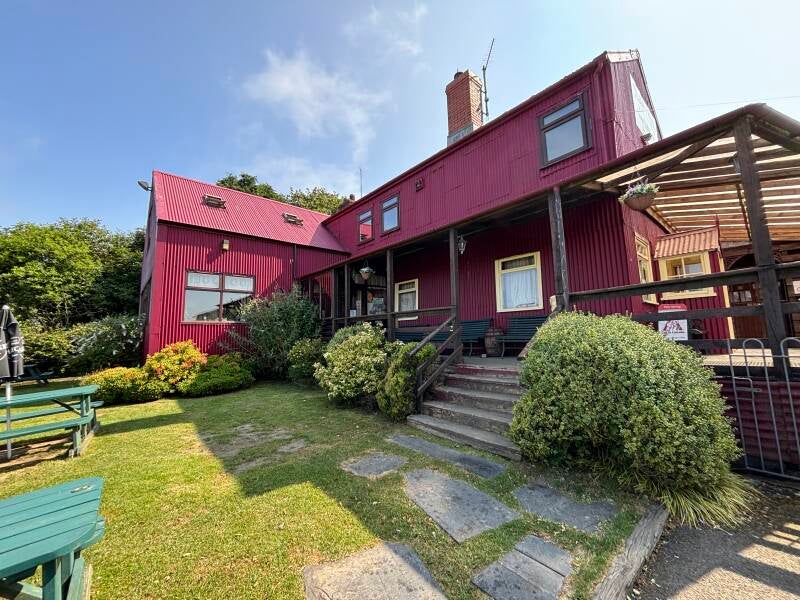
Which is a shame, because the Ffynnone Arms is exactly the pub you'd want waiting at the end of a bad day and never think to look for. No view. No sea. No chef with a following. Just a proper Welsh village local: warm, unshowy, doing the basics better than most places manage the fancy stuff. And CAMRA agrees with me: Pembrokeshire's Pub of the Year for 2025.
There aren't many Ffynone Arms in the world, and there's a reason for that: the pub takes its name from Ffynone, the Grade I mansion and estate up the valley that the pub was originally built to serve. That house was one of the first commissions of a man who went on to build Buckingham Palace (check the photo below) and numerous other iconic buildings in London.
None of that is on the pub's own website, and you won't see the house itself from the walk either — but you will walk through the working estate that sustained it: the woodland, the dammed lake, and the falls it once controlled.
The lake, in particular, was flooded in 1921 purely to light the mansion, and the falls themselves are now given over on a hot day to local families rather than to whoever's up at the big house. It's a walk that carries the estate's whole working history underfoot, even with the Ffynone Mansion itself staying stubbornly out of sight — which makes it worth doing before your pint as much as after it.
About The Ffynnone Arms, Newchapel


Last visit: July 2026
Hedydd Phillips was still running through the opening up routine when I joined eager regulars on this visit. She presides over the room with the particular gift of making everyone feel served without anyone noticing they've been waiting, and getting to know you while you wait.
The pub's name, of course, is Welsh through and through: Ffynnone is a corruption of ffynnonau, meaning "wells" or "springs" — there are a fair few of them hereabouts — and the name belonged to the valley and its springs long before anyone built a mansion, let alone a pub, to go with it.
I'll admit to a small private test on this trip. Forty years ago, when this area was my home, as a first-language English speaker and a none-too-confident Welsh learner, you knew which pubs in this corner of Pembrokeshire ran predominantly in Welsh — the Ffynnone Arms, Tafarn Sinc, the Dyffryn Arms among them, all three on my list to visit this week.
You went in occasionally back then, usually with a Welsh speaker at your side for cover. As an English speaker, it didn't feel hostile exactly. It felt, to me at least, like there was an invisible line you hadn't quite earned the right to cross.
Not now. Hedydd is so welcoming.
There's a great vibe here, the kind of atmosphere you get when naturally humorous people are gathered together and are genuinely open to including a stranger in the conversation.
And it's the kind of place that does the unglamorous things properly rather than the glamorous things loudly: a candlelit hearth, steaks from one of the area's own butchers rather than a supply chain nobody can name, a Sunday carvery people plan their week around, and a menu that quietly covers gluten-free, dairy-free, vegetarian and vegan without making a production of it. There's a beer garden for the summer evenings, dogs welcome at the bar (always makes me laugh when I read that), and a Sunday quiz from half eight that's become as much a fixture of the week as the carvery itself. None of it is trying to be clever.
All of it is done well, consistently, which turns out to be far harder to pull off — and is exactly what Pembrokeshire's CAMRA branch recognised in naming the Ffynnone Arms its 2025's Pub of the Year.
The pub itself was built to serve the Ffynone estate in the valley. Not its owners, but the people who kept Ffynone running: the foresters, farmhands and tradesmen whose work in the woods and fields paid for the house's Nash ceilings without ever setting foot under them. It seems to me that's still, more or less, who drinks here. Tonight the bar was full of people who I suspect have splinters in their hands from the same woodland, doing the same work their counterparts here would recognise across two and a half centuries — farming, forestry, the trades that keep both going, filling the same room the estate's own workers once did.
(See Notes, below, for more information regarding the Ffynone estate itself — Nash, the Colbys, and the rest of it.)
Pub Key Information
| WEBSITE | https://www.ffynnonearms.co.uk/ |
| ADDRESS | The Ffynnone Arms, Newchapel, near Boncath, Pembrokeshire, SA37 0EH |
| PHONE | 01239 841800 |
| WHAT3WORDS | ///pressing.patching.fizzle |
| PARKING | Parking at the rear of the pub. |
| LOCATION | Newchapel is a village on the A4332 between Cenarth and Boncath, roughly 7 miles south of the town of Cardigan. |
| HANDY FOR | Cenarth Falls; Cilgerran Castle |
Walk Overview
A walk through the working woodland of Ffynone & Cilgwyn Woods to a waterfall and pool. Local tradition holds that the waterfall is the entrance to Annwn, the Celtic otherworld, where Pwyll, Prince of Dyfed spends his year and a day in the first branch of the Mabinogi. It's a genuinely lovely thing to have on the doorstep for the good people of Newchapel, but worth being honest that the medieval text itself doesn't name this spot ;o)
The forest paths are of variable character, some well used and maintained, others at the fringe of the estate are a little overgrown after a humid summer, but passable throughout.
You won't see Ffynone mansion, unfortunately. Whoever bought it after the Colbys sold the woodland off separately, and the trails don't go near the house — you could walk the whole route and never guess a Grade I Nash-designed building sits somewhere above the treeline. What you do walk through is everything that made the house possible: the dammed lake, the falls, and mile upon mile of managed woodland — oak standards over coppice originally, conifers planted on since the 1780s, the whole valley worked for timber, fencing, pea sticks and fuel long before anyone thought to call it scenic.
You're walking through the working parts of one of Wales's most significant houses, without ever laying eyes on the object all that work was for.


Walk Key Information
| START/FINISH | The Ffynnone Arms, Newchapel, near Boncath, Pembrokeshire, SA37 0EH |
| PARKING | Parking at the rear of the pub. |
| GRID REFERENCE | SN 228 395 |
| WHAT3WORDS | ///pressing.patching.fizzle |
| DISTANCE/TIME | 5 miles / 8 km; approx 2.5 hours |
| ASCENT | 925 feet / 285 metres |
| PATHS/TERRAIN | Mainly woodland paths and forest tracks. One field, likely with cattle. Some tarmac walking on very quiet lanes. |
| DIFFICULTY | Easy to moderate. Some steep sections, and some sections might be slightly overgrown the further away from the Falls you are. |
| PUBLIC TRANSPORT | I don't believe that buses pass through Newchapel. However, the 430 service from Cardigan passes through Boncath, which is 1 mile away. |
| TOILETS | At the Ffynone Arms |
| OTHER PUBS TO VISIT | The Nag's Head at Abercych should be on your list; and for something a little different, try The Mason's Arms in Cilgerran, locally known as The Rampin. |
Walk Instructions: Choose what works for you
There are multiple ways to consume the route described below.
- Either follow the online Walk Directions below, or download and print a copy of the route.
- If you have the OS Maps App, you can follow a saved route directly in the OS App.
- Or download the GPX file for use with your chosen GPS-based tracker App, like Strava. Upload the file when you Create a New Route in the App.

Walk Directions

- Ffynnone Arms sits on the main road through the village of Newchapel, the B4332. A few doors up is an old chapel, and opposite, a No Through Road lane leading to Cilgwyn.
- As you cross the road to set off down that lane, next to the Cilgwyn sign is a footpath sign sending you over the bank on the right. After a short path that runs to the side of a garden, you proceed into a field. Follow the right-hand hedge all the way down the field – you might have to discourage some inquisitive cows – to pass through a metal footpath gate into woodland.
- This is the area known as Ffynone & Cilgwyn Woods, and we’re starting in the northern section. I found that the first part was becoming a little overgrown, and had to pick a slightly different route because of this. The Newchapel end certainly seems less frequented than eastern section just below Ffynone mansion.
- As you start to follow a slate path through the woods, ignore any OS map route to the right. That was definitely overgrown! Instead, continue ahead on the slate path downhill then round a corner and up a slight incline. Eventually the narrow path emerges into a wider forest track, with what looks like a turning area for forest vehicles, masquerading as a mini-quarry lookalike.
- Continue ahead on a forest track. You arrive at a junction in the forest path. The left-hand spur rises uphill to the Cilgwyn entrance into the woods, but stay straight ahead. The route travels downhill before passing a number of very active beehives.
- Soon, pass through a gate then onto a tarmac lane. The route uphill returns to the Cilgwyn junction near the Ffynnone Arms, we’ll take that on the return path. Now, turn right downhill on the tarmac lane.
- Follow this lane as it crosses a ford, and winds around until reaching a bend with a white house on the left. A bridleway sign points the way in front of the house, initially past some old pig styes.
- This pretty section crosses a footbridge and makes its way towards another property, with some cutting back needed as you emerge in front of the old stone cottage in the woods. Head to the left down the track.
- Stay straight ahead to pass what looks like a giant, white coloured hoover pipe, which is actually a shed. The path was bone dry when I walked it, but I passed across a ‘boardwalk’ that suggests it can get very wet here.
- The path starts to drop downhill, arriving in front of a pool in front of Ffynone Falls. The better view of the falls needs to be captured on the other side, and there’s a significant loop to do to get there.
- As you came down to the pool, head right away from the pool. Eventually turn left on a distinct path, then go left on a wide forest track/gravel road. Stay on this route downhill and uphill, then turn left at a junction.
- At a small concrete dam, you’ll get your first glimpse of the lake on the left. The dam is to the right.
- Continue ahead to a cottage, which I assume is called Lakehouse. Bear left to pass it, and continue ahead until the path drops downhill to the left. Take that route to arrive at the falls.
- The return route requires you to backtrack a little. Return to the cottage (Lakeside House). 25m further on you’ll see a forest track rising on your left-hand side. Before you take it, continue a little further to see the dam on the right-hand side.
- Back to the forest track, continue steeply uphill all the way to the tarmac lane referenced at point at #6. You’ll recognise it when you get there! Now you need to go uphill.
- This lane leads to Cilgwyn Farm, which straddles the road, so it feels like you’re walking through part of the farmyard. Continue ahead though, as the road rounds a bend to the left, and follow all the way back up the lane to the main road near to the Ffynnone Arms.
Additional Notes
Ffynone Mansion and the cluster of estates in the lower Teifi Valley
The pub takes its name — and, indirectly, its reason for existing — from Ffynone, the mansion that once ran the whole valley below.
Captain Stephen Colby bought the estate in 1752, and it stayed in Colby hands for 175 years. In the early 1790s his nephew and heir, Colonel John Colby, commissioned a young architect named John Nash to design a new house on the site — completed in 1799, and considered by Nash's biographer Terence Davis to be perhaps the most successful of his early houses.
Nash was in this corner of Wales at all because his mother had retired to Carmarthen in 1784, her own family being from the area, and it was here — not London — that he properly grew into the architect he'd become; his first substantial commissions were prisons at Carmarthen, Cardigan and Hereford, before the country-house work began.
This is worth sitting with for a second: Nash built Ffynone the better part of two decades before Buckingham Palace, Regent Street, Marble Arch or the Brighton Pavilion — all the London and Regency work that made his name came later, once he had the Prince Regent's ear.
Ffynone belongs to his before period: a rural Pembrokeshire commission for a colonel, built while Nash still had a free hand and nobody grand looking over his shoulder. He went on to design at least a dozen such villas across south Wales, of which several — Llanerchaeron in Ceredigion chief among them — also survive; Ffynone's claim isn't to be the largest or the most complete, but simply, in his own biographer's judgement, his finest private work.
A century later, in 1902, John Vaughan Colby's wife commissioned the architect and garden designer Inigo Thomas to remodel the house and lay out its Italianate terraced gardens — work she set in motion, so the story goes, while her husband was away on a bear-hunting trip in Siberia. He came home to sixty thousand newly planted trees, shipped in from a Norwich nursery, and a formal terrace where his plain Georgian lawn used to be. He does not appear to have complained, at least not on the record.
The Colby line ran out not long after. John Vaughan Colby's only son was killed in the First World War; when Colby himself died in 1919 the estate passed to his daughter Aline, who sold it in 1927, ending the family's association with the valley.
It has passed through several hands since — most notably to the 3rd Earl Lloyd George of Dwyfor, grandson of the Prime Minister, who bought the house in 1988 in a state of near-dereliction and spent the rest of his life restoring it. The Earl died at Ffynone in 2010.
The house has changed hands more than once since, and the sales particulars in hand (Savills, early 2000s, guide price £1.8m) are one snapshot among several rather than the full story — worth remembering that "current owner unknown" says more about a gap in the paperwork than about any real mystery. I bet Hedydd knows who owns it now.
The lake passed on the walk was itself a working farm until 1921, when it was dammed and flooded to generate electricity for the house — a nice, late flourish of the estate modernising itself even as the family's own time there was running out.
The cluster of estates
One thing that stands out, working on this entry, is how many substantial estates or manor houses sit within a few miles of each other between Abercych and Newchapel — Ffynone, Clynfyw, and Cilwendeg among them — and how differently they've each ended up.
Cilwendeg, another Nash building from the 1780s, built for the Morgan Jones family (whose money came via the Skerries lighthouse, of all things), spent decades as a council-run care home before becoming today's private events venue — and still holds Pembrokeshire's only surviving shell house, an extraordinary 1820s garden folly restored from near-ruin in the 2000s.
Clynfyw, a few miles the other way, has taken the opposite path entirely: farmed by the same family since the 1750s, it's now a community care farm, its future openly tied to the wider community rather than to any single owner's fortune.
Three estates, one small corner of West Wales, three completely different afterlives — Ffynone restored to private grandeur, Cilwendeg turned to commerce, Clynfyw given over to social care.
And this tight little pocket is only the beginning of it. Zoom out along the wider lower Teifi valley — Castell Malgwyn, Coedmore, Glanarberth, Stradmore and a good many more — and the pattern repeats itself on a much larger scale: by one count, some fifty mansions once stood along tor near his single river between Cardigan and Llandysul, built and abandoned by generations of the same interlinked 'landed gentry' families. That's a story too big for one pub's Notes section, and one I'm hoping to tell properly elsewhere in due course.
Other Pubs to try in Pembrokeshire

Gwaun Valley woods and fields around Pontfaen, on the way to Bessies.
3.3 miles
