

The Tower Inn, Slapton
Pub Walk to Slapton Ley Nature Reserve & the Slapton Sands D-Day Memorial, 3 miles

Try this Pub & Walk
Every entry on this site is really a plea to visit a pub. This one starts with a different plea: visit a village, visit an area.
Slapton sits a quarter of a mile inland from Slapton Sands, on the coast road between Dartmouth and Kingsbridge, in the middle of the South Devon National Landscape — the area most of us still call the Area of Outstanding Natural Beauty.
If you don't know it, picture this: a three-mile shingle beach, a freshwater lake sealed off behind it by nothing more than a ridge of pebbles, and a scatter of ancient villages tucked away in the hills behind. It is one of the most beautiful stretches of coastline in England.
It's also, right now, in real trouble.
In early 2026, Storms Ingrid & Chandra tore up the A379 coast road along the shingle beach— known as the Slapton Line — between Torcross and Slapton. The road has been closed ever since. Devon County Council says it doesn't currently have the money to fix it, and the future of the road now rests on a decision in Westminster.
It isn't the first time this has happened here, either: the same stretch failed in 2001, and again in 2018. It is a road that keeps being asked to absorb the sea's temper, and keeps having to find a way through it.
What this means, practically, is that traffic is diverting away from the route, and away from the businesses between Dartmouth and Kingsbridge, significantly impacting the closure points of Torcross and Slapton. At Slapton, it means two great pubs, a volunteer-run village shop, and a nature reserve of genuine national importance are all relying, this summer, on people making a deliberate effort to come and spend money in a place that the map has made (let's hope) briefly awkward.
Devon County Council clearly agrees: they're subsidising a brand new summer bus service, running from the end of June through August, specifically to get visitors back into Slapton. When the council itself is paying to make it easier for you to turn up, that's about as clear an invitation as you'll get.
So this entry carries the usual promise — a proper walk, and a properly good pub called The Tower Inn at the end of it — but it also carries the plea plainly: make the effort. Not just for the pint, though the pint is very good. For the place and its businesses.
About The Tower Inn, Slapton


Last visit: June 2026
You’d never know the Tower Inn was there if you stayed on the main route through the village. From the direction of Slapton Sands, you pass the Queen’s Arms, then The Chantry, then St James’s Church. Only a small chalkboard hints that a pub lies up a narrow lane you’d otherwise ignore. Slip between the houses though — barely space for a car — and suddenly it opens into a gravel courtyard. Wisteria climbs the walls, the air changes, and behind it all a great tower stands watch, as if still on duty.
It’s worth pausing in the courtyard before you go in to the pub. This feels like some ancient theatrical scene, like a film set.
The outdoor kitchen under its tin roof turns out a short, high‑quality menu and wood‑fired pizzas — and it only makes full sense once you know that the main kitchen was lost in a serious fire in 2021. The team cooked outside over wood and coal for the best part of a year while the rebuild happened, not reopening the indoor kitchen until the following spring. With that in mind, the outdoor setup stops looking like an artisan gastro flourish and starts looking like what it really is: a piece of ingenuity the pub chose to keep rather than retire.
And then there’s the wagon — a covered wagon stands in the courtyard like a prop waiting for its cue. With the medieval tower above, the tin‑roofed wood‑fired shack smoking away, and people eating and drinking at long benches, the whole place feels like a film set someone built for an ancient story. I’d come to Slapton on a diet of its WWII history, so the wagon looked faintly suspicious, that it might suddenly reveal something dramatic. In truth, it’s the stage: friends of the owners sometimes drift in with guitars, like tonight, but on more 'formal' music nights the canvas rolls back and the wagon becomes the centre of things.
The tower itself is the surviving fragment of something much larger — the pub's own explanation for its name, and the one most visitors will hear, and leave it there. In 1372, Sir Guy de Brian, standard-bearer to Edward III and a man of serious influence at court, founded the Collegiate Chantry of St Mary here, one of only four such colleges ever established in the South West. It stood for the best part of two centuries before the Reformation caught up with it in 1547; the church itself was lost, the tower left standing, Grade I listed in its own right. The pub predates even that: built around 1347 as cottages for the stonemasons and craftsmen working on the chantry, making it one of the oldest continuously occupied buildings in the village — older than the tower it now shelters beside.
I've added a blog post that expands on this piece of Slapton's history: The Man Behind the Slapton Tower: Guy de Bryan, Edward III, and Why Slapton Has a Chantry at All.
Inside, the building carries its six-and-a-half centuries as you might expect: low beamed ceilings, flagstone floors, candlelit tables - it gives the place a slightly conspiratorial, low-lit feel — and a genuinely rare piece of pub etiquette I noticed straight away: the regulars, gathered tidily around the one bar, somehow manage to leave enough room for everyone else to actually reach it.
The owners themselves were elbow-deep in the kitchen the night I visited, so my welcome came from Adam, who's been front of house for a good few years I understand, and I'm certain has been serious about keeping a good pint far longer than that. I told him it was the best Otter Bitter I'd had, and I've had plenty — which led straight into a conversation about the Copperhead beer about to land, a new one called Fresh Cream. It was every bit as good as promised. Before I left, Adam had added me to the pub's WhatsApp group, in case I fancied joining a planned brewery trip to Copperhead in Totnes. That's not service, particularly. That's just what a welcome looks like here.
There's a rear garden too, reached from inside past the loos, and I went looking for a better angle on the tower from back there — but the courtyard out front is the place to be, on every count.
Do be warned before you drive: the pub's own parking, such as it is, is notoriously tight — reviewers mention scraped wing mirrors often enough that it's clearly a running joke among regulars. Park in the village and walk the last stretch.
I could have left the Tower Inn thinking exactly what most people probably do: great old pub, named after the tower behind it, lovely evening, fab people. It's only because I went looking that I found out the tower is the last trace of a doomed medieval college, that the pub itself is older than the tower, that the Church of St James next door was quietly bankrupted by the whole arrangement, and that the walled house you'll pass shortly after leaving The Tower Inn - The Chantry - is built on top of what's left of it all.
Slapton doesn't offer any of that up readily. You have to go and find it. Enjoy the blog post!
Pub Key Information
| WEBSITE | https://www.thetowerinnslapton.com/ |
| ADDRESS | Church Street, Slapton, Devon , TQ7 2PN |
| PHONE | 01548 580216 |
| WHAT3WORDS | ///traded.showed.crescendo |
| PARKING | Don't attempt to park at The Tower Inn. Park at or near the entrance to the village and walk to the pub. Roads in the village are narrow, and narrowest of all in the lane leading to the pub itself. A larger car park is available near the war memorial on Slapton Sands beach, 3/4 mile from pub. The walk starts/ends from this car park. PLEASE NOTE THE CLOSURE OF THE A379 BETWEEN SLAPTON AND TORCROSS and follow diversions. See the Notes section below for guidance. |
| LOCATION | Slapton is situated in the South Hams district of Devon, approximately a quarter-mile inland from Start Bay along the A379 road, which connects Kingsbridge and Dartmouth. The village is part of the South Devon Area of Outstanding Natural Beauty. Slapton is a small village of thatched cottages, home to the beautiful and popular Slapton Sands pebble beach and Slapton Ley freshwater nature reserve, and fascinating connections to WWII. |
| HANDY FOR | Some of the best landscapes & beaches in the UK. Exceptional South West Coast Path sections. Totnes, Dartmouth, Kingsbridge & Salcombe are all nearby, although travel consideration is required with the storm damage & closure of the A379 near Torcross, on the 'Slapton Line'. |
Walk Overview
Start at the war memorial on Slapton Sands, standing above the beach. If you've read Michael Morpurgo's ‘The Amazing Story of Adolphus Tips' to your children, you'll likely know why it's here.
The memorial was presented by the United States Army to the people of Slapton, Stokenham, Strete, East Allington and Blackawton — five parishes evacuated in the winter of 1943 to make way for invasion rehearsals for the D-Day landings.
Around 3,000 people — roughly 750 families and farmers — were given six weeks to evacuate, taking what livestock and belongings they could. The memorial thanks them for what they gave up, so that the rehearsal for D-Day could happen on ground that genuinely resembled Utah Beach and hasten the end of WWII.
From the memorial, the walk turns inland toward Slapton Ley — the largest natural freshwater lake in the South West, sealed off from the sea only by the shingle bar you've just walked.
It doesn't look particularly dramatic from the path — a long, reed-fringed lake — but it's genuinely irreplaceable. It has been a National Nature Reserve since 1993 and a Site of Special Scientific Interest since 1952 — a wetland that has been important for seventy years, while the road beside it keeps falling into the sea.
The path threads on into the village itself and you arrive, eventually, at a squat, ivy-softened tower rising incongruously behind a beer garden — and at the pub that has sat beside it for nearly 700 years.


Walk Key Information
| START/FINISH | The walk starts from the car park of the WWII War Memorial on Slapton Sands, outside the village. The route visits the Slapton Ley nature reserve then routes through Slapton village for a visit to The Tower Inn, before the c. 3/4 mile return to the car park. |
| PARKING | Parking is available at The Slapton Sands War Memorial. It's a distinctive feature as you approach the junction for Slapton Village along the A379 from Dartmouth direction. See the Notes section below for guidance. |
| GRID REFERENCE | SX 829 443 for the War Memorial and parking at Slapton Sands |
| WHAT3WORDS | ///dodging.readjust.perch for the War Memorial and parking at Slapton Sands |
| DISTANCE/TIME | 3.1 miles / 5 km; approx 1.5 hours |
| ASCENT | 340 feet / 105 metres |
| PATHS/TERRAIN | Easy walking on pavements, tracks and boardwalks. Some steps. A section of the walk is along a narrow lane entering the village, usually quiet but busier now that the main road is closed. Take time at Slapton Sands to views the beach and walk 'the Line' towards Torcross. |
| DIFFICULTY | Easy. Uphill section along lane into the village after the nature reserve. |
| PUBLIC TRANSPORT | Bus services have been disrupted by the A379 closure. Devon Council has introduced services to help local communities and visitors with a new service connecting Dartmouth and Slapton. |
| TOILETS | At The Tower Inn |
| OTHER PUBS TO VISIT | All businesses between Dartmouth and Kingsbridge have been impacted by the closure of the A379. Please make the effort to support them. The walk passes the other pub in Slapton, The Queens Arms. The Start Bay Inn at Torcross was battered by the 2026 storms but it's open and ready to welcome you. They have an incredible photographic collection on their website that shows the exposure to the elements and the evolution of the coast here at Start Bay and Slapton Sands. The Tradesman's Arms in Stokenham is a picture postcard thatched inn. |
Walk Instructions: Choose what works for you
There are multiple ways to consume the route described below.
- Either follow the online Walk Directions below, or download and print a copy of the route.
- If you have the OS Maps App, you can follow a saved route directly in the OS App.
- Or download the GPX file for use with your chosen GPS-based tracker App, like Strava. Upload the file when you Create a New Route in the App.

Walk Directions
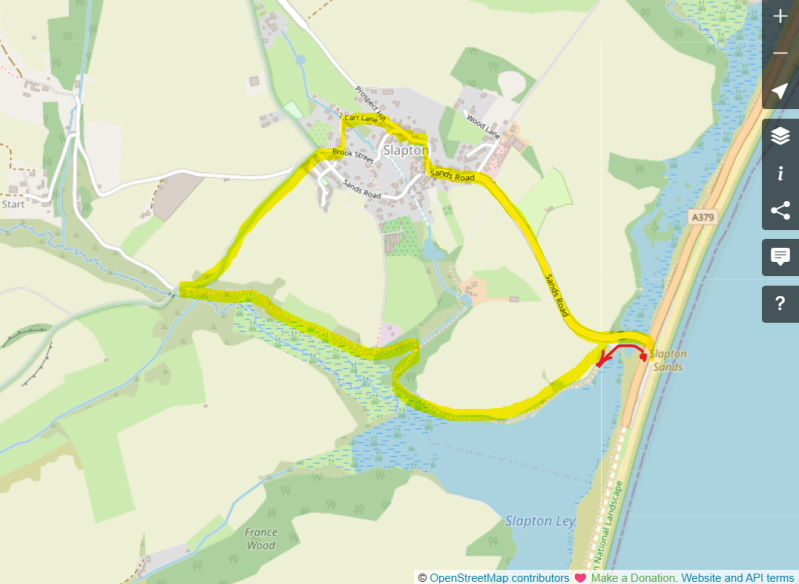
- As mentioned, there’s limited parking in the village. Some parking across the road from Camping site, and near to the entrance of Slapton Ley. Otherwise, the parking at the War Memorial on Slapton Sands is the easiest, and logical for this route – the directions start and end there. Take time while visiting to reflect on the commemoration on the monument.
- The Memorial was presented by the US Army to the people of the South Hams – three thousand of them - who left their villages and farms in December 1943 as the beach of Slapton, the bay in front of you, and the land behind you became a live battle practice area for the D-Day landings over the months that followed. Their sacrifice helped to save thousands of lives and contributed to the end of the Second World War. On a personal note, my father was a despatch rider at this time, carrying orders from US Command at the Salcombe Hotel to the Generals overseeing preparations on the beach here. He would have loved a pint at The Tower Inn.
- From the memorial, cross the Slapton Link road (A379) in the direction of the village, signposted from the junction in front of you. Just after the bridge, look for the entrance to the Slapton Ley Nature Reserve on your left. The well-marked route offers wonderful views over the nature reserve, with plenty of opportunities to stop and study activity on the freshwater lake, and reedbeds.
- The path forks in two after the first jetty, but they combine again later. If conditions allow, follow the left-hand path along the shoreline, and use the other path if the water level is raised.
- After the Ireland Bay hide, round the corner and, at a gate, drop down to your left onto a boardwalk.
- At the end of the boardwalk, bear left. A viewing point provides views over Southgrounds Marsh reedbed and explains the view in front of you.
- At the end of the Slapton Ley trail emerge onto a lane, and turn right to follow the road uphill back to the village. Note, this lane and those surrounding Slapton and Stokenham, are usually very quiet. The storm damage on the A379 that has led to the closure of the Slapton Line has forced local traffic, and some not-so-local traffic onto these lanes. Please take care as you head back into the village.
- You enter the village at a T junction. Go straight across. Follow the narrow road downhill, then round to the left as it starts to meander through this fabulous, ancient Devon village. You’ll soon arrive upon a sign for The Tower Inn, but you’ll need to explore up a lane on your left to actually find it. If you’re passing the Church, you’ve just missed it – retrace your steps a little!
- Continue through the village, passing the village’s 2nd pub – the Queen’s Arms. The road bears left to start to head out of the village in the direction of the beach. You’ll soon pass the Camp site (very good!), and the gravel, then tarmac footpaths that lead back down to Slapton Sands.
Additional Notes
With the A379 closed along the Slapton Line 'Directions' are now even more important!
The A379 Dartmouth to Kingsbridge road is the long, straight road that runs along Slapton Sands, known locally as the Slapton Line. It's vulnerable to winter storms and was catastrophically affected in the early months of 2026 when successive storms wiped a section of it away completely, near Torcross. Through-traffic has ceased, and neighbouring villages either side of the closure have practical, everyday logistics challenges to overcome. Local public transport services are in place to help, but most people will arrive in the area by car. I hope the following information helps.
From Dartmouth, it's straightforward: the A379 runs directly to Slapton Sands and you can access the village without any problems. And — small silver lining — it's now dramatically quieter than it's been since Covid, since it's no longer a through route to anywhere. A pleasant, uncrowded drive along a road that used to carry through-traffic to Kingsbridge and beyond. If you're heading to Torcross, however, and were planning on heading along the coast via Slapton, you'll need to read on and reverse the described route.
From the Kingsbridge side — which matters, because Kingsbridge, Salcombe, Hope Cove and Bigbury are among the busiest holiday spots in the South Hams, and plenty of people staying there will be tempted to just follow the coast road — it's more complicated. The A379 from Kingsbridge still reaches as far as Torcross perfectly normally. However, it does not reach Slapton; that's the closed section.
The alternative is the A381 Kingsbridge-to-Totnes road, which is signposted in and around Kingsbridge. Follow it nearly to the little hamlet of Halwell — and turn onto the A3122 — there's a petrol station at the junction - signposted for Dartmouth. Once you pass the Woodlands Leisure Park entrance, watch for signs to Strete on your right, and follow that lane through. At Strete, you rejoin the A379 and turn right for Slapton.
It's a proper diversion, and it will add real time to your journey. Resist the temptation to shortcut it via the web of minor lanes on the map which your Satnav might encourage you to consider.
Devon's country lanes look inviting on a screen and are, in practice, single-track, high-hedged, and built for a horse and cart rather than diverted holiday traffic — passing places are scarce, and reversing blind around a bend is a routine part of driving them. Best left to the locals and the farmers who actually know them. Take the long way round on the proper roads; it's genuinely the quicker option, when you account for the alternative.
But the key point is: don't be put off, make the journey. The businesses need your custom.
Other Pubs to try in Devon
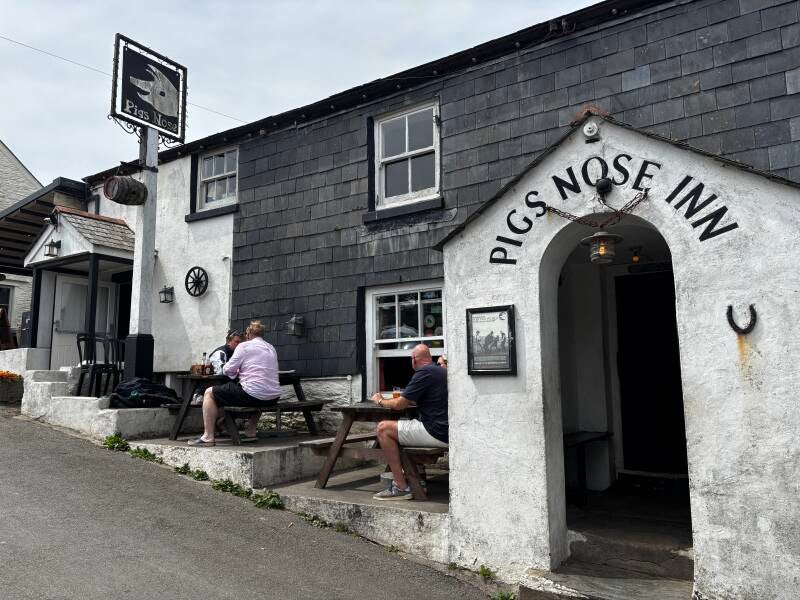
Fabulous Coast Path walk: Devon’s most southerly tip at Prawle Point
5.8 miles

Salcombe to East Portlemouth Circular, via Ferry & the South West Coast Path
3.8 miles
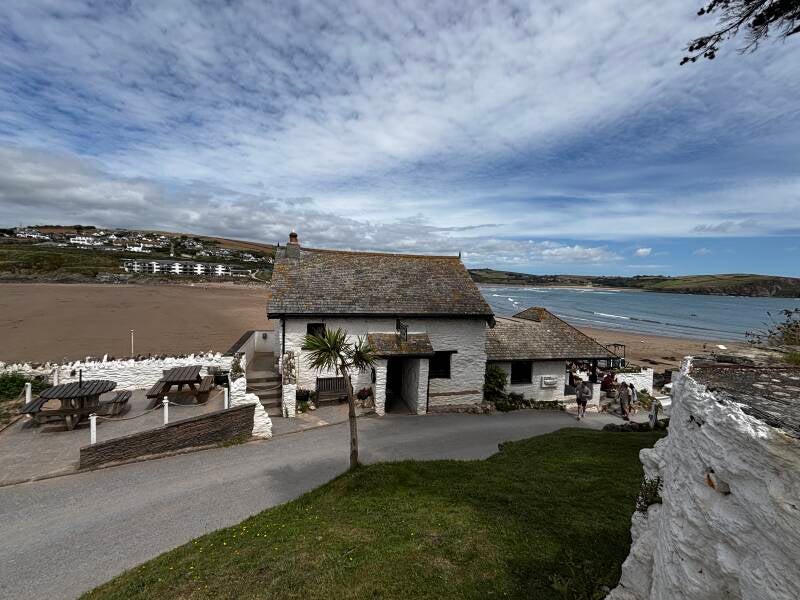
Ringmore & Aylmer Cove, returning via the South West Coast Path
4 miles