

The Logan Rock Inn, Treen
Pub Walk: Granite, Theatre and the Atlantic — A Taste of West Cornwall, 4.4 miles

Try this Pub & Walk
This spectacular circular walk begins at the car park in Treen, a tiny cluster of granite houses and small farms gathered around a couple of narrow bends and a dead-end. As you drive into the hamlet, you pass the Logan Rock Inn, the walk’s eventual destination. The fact that Treen has a public toilet, café and car park is a reminder of how many visitors are drawn to this otherwise wonderfully quiet and remote corner of West Cornwall.
From Treen, the route crosses fields and farm tracks to St Levan Church before reaching Porthchapel and the South West Coast Path. It then follows one of Cornwall’s most dramatic stretches of coast with its stunning coves and beaches, passing the Minack Theatre, Porthcurno and the Iron Age headland of Treryn Dinas before returning across the fields to Treen.
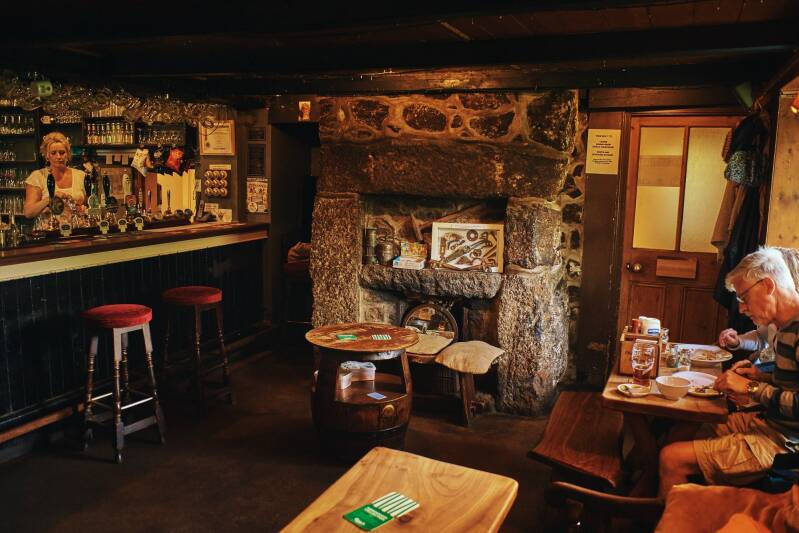
The Logan Rock Inn makes an especially intriguing finish. Behind its traditional granite exterior lies an unexpected sporting gallery, with cricket and rugby memorabilia, photographs, awards and local connections filling its bars, dining rooms and pavilion-like rear building. After a walk through the many identities of West Cornwall — ancient, agricultural, theatrical, technological, coastal and sporting — it is a fitting place to end.
About The Logan Rock Inn, Treen



Last visit: August 2026
I arrived at the Logan Rock not long after opening on a Sunday, and found a pub that was quiet for now but clearly not expecting to stay that way — the reservations book was already filling up for the day ahead.
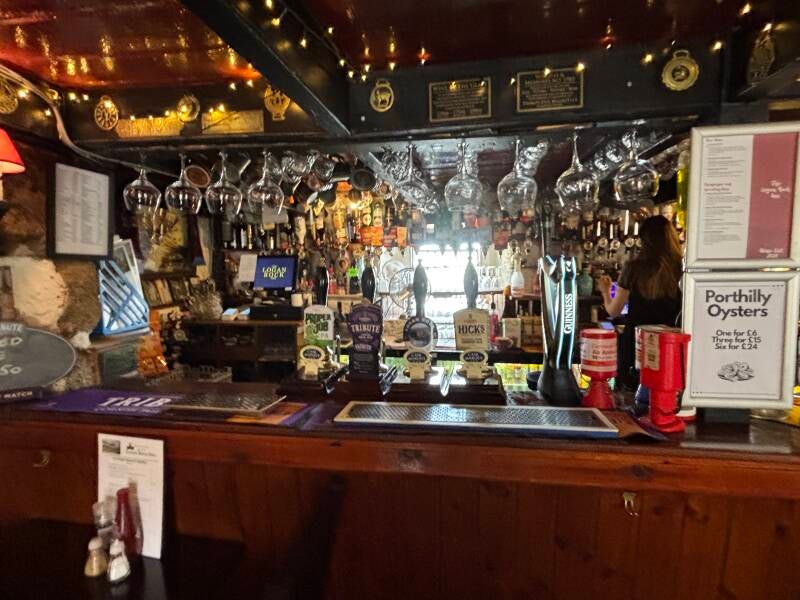
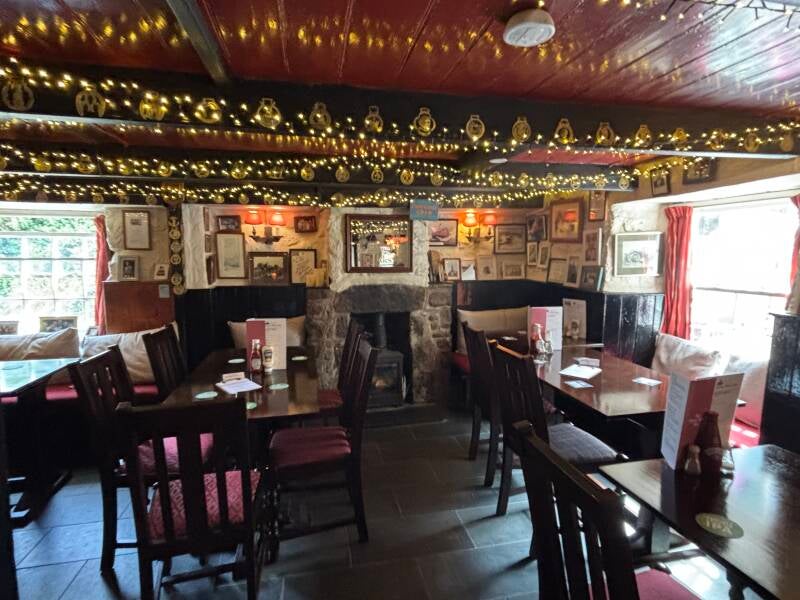
This is a Grade II listed granite inn at the entrance to the hamlet of Treen, a few miles from Land's End and within walking distance of Porthcurno, the Minack Theatre and the Logan Rock headland itself. It's all low ceilings, thick granite walls and warren of separate rooms, and the main bar — properly cosy, menus everywhere rather than obvious space for casual drinkers — is the kind of room that must come into its own with the log burner going and the Atlantic doing its version of The Tempest outside.
What I hadn't expected, and what makes this pub memorable, isn't visible from the car park at all.
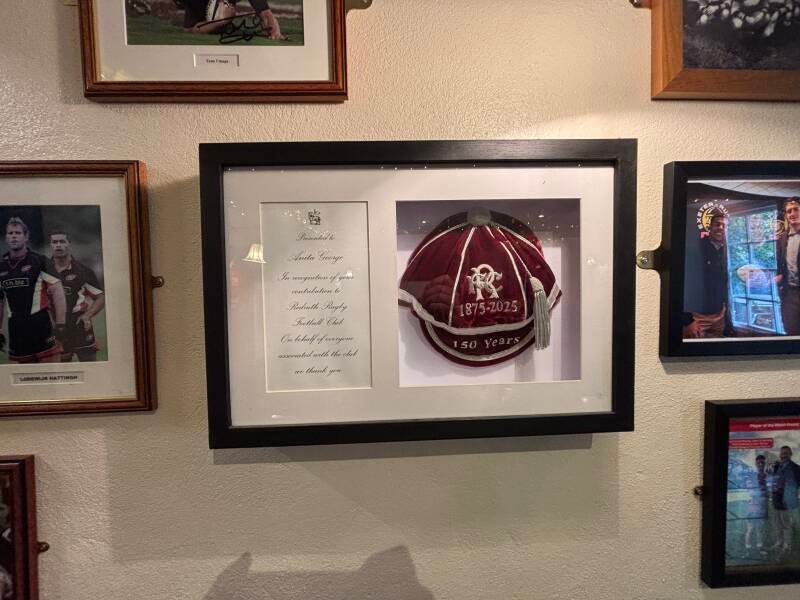
Inside, room after room, is an extraordinary sporting gallery, with rugby and cricket at its heart. Photographs of local teams and players sit alongside images of famous international sportsmen and women, awards, brewery certificates and other memorabilia. It starts in the main bar, continues through a small snug behind it, fills a larger dining room across the entrance hall — reached, I suspect, along what was once a coaching route through the building — and reaches a kind of climax in a substantial timber building at the rear, which feels less like a function room and more like a cricket pavilion, complete with its own near-full bar and a large tribute to Shane Warne.
It's a genuine surprise — you don't expect to find, tucked into a remote corner of Cornwall three miles from Land's End, such a concentrated celebration of sporting memory. For anyone who loves rugby or cricket, as I do, the displays produce that sudden pleasure of recognition — a familiar face, an important match, a local hero, a moment remembered from stadiums a very long way from Treen. And yet none of it feels staged. This isn't a museum exhibition arranged for effect; it belongs to a pub whose social life has clearly been bound up with sport for a very long time.
That connection is closely tied to Peter and Anita George, who ran the Logan Rock for nearly four decades from 1982 onward. Peter died in 2019, but the pub's sporting and community identity hasn't gone anywhere with him and it's still very much a family affair. The Logan Rock continues to sponsor the Peter George Memorial Cup, a local cricket competition, and St Just Cricket Club retained the cup in 2026 for a fourth consecutive year — a photograph of that win hangs among the others. The cup gives the whole gallery a living context: this was never simply a collection assembled to decorate the walls, and it isn't only a memorial to a much-loved landlord either. It reflects an ongoing relationship between the pub, local families, cricket and rugby clubs, and the wider sporting life of West Cornwall — a relationship the Cornish Pirates have themselves recorded, noting the George family's long-standing hospitality including annual Christmas lunches for the squad.
There's plenty here beyond the walls, too. Outside, the pub spreads itself generously across a sun-trap patio at the entrance, umbrella-shaded tables by the pavilion, a proper lawned garden, and a newer terraced area below — all of it looking immaculate even in a summer as punishing as this one, which says something for whoever's still tending the award-winning floral displays. Between the reservations board, the volume of covers, and the sheer footprint of the place, this is a pub built to handle serious numbers without losing the sense that it still belongs to the community.
The Logan Rock is worth the walk for more than its food, its drink, or its proximity to some of Cornwall's most famous sights. It offers a concentrated encounter with another side of West Cornwall — its sporting passions, its local loyalties, its generosity, its people. The coast supplies the drama. Porthcurno, just down the road, supplies the international history. And the Logan Rock Inn, quietly and a long way from any stadium, supplies the human and communal character that ties those different identities together.
Pub Key Information
| WEBSITE | https://www.theloganrockinn.co.uk/ |
| ADDRESS | The Logan Rock Inn, Treen, St. Levan, Penzance, Cornwall, TR19 6LG |
| PHONE | 01736 810495 |
| WHAT3WORDS | ///bedrock.opts.reclined |
| PARKING | The pub has a decent sized car park that can still get very busy. Continue through Treen to the village car park if it's already full up. |
| LOCATION | Simple - drive on the A30 to Land's End, then turn off 3 miles before you get there! |
| HANDY FOR | Land's End; Sennen; Porthcurno beach and Museum; the Minack Theatre. Perhaps all of those are on your list when visiting West Cornwall - make time to do this walk and pub visit also! |
Walk Overview
Starting in Treen, this varied circular walk first heads inland across fields and farm tracks towards St Levan. The route then joins the South West Coast Path and the scenery changes dramatically.
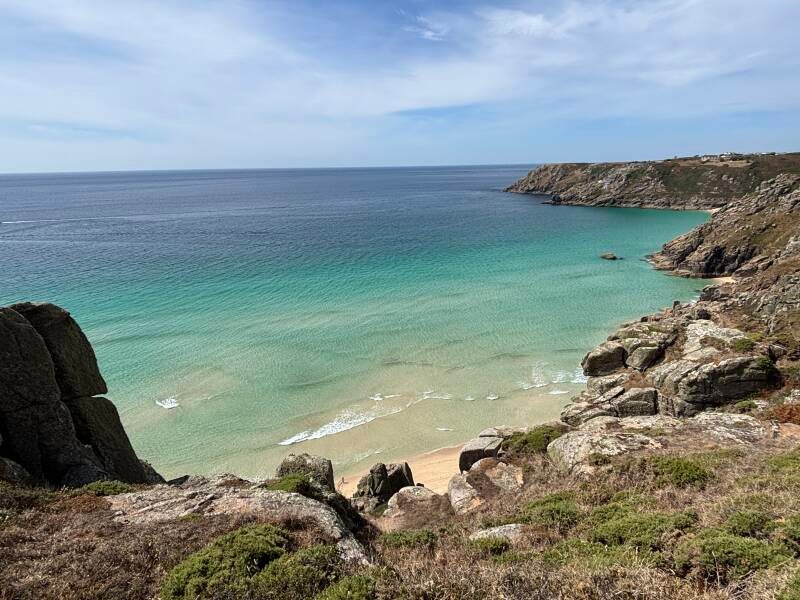
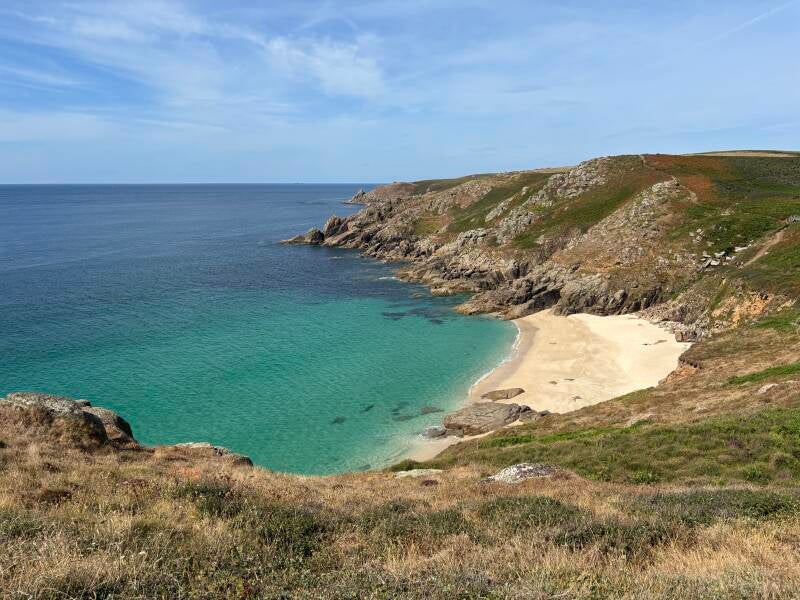
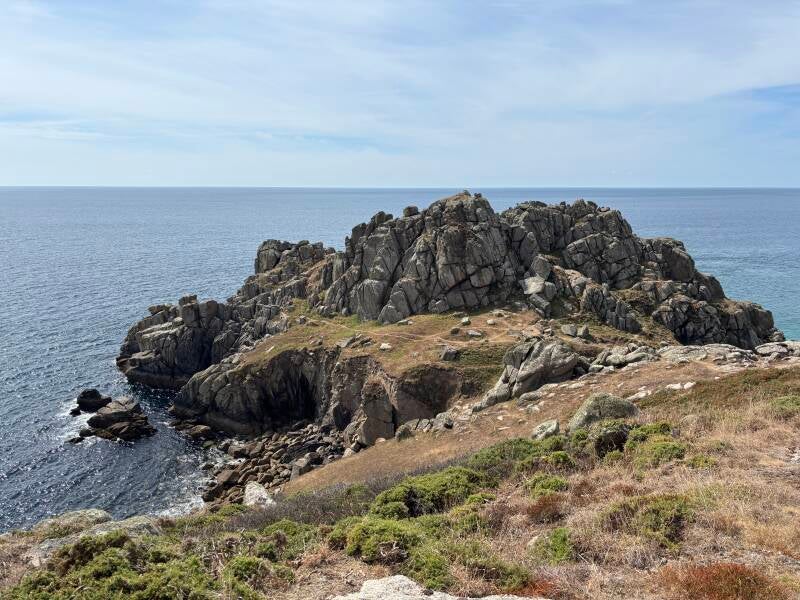
From here, the walk follows the coast towards Porthcurno, passing St Levan’s Holy Well, the remains of an early cliffside chapel, and the superb beach of Porthchapel that I remember from years ago, then the spectacular viewpoints of Rospletha Cliff.
Along the way, there are opportunities to visit PK Porthcurno, the museum occupying the former cable station that once connected Britain with the wider world through its submarine telegraph network. Porthcurno’s communications history is closely linked to the story of Marconi: a 170-foot mast was erected above the valley in 1902 so that cable-station staff could monitor and intercept his wireless transmissions from Poldhu on the Lizard!
The route continues past the Minack Theatre, the extraordinary open-air theatre created by Rowena Cade above Porthcurno, before reaching the Iron Age promontory fort of Treryn Dinas and the Logan Rock headland. The return to Treen crosses open fields and working farmland, eventually bringing walkers back to the village and the welcoming Logan Rock Inn.
This is a rewarding but demanding walk, with some steep coastal steps, exposed cliff paths, uneven ground, stiles and several field crossings. Conditions can change quickly on this exposed section of Cornwall’s Atlantic coast, so sturdy footwear and care near cliff edges are essential.



Walk Key Information
| START/FINISH | Treen's village car park. |
| PARKING | Good sized parking space here, pay by card. |
| GRID REFERENCE | SW 395 230 for the car park |
| WHAT3WORDS | ///shopping.rifled.scored for the car park |
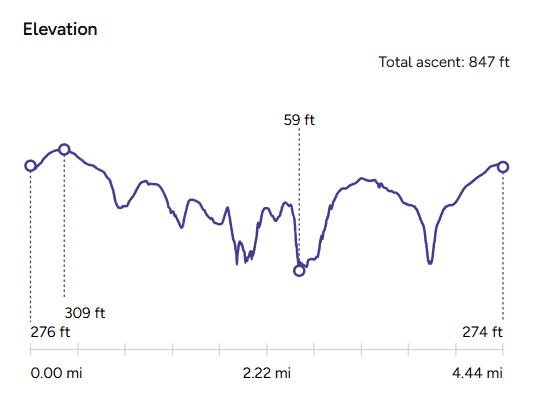
| DISTANCE/TIME | 4.4 miles / 7 km; approx 2 hours |
| ASCENT | 850 feet / 260 metres |
| PATHS/TERRAIN | Fields and farm tracks; coastal footpaths, some steep sections. Very steep cliff steps from the Minack Theatre car park towards Porthcurno, although a road-based alternative is presented. |
| DIFFICULTY | Moderate. More difficult in rough weather. |
| PUBLIC TRANSPORT | Remarkably, there is a bus from Penzance! The 1A service feeds the small villages all the way to Land's End. Check timetables for frequency. |
| TOILETS | A plethora: At the car park in Treen; at St Levan Church; and at Porthcurno. |
| OTHER PUBS TO VISIT | The First & Last Inn at Sennen; and Old Success Inn at Sennen Cove. At St Buryan, try the St Buryan Inn. |
Walk Instructions: Choose what works for you
There are multiple ways to consume the route described below.
- Either follow the online Walk Directions below, or download and print a copy of the route.
- If you have the OS Maps App, you can follow a saved route directly in the OS App.
- Or download the GPX file for use with your chosen GPS-based tracker App, like Strava. Upload the file when you Create a New Route in the App.
Walk Directions
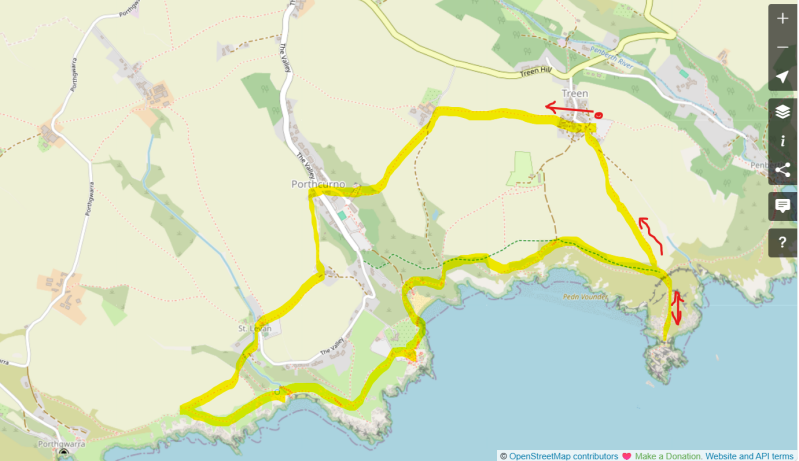
- The Logan Rock Inn marks the heart of the tiny hamlet of Treen and is both the start and finish of today's walk. Continue past the pub towards the village car park. There’s a camping site adjacent to the car park, and some other sites in the area too. It’s handy to reach Land’s End, Logan Rock, Porthcurno and multiple bays and beaches off the beaten track. Exit the car park in Treen and continue straight ahead past the public toilets and café. As the road bends right, the farm in front of you is called ‘Houses Farm’. A footpath sign guides you to the left-hand side of it and onward into fields beyond.
- Go into the field, which may have cattle in it, and follow the left-hand boundary hedge up to the top of the field. Continue straight ahead through a series of fields and farm gates, and then to a wooden footpath kiss gate.
- Go through the wooden gate, then immediately over a stile into a field, to follow a stone wall to your right in the immediate direction of a farm ahead, called Trendrennen Farm. Follow the field around its boundary in front of the farm, until you come to stile to exit onto a gravel drive. Go left.
- Within 25 metres there are two footpath options. One is to the left-hand side down a farm track. Instead, take the one that goes into the field then slightly right. The OS Map suggests a hard right hand turn at the hedge line, but there’s a correction to make. You’ll see a telegraph pole on the far hedge boundary diagonally across the field. That’s the goal. You should see a distinct grass path towards it within 50 metres of coming into this field.
- Our direction at this point is Porthcurno. There’s a stile over the hedge made out of granite steps. Cross it, and drop into the next field. I see a distinct path has been trodden in a direct line from the stile to the exit from the field diagonally across. The fields here are often planted with potatoes. If crops are growing, follow the field boundary to the right rather than crossing directly.
- The exit of this field is clear – an overgrown stile and a broken farm gate – and into rough grassland on a clear path. The exit to this field goes onto a distinct path that curves around to the right, and emerges above Porthcurno Museum, well worth exploring either now or after the walk. Continue on to the tarmac driveway that leads to the museum.
- Continue ahead and exit the museum‘s driveway straight onto the main road that leads down into Porthcurno. The footpath that we want to take is immediately across the road, running up a driveway in front of a house called The Retreat. Look for a route with grass growing in the middle of the drive! We’ll arrive lower down in Porthcurno later, but now we’re aiming for St Levan Church and then the coast path.
- This lane rises gently uphill to a metal farm gate. Continue straight ahead as it levels out. The route continues on a grassy path between fields. As the path approaches some cottages, there’s another route alteration to flag. You might see an overgrown footpath sign & stile ahead. Instead, the route continues around the corner to the front of the cottages, and exit into the fields in front of them via a metal gate.
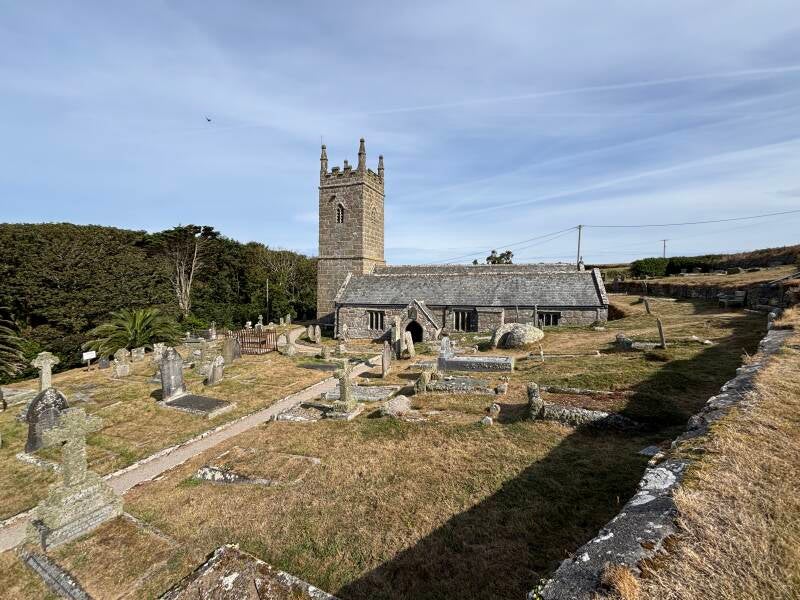
- There’s a distinct footpath running across this next field. Look on the horizon for the Tower of St Levan’s Church – that’s the right direction. Look out for the Celtic cross in the field as you cross, then navigate the granite cattle grid into the Church Yard. The Church is 12th Century, but there was an earlier chapel closer to the beach of Porthchapel which we’re heading towards soon. Take a look around. The St Levan Stone is the real showpiece. It sits by the south porch, split clean in two, and legend has it the saint himself did the cracking: he liked to sit on the rock when tired from fishing, and one day struck it with his staff and split it clean through, as a keepsake of his favourite seat. There's an older, darker layer beneath the whimsy too — in pre-Christian times the stone was venerated in connection with fertility rites, a use the Church later neutralised by raising a tall granite cross, nearly seven feet high, right next to it.
- Leave the church yard at its main exit. (There are toilets here, just as the church yard path meets the main road). Cross the road and immediately join a gravel driveway downhill, passing some granite cottages on your left, and the Rectory on your right.
- The footpath continues straight ahead on an obvious route and starts to make its way towards the Coast Path through ferns and undergrowth. At a fork in the path, take the narrower footpath uphill to the right through the hedges, then continue along this path straight ahead until it levels out in a field.
- Follow the field boundary with the field hedge on your right. The clear path proceeds through undergrowth, and then very soon reaches a junction with the South West Coast Path. The scenery now changes dramatically, and from here onwards the walk is going to be a succession of wonderful coastal views. Turn left to follow the Coast Path towards Porthchapel – explore some of the viewpoints to get some great views of the beach.
- As you make your way to the rear of Porthchapel Beach, look out for St Levan’s Holy Well, and a small stone chapel below it, reached by stone steps and thought to be among the oldest Christian buildings in Cornwall. Continue East on the Coast Path in the direction of the Minack Theatre and Porthcurno,
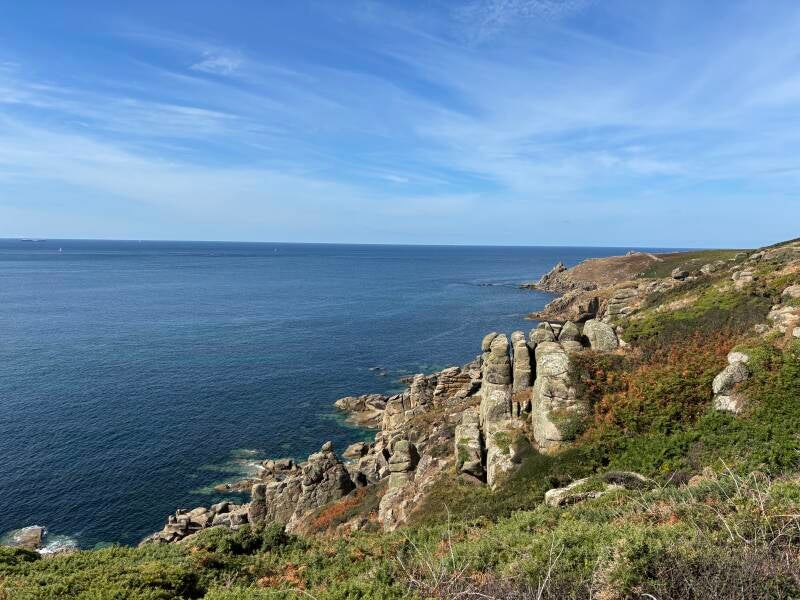
- Just before the Minack, visit Rospletha Cliff for more excellent coastal views in both directions, to Logan Rock and back towards Porthchapel. At the highest point there’s a concrete base with an iron cage attached for housing a mast. It was erected in 1902 by The Eastern Telegraph Company to monitor Marconi’s experiments on the Lizard. It was a total height of 170 feet and had a large arial attached at the top. Basically, Marconi was discovering wireless communications, and the team at Porthcurno were trying to show that the messages were insecure and could be intercepted – they were spying on the Italian inventor!
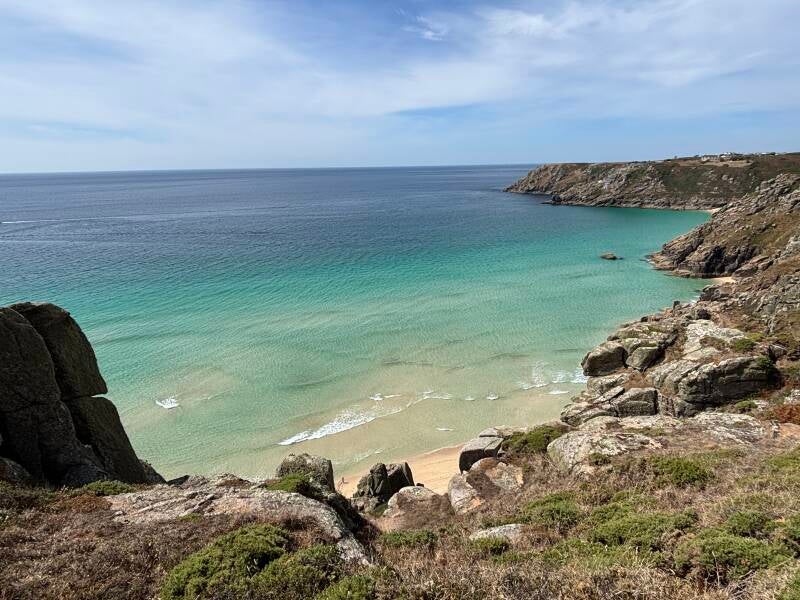
- Continue now on the Coast Path to the car park of the Minack Theatre. There’s a footpath sign at the entrance/exit that guides you left, away from the Minack, to follow the main road down into Porthcurno. There is actually a footpath straight ahead across the car park which offers excellent views of Porthcurno Beach and the coves across to Logan Rock. The path down is quite dramatic, via steep steps and handrails, so use the road if it’s not for you or if the weather is against you.
- If you followed the road, make your way towards the beach to pick up the Coast Path again. You don’t need to reach the beach, just follow the Coast Path markers. There’s a Telegraph Cable marker on the hill above you on the other side of the beach and that’s the next goal, up a steep section of the Coast Path. There’s an old military defence box there too.
- Back on the path, pass through a gap between two small granite buildings. The path soon splits to follow a level bridleway straight ahead, or the coast path that drops down to the right. They arrive at the same place further along, but this section is all about finding great vantage points for photographs as you proceed towards the headland and Logan Rock ahead of you.
- The headland is referred to as Treryn Dinas and was an Iron Age hill fort, a scheduled monument now owned by the National Trust. Logan Rock is balanced on the promontory above the sea, a rocking stone that once could be rocked with light pressure. It’s now also the name given to the surrounding tip of the headland and a major tourist area in this part of Cornwall.
- For the return to Treen, from the headland look straight back inland. Weather permitting, you should be able to see the rooves of the village on the horizon. Make your way back towards the main Coast Path and look for a wooden footpath gate slightly left heading inland, into a field.
- Pass through the wooden kiss gate, and over a stile into a (potato). This is the main route for those visiting Treen to walk directly to see Logan Rock, so the path is distinct across each of the fields in front of you to the village. Exit the fields via a wooden kissing gate to join a farm track and bear left, then chop right before a house with a large glass conservatory to arrive back near the café and toilets at Treen.
Additional Notes
St Levan Church, Well and Chapel
St Levan Church stands within an ancient religious landscape above Porthchapel. The present church is medieval, with early work dating from the Norman perio, then later additions. By the south porch is the St Levan Stone, a large granite boulder split cleanly in two. Local tradition says that St Levan struck it with his staff after resting there following a day’s fishing; older associations with the stone may reach back into the pre-Christian past.
There's an older, less whimsical layer beneath that story too. In pre-Christian times the stone was venerated in connection with fertility rites, a use the Church later neutralised by raising a tall granite cross, nearly seven feet high, right beside it.
Inside, the bench ends carry their own small carved stories — a shepherd, a jester, and two fish sharing a single hook, a nod to the local tale of Levan's nieces choking on fish he'd caught. St Levan himself is thought to have lived in the sixth or seventh century, with the Cornish "Selevan" possibly linked to St David's across the water in Pembrokeshire — one of several threads tying this corner of Cornwall back to Wales
The church, well and former chapel form a remarkable group of related sacred sites: St Levan’s Holy Well lies beside the footpath descending towards Porthchapel (it’s older name – Porth Levan), while the remains of a small chapel stand lower down the cliff, reached by a flight of granite steps. The chapel may date from the early medieval period and is considered one of Cornwall’s oldest Christian buildings, although its precise history remains uncertain. Water from the well is still used for baptisms in the parish church.
The Minack Theatre
The Minack Theatre began with Rowena Cade’s willingness to lend her cliffside garden to a local group of amateur performers. Their first production there was Shakespeare’s The Tempest in 1932, performed on a rough stage with simple seating, the sea as a backdrop and batteries and car headlights providing the lighting.
What followed was not the construction of a theatre in the conventional sense, but the patient transformation of a cliff. Cade and her gardener, Billy Rawlings, moved earth and granite, built terraces and steps, and continued improving the theatre over many years. The name Minack comes from the Cornish meynek, meaning a rocky or stony place. Cade eventually gave the theatre to a charitable trust in 1976, ensuring that her personal vision could continue as a working venue.
The Minack’s power comes from the combination of imagination and setting. It is both a functioning theatre and a monument to one woman’s determination to make something extraordinary from the landscape immediately around her home.
Porthcurno: a remote place with a global reach
Porthcurno looks like a remote beach at the end of a narrow valley, but has a history that has nothing to do with sand or sunbathing.
From 1870, this quiet cove became the landing point for a telegraph cable connecting Britain directly to India, and within a couple of years the Eastern Telegraph Company — formed here under the Cornish cable pioneer John Pender — had turned Porthcurno into the hub of a worldwide network.
Messages that had once taken six weeks to reach India began arriving in minutes. By the early twentieth century, fourteen separate cables came ashore on this one beach, and Porthcurno had become, briefly, the most important telegraph station on Earth — the nerve centre of the British Empire's communications, run from a Cornish valley most people would otherwise have passed straight through.
The former cable station is now PK Porthcurno, a museum that tells the story of the people, technology and international connections associated with the site.
Porthcurno therefore adds another identity to the walk — not just beach and coastline, but Cornwall as a centre of global communication.
Logan Rock: a remarkable piece of foolishness
Logan Rock is a massive granite boulder that once rocked on its natural pivot when pushed, even gently. In April 1824, Lieutenant Hugh Goldsmith and a group of sailors from the cutter HMS Nimble decided to prove that it could be moved. Using levers and bars, they succeeded in dislodging the stone and sent it tumbling down the cliff.
The local reaction was less admiration than outrage.
Goldsmith was ordered to restore the rock at his own expense, and the task proved considerably more difficult than knocking it down. More than 60 men, using ropes, winches and other equipment, were eventually needed to return the stone to its headland. The operation took months and cost Goldsmith more than £130 — a ruinous sum at the time. The rock was finally replaced in November 1824, although it apparently never regained quite the same rocking movement as before.
The episode gives Logan Rock an unusually entertaining history. It is not simply a natural landmark or a picturesque viewpoint, but the surviving evidence of one spectacularly ill-judged attempt to disprove a local legend. The original account of the restoration is associated with the Logan Rock Inn, giving the pub a direct connection with the story of the landmark that provides its name.
Other Pubs to try in Cornwall
Walk the finest section of the South West Coast Path, from St Ives to Zennor
6.5 miles

