

Snowshill Arms, Snowshill
Walk: Snowshill, Stanton, Shenberrow Hill - A Cotswold Education packed into 7 miles
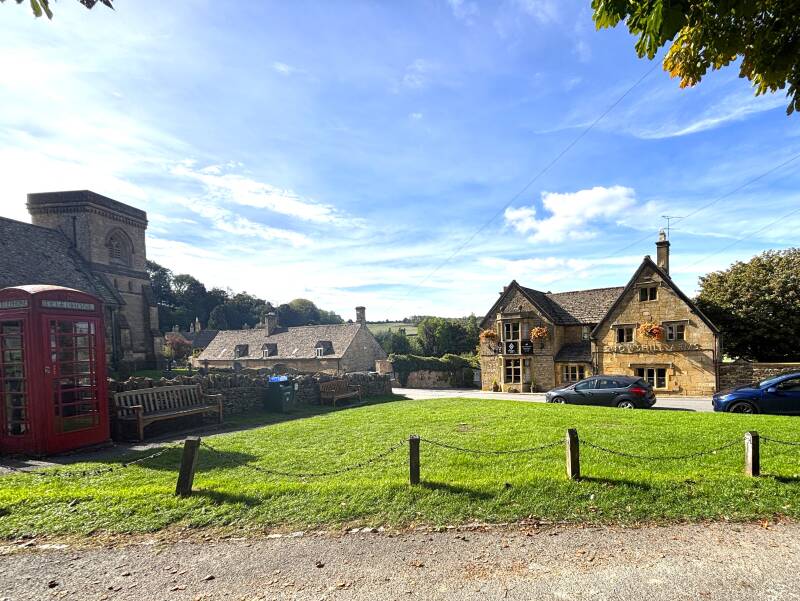
Try this Pub & Walk
If you want a walk that teaches you the Cotswolds rather than merely shows them, start in Snowshill.
This tiny hilltop village — topographically isolated — sits high above the Vale of Evesham, at around 1,000 feet. Its name, derived from the Old English snaw and hyll, means simply “snow hill”; local tradition holds that snow remains in the folds of the hill long after it has disappeared from the Vale below.
Snowshill feels like a place that has always been here. And, in some respects, it has.
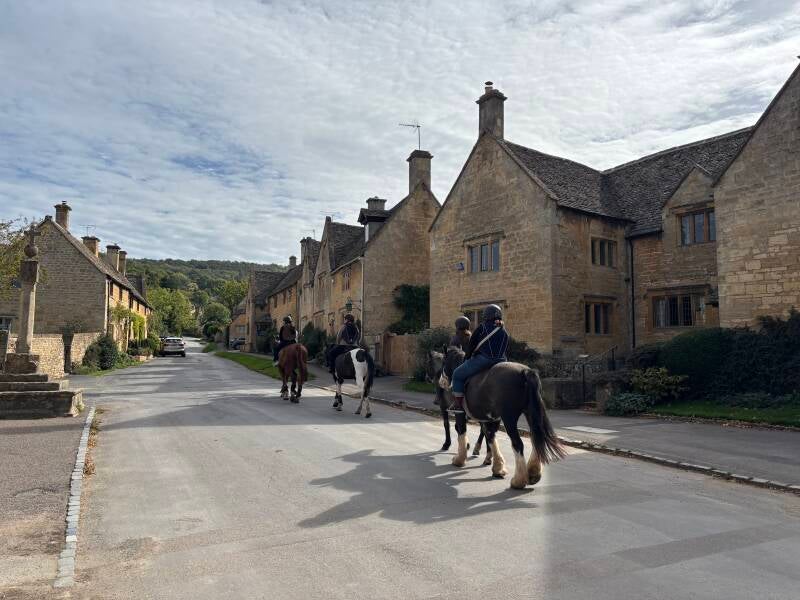
From the village green, the route heads out on the Winchcombe Way, then joins the Cotswold Way for a dramatic descent of the escarpment into Stanton. Here the character of the Cotswolds changes almost as dramatically as the landscape: Stanton's honey-coloured houses and immaculate lanes have an almost cinematic perfection, before the route turns upwards again via Shenberrow Hill and returns to the high wolds.
It's a six-mile walk of contrasts — upland and vale, open country and village, preserved and lived-in — but, more importantly, it explains the landscape beneath your feet.
And waiting back at the top is the Snowshill Arms — warm, genuine and unpretentious, and exactly the kind of pub that shouldn't exist in a village of this size, yet somehow does.
Snowshill Manor undoubtedly helps bring people here. Charles Paget Wade's extraordinary house and collection have given the village a cultural draw far beyond anything its size might suggest. But the Manor came very late in Snowshill's story.
The pub feels older than the attraction — a genuine village pub that has somehow retained its place at the centre of a very small community.
About The Snowshill Arms, Snowshill


Last visit: September 2026
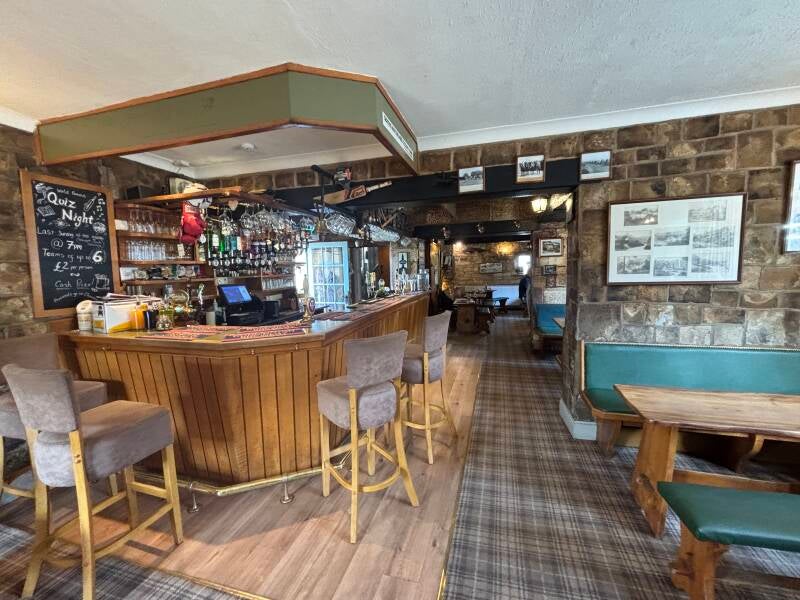
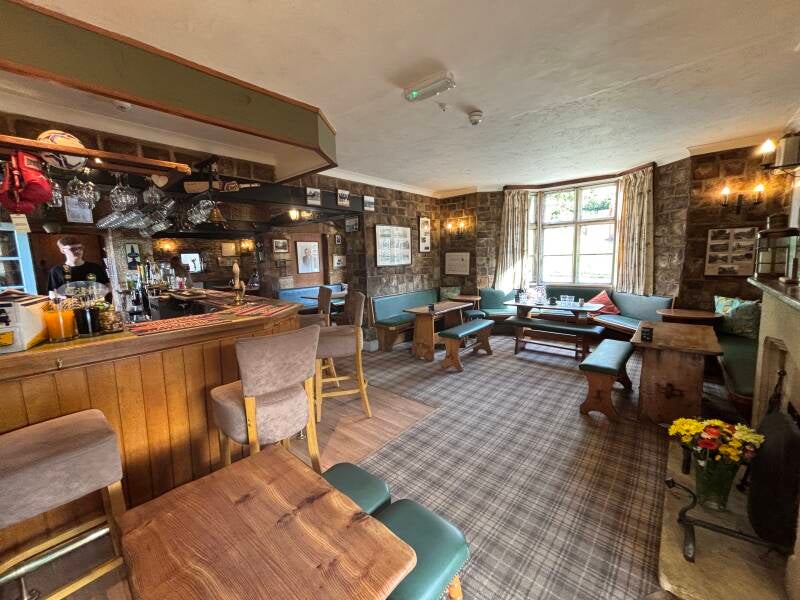
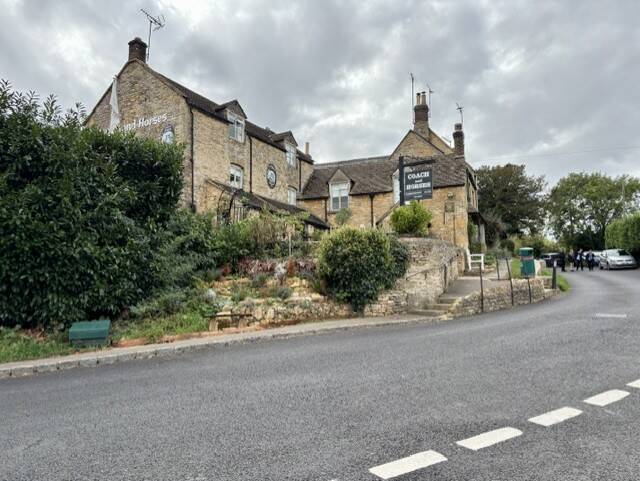
The Snowshill Arms sits at the heart of this lovely village, across the green from the church, at the end of Snowshill Manor's garden. It is an unassuming building from the outside, but step inside and it feels immediately like a pub rather than a visitor attraction that happens to serve beer.
And that distinction matters in Snowshill.
It's the Manor brings a steady stream of National Trust visitors, while the village's position on the Cotswold Way and surrounding footpaths brings walkers. Yet the Snowshill Arms has a life which clearly predates, and exists beyond, those visitors.
Look at the photographs on the walls and you see village teams, local events and familiar faces — a visual reminder that when the walking crowd has gone home and the lights go out at Snowshill Manor, this is still a village pub with local's history.
The pub's own timeline records Edward Skey running it in 1826, followed by a succession of Beards: Anthony in 1861, John in 1872, William in 1884 and Edwin in 1895. In 1914, Blanche Ada Beard took over from her mother. The Beard family's association with the pub therefore stretches across much of the nineteenth century and into the twentieth. The Biles family took over in 1968, followed by the Schad family in 1979.
It is an unusually tangible thread of village continuity — one which helps explain why the Snowshill Arms feels less like a pub in a Cotswold village and more like the pub belonging to that village.
Today it remains resolutely unpretentious.
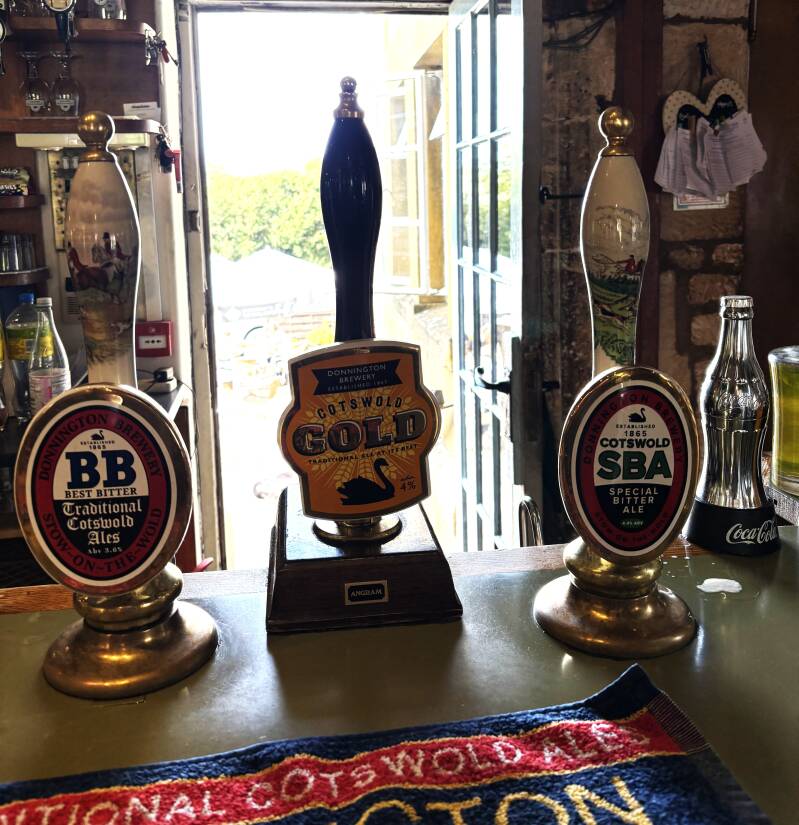
This isn't a gastro-pub trying to turn a tiny upland village into a dining destination, nor a celebrity-chef showcase, nor somewhere engineered for the Instagram visitor. It's a proper drinking pub, serving Donnington beers alongside straightforward food, and it seems entirely comfortable with the fact that its customers might have arrived after a walk, after visiting the Manor, or simply because they live nearby. Frankly it's a blessed relief that it's 'just a normal pub'.
My midweek visit in September perhaps captured it at its best.
The pub was surprisingly busy for a warm early-autumn lunchtime, with walkers and visitors mixing with the sort of customers who clearly knew the place. Service was genuinely friendly and helpful from the moment I arrived. We joked about the wisdom of ordering a curry on such a warm day; the joke was still going when I came to pay. And before settling on the Donnington BB that I've come to enjoy, I was happily offered the chance to taste some of the other beers first.
Those small interactions are difficult to put on a menu or a website, but they tell you rather more about a pub than a collection of carefully chosen adjectives. Landlords - your staff can make the difference!
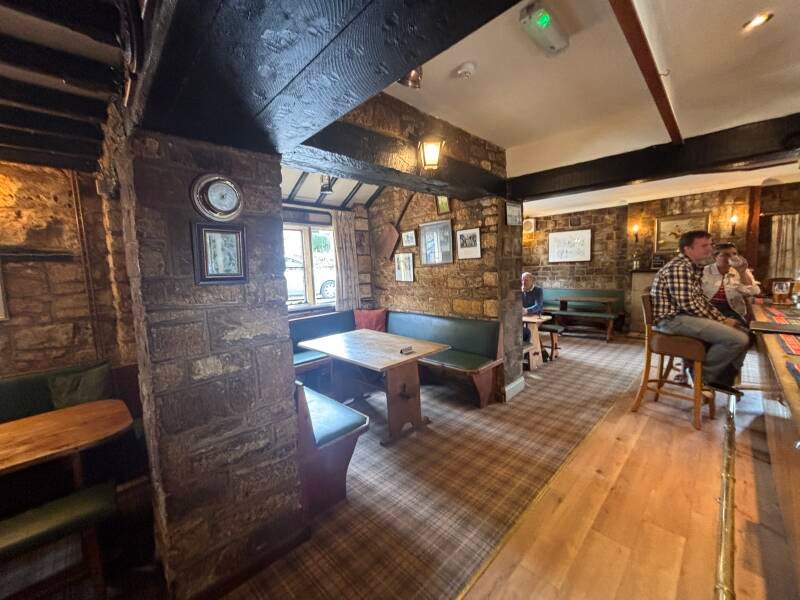
Inside, the building adds to the feeling. It appears that separate rooms have been partially opened into one another over time, leaving alcoves and tucked-away tables. You get a degree of privacy without being detached from the rest of the pub — somewhere to settle into your own corner while still hearing and feeling part of the place.
And perhaps that's the best description of the Snowshill Arms: it feels lived in.
For a village of Snowshill's size, a pub like this might seem almost an anachronism. Instead, it feels like part of the reason the village remains a village.
And that makes the Snowshill Arms very much worth the walk.
Pub Key Information
| WEBSITE | http://www.snowshillarms.co.uk/ |
| ADDRESS | Snowshill Arms, Snowshill, Near Broadway, WR12 7JU |
| PHONE | 01386 852653 |
| WHAT3WORDS | ///surpasses.farms.niece |
| PARKING | Car park at the pub, limited parking in the village. |
| LOCATION | Snowshill is a secluded Gloucestershire village high on the western edge of the Cotswolds escarpment, roughly 2.5 miles south of Broadway, and less than 10 miles from Moreton-in-Marsh. The nearest main road is the A44. |
| HANDY FOR | Snowshill Manor; Broadway |
Walk Overview
This is a Cotswolds education in miniature — upland solitude, escarpment drama, vale openness, and village contrast. Leave Snowshill along quiet lanes and field paths to join the Winchcombe Way, where you immediately sense Snowshill’s height and exposure. Join the Cotswold Way towards the escarpment, where the Vale of Evesham appears — vast, agricultural, almost continental in scale. This is the moment you understand why Snowshill feels remote: the drop is steep, the separation real.
At the bottom lies Stanton, a village of immaculate stone houses, clipped lawns, and cinematic symmetry. It is beautiful — undeniably — but feels carefully preserved, as though maintained for a period drama. The ascent back up Shenberrow Hill is broad and open, a steady climb that returns you to the high wolds. The contrast with Stanton is striking: from carefully preserved perfection to elemental upland in minutes. Snowshill reappears suddenly, tucked into its high bowl of fields and stone. And at its centre, the Snowshill Arms offers exactly the welcome you want after such a walk — warm, genuine, and rooted.



Walk Key Information
| START/FINISH | Snowshill Arms, Snowshill, Near Broadway, WR12 7JU |
| PARKING | Car park at the pub, limited parking in the village. |
| GRID REFERENCE | SP 096 338 |
| WHAT3WORDS | ///surpasses.farms.niece |
| DISTANCE/TIME | 7.1 miles /11.4 km; approx 3 hours |
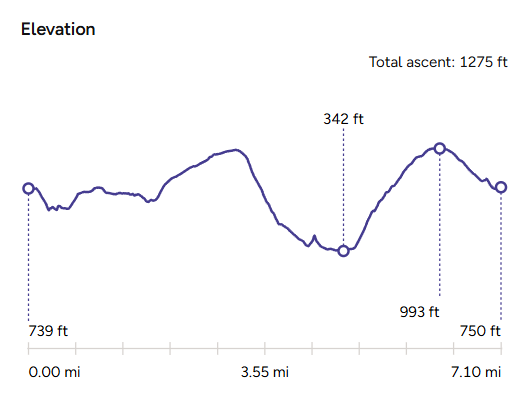
| ASCENT | 1275 feet / 390 metres |
| PATHS/TERRAIN | Lanes, field paths, gravel tracks |
| DIFFICULTY | Moderate - some steep ascents. |
| PUBLIC TRANSPORT | Broadway is nearest bus stop, 2.5 miles away. |
| TOILETS | Pubs in Snowshill and Stanton |
| OTHER PUBS TO VISIT | The Mount Inn, Stanton is in a picture perfect position above the village. Also, try the Plough Inn at Ford – it has a historic interior. |
Walk Instructions: Choose what works for you
There are multiple ways to consume the route described below.
- Either follow the online Walk Directions below, or download and print a copy of the route.
- If you have the OS Maps App, you can follow a saved route directly in the OS App.
- Or download the GPX file for use with your chosen GPS-based tracker App, like Strava. Upload the file when you Create a New Route in the App.
Walk Directions
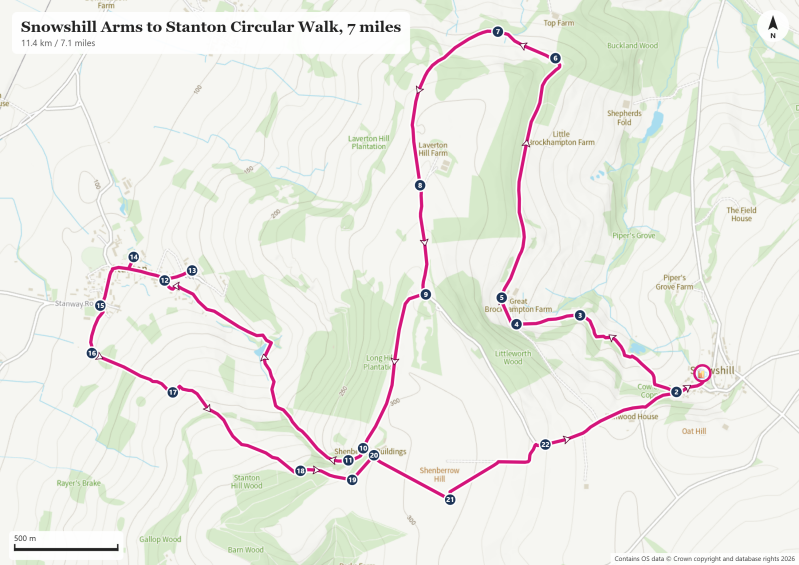
- The Snowshill Arms sits opposite the green and church on the road through the heart of this quiet village. Follow the village road with the pub on your right and the church on the left. Round a bend to pass the newly renovated Oat Hill Farm on your left, and a few metres further along, just before you reach Oat Hill Coachouse, follow a footpath on your right that drops downhill from the road on a concrete cobbled driveway to start the trek to Stanton. (Waymark #2)
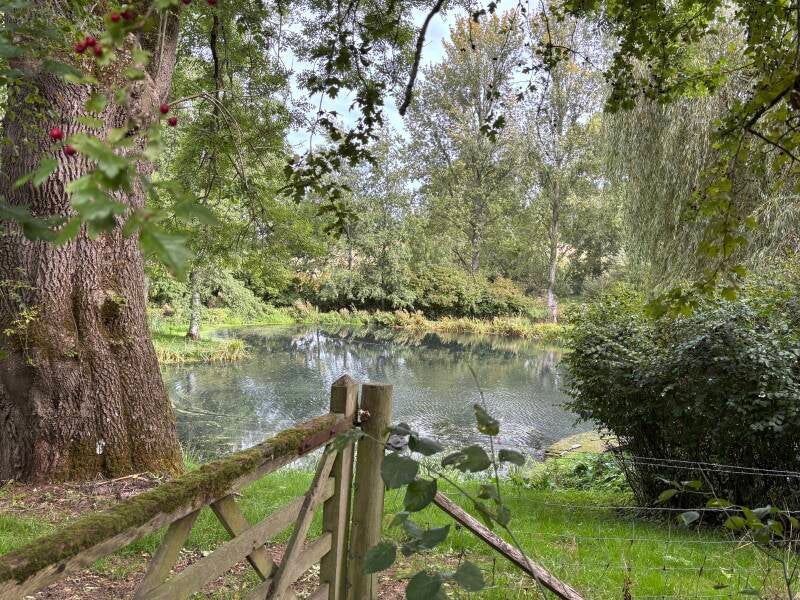
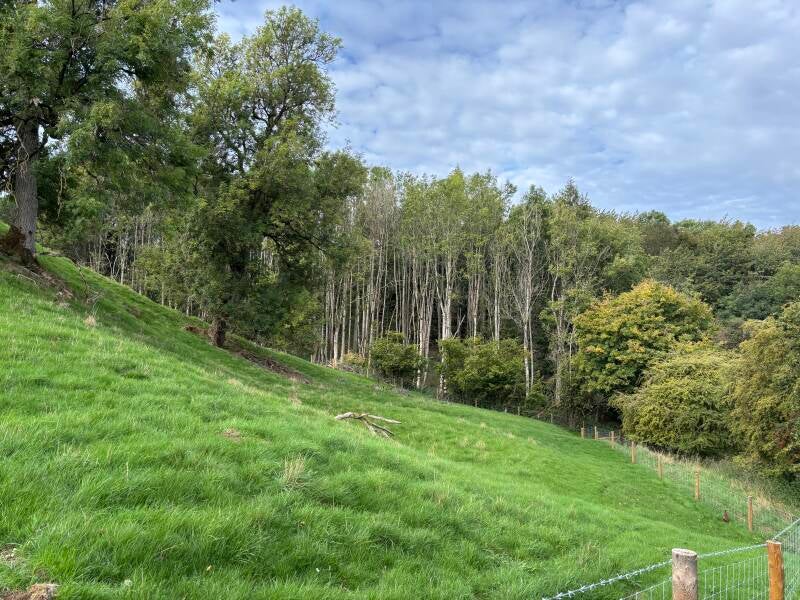
- Follow this strangely cobbled track down to a gate. There are ducks on the pond to your right, but the footpath markers guide you to the left here before the gate, along a field fence. Follow this grassy path as it heads towards woodland, and follow the footpath signs gently uphill through the woods, to the left.
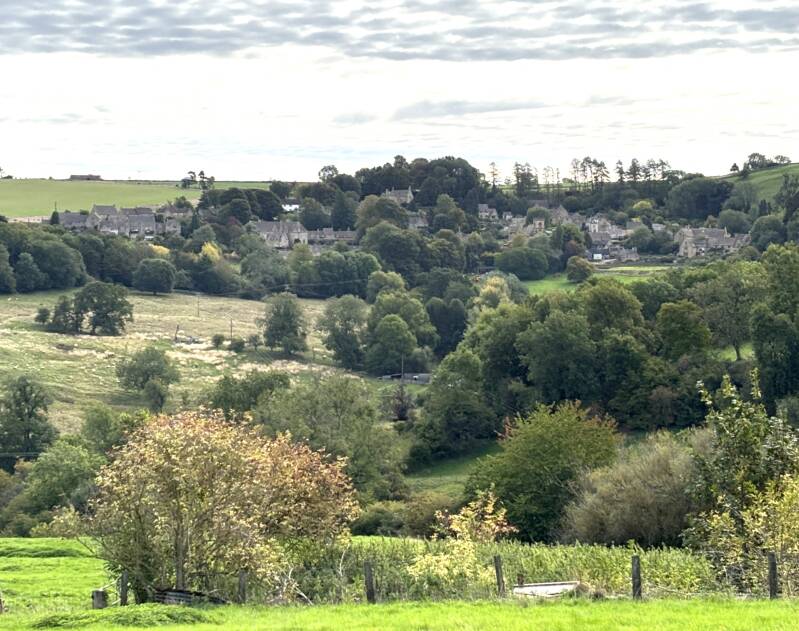
- The path soon leaves the woodland and opens out into fields with lovely views across the valley towards houses on the hill above. You’ll see the path, and the gate to aim for uphill ahead of you.
- Leave the field through a wooden footpath gate onto a gravel drive (waymark #5). Turn right. There’s a fork in the track immediately – the OS Map suggests the right of way is to the right, but that has a determined Private Driveway sign. The easier option is to the left to loop around Great Brockhampton Farm.
- From here, continue straight ahead. This route soon becomes the Winchcombe Way, arriving from the right. Continue straight ahead on the farm track, easy walking now above the valley with good views of Snowshill on the opposite side.
- Pass through a wooden footpath gate, and then as the path forks, go left after a few yards, then straight ahead on a stony track offering extensive views of the Vale of Evesham to your right.
- At a junction in the tracks (waymark #7), leave the Winchcombe Way as it makes its way north west towards Buckland, and instead keep left to follow the Cotswold Way heading south. The route here is a gentle but steady uphill on distinctive paths.
- Eventually, pass through a wooden gate to the side of Laverton Hill Farm and continue straight ahead. Near Shenberrow Farm a number of footpaths seem to converge. Our route is to the right – over the cattle grid of Shenberrow Farm (waymark #9), to follow its driveway slightly uphill on an arc. We’re continuing to follow Cotswold Way signs all the way to Stanton.
- Continue on this route, passing Shenberrow Farmhouse, to your left (waymark #10). Continue on the route straight ahead, and then a downhill section begins offering some relief! Follow the route all the way downhill signposted for Stanton.
- The path arrives in the picture-perfect village, and at the first junction, our route is to the left, to proceed down the ‘High Street’ in the direction of the church. You’ll soon understand why this immaculate village was used in episodes of Sherlock Holmes. Note, however, before continuing to the left, that you should turn right at this junction to head up to The Mount Inn – even if just to see the views from its terrace (waymark #13)!
- Follow the road down through the village. The church is set slightly away from this main street – it’s a building that seems to reflect the village’s long association with estate stewardship and architectural preservation. Just beyond the village cross, turn left and follow this village road to the point it starts to bear right to exit the village (waymark #15) . Instead, at this bend continue straight ahead to follow the Cotswold Way as it passes between two yew hedges.
- Follow the Cotswold Way to cross a field. At the exit (waymark #16), now take the left-hand route (blue bridleway markers). This is the start of the uphill return towards Snowshill, back up the Cotswold escarpment.
- Continue to a marker post towards the top of the hill, and go left to pass a series of gates, then through a wooden gate, and soon a right-hand turn, to continue to the top of the hill. Still following the blue markers, on field paths now.
- You will spot a Toblerone-shaped stone on your left – you’re on the correct line - and continue uphill through the meadow. Pass through a metal farm gate, and continue into the next field on a distinctive path to another gate in hedgerow. (there are two gates in the hedge – you need the right-hand gate).
- The route across the field continues gently uphill towards woodland, which you enter via a metal gate, still following blue signs. Continue ahead uphill on a clear path on the woodland fringe. The path opens into a clearing. There are a number of footpaths arriving/leaving here, but continue straight ahead, up to a metal gate onto a farm track (waymark #19). Congratulations – you’ve just climbed the Cotswold escarpment!
- Continue towards the barn of Shenberrow Farm. At the barn (waymark #20), turn right onto the bridleway, to start to head directly to Snowshill. It runs gently uphill to the side of a field initially, and finally plateaus to mark the start of the descent to the village.
- Continue, to then pass through a metal gate to join a farm track. Turn left (waymark #21). You’ll clearly see the footpath markers a little way in front of you. Turn right here and continue on established paths. Leave the field and follow the fence line to the left-hand side.
- At the road bear right, and follow it all the way into Snowshill, eventually passing Oat Hill Coachouse as you arrive back in the village.
Additional Notes
A deeper story of Snowshill, Stanton and the high Cotswolds
To walk from Snowshill is to step into a landscape shaped long before the Cotswolds became synonymous with honey-coloured cottages and weekend escapes.
The high ground here has always been a little different: exposed, colder and separated from the valleys below. Snowshill is one of the clearest expressions of that upland character. At around 1,000 feet above sea level, it is one of Gloucestershire's highest villages, and its position helps explain both its character and its name.
The village is recorded as Snawesill in the Domesday period, followed by forms including Snauzilla and Snoweshulle; the name derives from Old English snaw, snow, and hyll, hill. The local conservation appraisal records the traditional observation that snow can remain in the folds of the hill long after it has disappeared in the Vale of Evesham.
It is an evocative name for an evocative place.
Yet Snowshill was never completely cut off. Archaeological evidence points to prehistoric activity in the area, and the settlement lies close to the course of two prehistoric trackways. More importantly, its medieval history connected this tiny upland community to a much larger world.
In 821, King Coenwulf of Mercia gave the manor of Snowshill, together with its tithes and chaplaincy, to St Mary's Abbey at Winchcombe.
That is a remarkable connection when you look at Winchcombe today.
The modest market town tucked beneath the Cotswold escarpment gives little impression of the power it once possessed. In the Anglo-Saxon period, Winchcombe was an important royal centre, and its abbey became the focus of a substantial landed estate. Snowshill was one of the small agricultural settlements within that wider world. Stanton was another: King Coenwulf had given Stanton to Winchcombe Abbey in 811.
So the walk from Snowshill to Stanton is, in a sense, passing between two places that were once part of the same medieval landscape.
For the people who lived here, however, the immediate landscape would have been much more important than the politics of abbots and kings. Snowshill developed as a farming village, with sheep and wool central to its economy, while local quarrying provided the stone from which the settlement was built. The old maps show fields, woodland, a sheepfold and quarry immediately around the houses.
It is easy to imagine the small geographical world that this created. House, church, fields, pasture, woodland and neighbouring farms were all within walking distance. Generations of families could live much of their lives within sight of the same ridge lines and fields. The village would have been small enough for the church and the pub to be more than buildings: they were places around which community life revolved.
That continuity is part of what still makes Snowshill feel different.
The medieval manor survived the Dissolution of the Monasteries in 1539, when it passed out of Winchcombe's hands and into royal ownership. It was subsequently given to Catherine Parr, then passed to Edward VI and Mary I before Mary gave it to Frances Bulstrode in 1557.
But the extraordinary Tudor history of the Manor should not obscure the more important story of the village itself. For centuries, Snowshill remained fundamentally a small agricultural settlement.
The great transformation came much later.
In 1919, Charles Paget Wade bought Snowshill Manor. By then the house had declined into a farmhouse, occupied by tenant farmers for well over a century. Wade saw something very different in it. He restored the building, lived in the much smaller Priest's House, and turned the former farmyard into an Arts and Crafts garden. He then filled the Manor with his extraordinary collection, creating a theatrical world quite unlike anything else in the Cotswolds.
The National Trust now cares for more than 16,000 objects at Snowshill Manor. But Wade's creation is, in many ways, an extraordinary late chapter in the history of a village that had already been here for centuries.
The descent into Stanton makes another part of the story visible.
Stanton is every bit as beautiful as its reputation suggests. Its church is remarkable, its houses are beautifully preserved and its lanes have the almost improbable neatness that makes the village so recognisable.
But the village's present appearance is not simply the accidental survival of an untouched medieval settlement.
In 1906, Sir Philip Sidney Stott bought the Stanton estate, including around 882 acres and much of the village. Over the following decades he undertook an extraordinary programme of restoration and improvement, affecting the houses, church, school and public realm. He even provided the village with a reservoir and street lighting.
Stott didn't create Stanton from nothing — the village is much older than he was — but he played a huge part in determining the version of Stanton that survives today.
Perhaps that explains the difference in atmosphere.
Stanton can feel almost curated: a remarkably complete vision of what an ideal Cotswold village might look like.
Snowshill feels more accidental, more lived-in. Its character seems to have survived rather than been consciously reconstructed.
Neither is more authentically Cotswold than the other. They simply tell different stories.
And the walk makes that difference unusually clear.
You begin high on the wolds, where Snowshill feels tucked into its own landscape. Then you cross the escarpment and descend towards Stanton, with the Vale of Evesham opening out below you. The scale of the landscape changes. The apparent isolation of Snowshill suddenly makes sense.
Then you climb again, via Shenberrow Hill.
The ascent is a reminder that the escarpment isn't merely a pretty backdrop. It is a physical division between two very different landscapes. From the top, the Vale stretches away below, and Snowshill once again feels like the small upland settlement it has been for centuries.
By the time the village reappears, you understand it rather differently.
Snowshill isn't simply a pretty Cotswold village.
It is a small community on the high ground, shaped by farming, wool, stone, weather and centuries of continuity — connected to a great medieval abbey, touched by Tudor history, transformed by Charles Wade, and now sustained by a mixture of residents, walkers and visitors drawn by the extraordinary Manor.
And at its centre, the church and the pub remain.
After a walk that has taken you from the high wolds to the Vale and back again, the Snowshill Arms feels like exactly what a village pub ought to feel like: not an attraction, but a place to come home to.
Other Pubs to try in Gloucestershire
Longborough and Sezincote – looking beyond the Cotswolds Postcard.
5.1 miles

Guiting Power & Naunton Villages, Eyford Park & Barton via the Wardens Way
9 miles
From Gustav Holst to Cooper's Hill Cheese Rolling. Fine Cotswolds Circular.
6 miles