

The Flemish Weaver, Corsham
The Walk: Peacocks, Parks & Port: Historic Corsham & The Flemish Weaver, 4.3 miles
Try this Pub & Walk
Situated just south of the Cotswolds between Bath & Chippenham, the quiet market town of Corsham shares all the beautiful, honey-toned stone attributes of its northern neighbours. It's one of Wiltshire's best-kept secrets.
At first glance, it feels like a full-scale theatrical stage set for a period drama. The High Street is entirely pedestrianised, allowing you to wander freely past grand Georgian facades, striking multi-gabled 17th-century weavers' cottages, and lawns where magnificent peacocks roam completely unbothered by passersby. It is so perfectly preserved that when the BBC filmed Poldark here, the production crew barely had to change a thing to transform the town into 18th-century Truro - allegedly, all they needed to add was a scattering of horse manure to hide the paving!
At the Eastern end of this cinematic backdrop sits the grand Elizabethan estate of Corsham Court. At the other stands the almost palatial Methuen Arms, standing guard at the western end of the High Street, a former coaching inn now the flagship of the Butcombe pub stable.
Yet this is also a place whose fortunes were built on the stone beneath its feet, whose railway connections transformed its industrial history, and whose underground workings would eventually play a remarkable role in Britain's national defence – for a time, another best kept secret.
This 4.5-mile route systematically reveals the town's layered past, moving seamlessly from a quiet medieval churchyard into sweeping, sheep-dotted parklands, before guiding you right down the spine of the historic High Street.
And the pub?
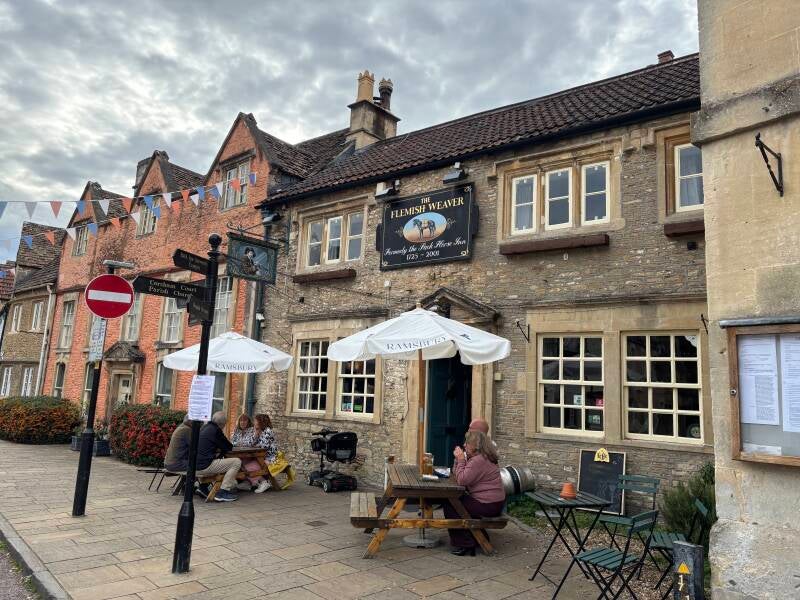
I had originally intended to make the Methuen Arms my destination, given its prominent position and its historical associations with Corsham. But a recommendation from volunteers at the Almshouses sent me elsewhere, to the independent Flemish Weaver. I'm very glad I listened. Its collection of rooms, nooks, memorabilia, excellent beer range and chatty locals made it a wonderful discovery.
It is the perfect spot to unlace your boots, sit by a roaring fire, and toast a truly magnificent Wiltshire gem.
About The Flemish Weaver, Corsham




Last visit: October 2026
"The Met is a Butcombe pub, their flagship. You should try the Flemish Weaver instead—it’s independent."
So came the advice of two lovely lady volunteers at Corsham’s Lady Margaret Hungerford Almshouses. It was a recommendation that proved impossible to ignore, though in a historic town like Corsham with pub choices, following it takes a deliberate act of will. The Methuen Arms – The Met – named after one of the town’s most famous families had been my intended destination for this walk!
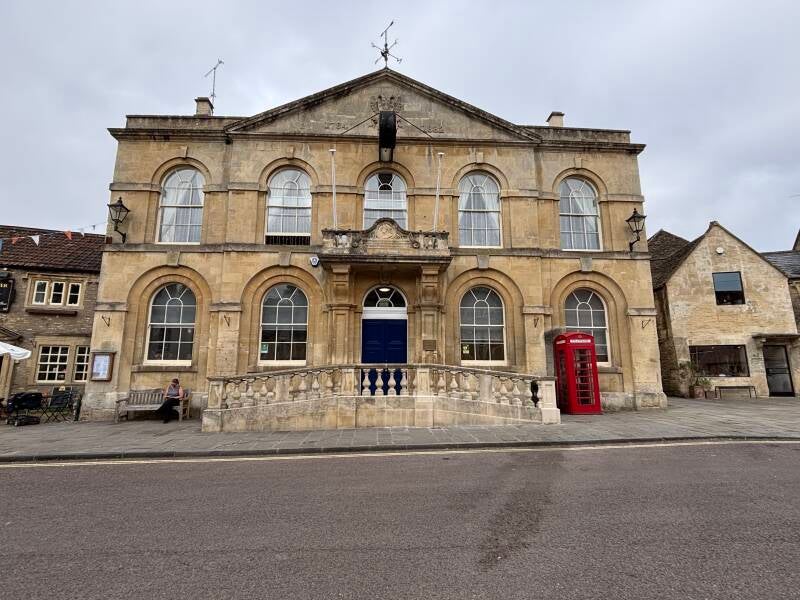
The Flemish Weaver sits right at the top end of the High Street next to the Town Hall. This area marks the original heart of old Corsham. Positioned firmly within line of sight of St Bartholomew’s Church and the grand estate of Corsham Court, it is a setting so densely packed with architectural jewels and heritage that it is tantalisingly easy for a casual visitor to get distracted and walk right past.
To do so, however, would be a mistake.
The building itself dates back to 1625, originally serving as the parish vestry on church land—holding administrative authority over the town long before local councils existed. By the late 18th century, it was licensed as a pub under the name The Pack Horse, a nod to the drovers and laden pack horses transporting locally produced wool. A glass panel inside still carries the name.
Its 'modern' name, The Flemish Weaver, pays homage to the 17th-century Flemish cloth workers who fled religious persecution in mainland Europe and settled nearby in Corsham’s famous weavers' cottages. They laid the foundations for the town’s prosperous textile trade.
Step through the doorway, and any lingering urge to keep moving vanishes. The Flemish Weaver feels like a proper pub should: warm, unpretentious, and full of soul. The interior opens into a series of naturally divided spaces, complete with cosy nooks, timbered corners, and walls crammed to the brim with curios, antiques, and local memorabilia. It is the sort of place that demands a quick wander around to take it all in before you pick a spot to settle down.
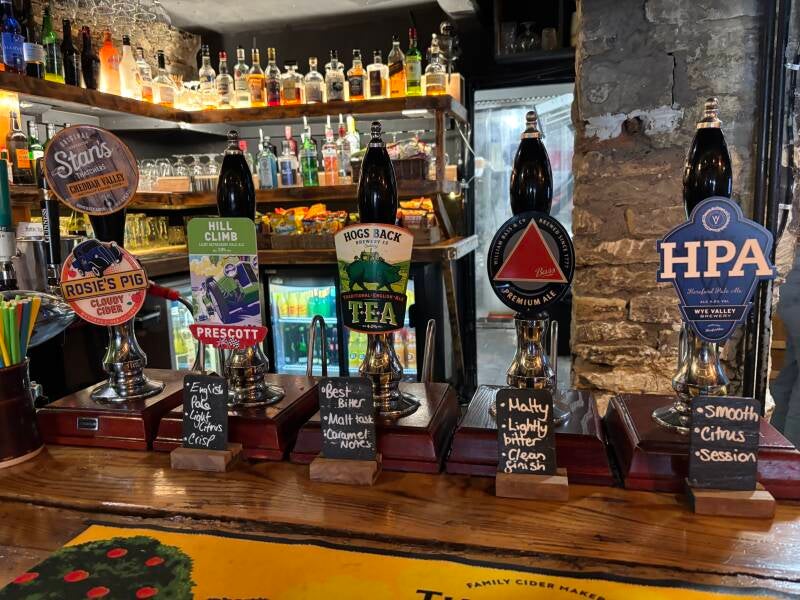
Behind the bar, a fabulous beer range caters to every palate, complemented by a menu that has earned an excellent reputation. Arriving a little early for tea, I opted for some tasty bar snacks, which filled the gap admirably.
Most tellingly, the pub was inhabited by chatty locals who clearly adored the place. They insisted it hadn't changed in fifty years. I learned it had been renovated in 2022, so whoever has been responsible has done a masterly job. The character feels authentically accumulated rather than artificially concocted, and I imagine the atmosphere when the rooms are full is nothing short of electric. I visited on a quiet Tuesday afternoon, so returning on a bustling evening is a commitment I’ll gladly make.
I had just one final question to settle before leaving. Having seen no sign of Corsham’s famous free-roaming peacocks during my stroll, I had begun to wonder if their apparent omnipresence was exaggerated. But right on cue, as I stepped back out onto the street, a pair of them were waiting outside—as if sent to usher me towards my bus stop.
The Almshouse volunteers had pointed me in exactly the right direction too. Amidst a town overflowing with history, The Flemish Weaver isn't just another landmark to admire from the outside—it is the pub discovery that turns a good visit to Corsham into an unforgettable one.
Don't just walk past; walk in.
Pub Key Information
| WEBSITE | https://flemishweaver.co.uk/ |
| ADDRESS | 63 High Street, Corsham, SN13 0EZ |
| PHONE | 01249 591959 |
| WHAT3WORDS | ///myth.breathed.poses |
| PARKING | None at the pub. Long Stay at Post Office Lane Car Park, Newlands Road, Postcode SN13 0BS or ///masterful.glare.nitrate |
| LOCATION | Corsham is off the A4 between Bath and Chippenham. |
| HANDY FOR | Bath; Castle Combe |
Walk Overview
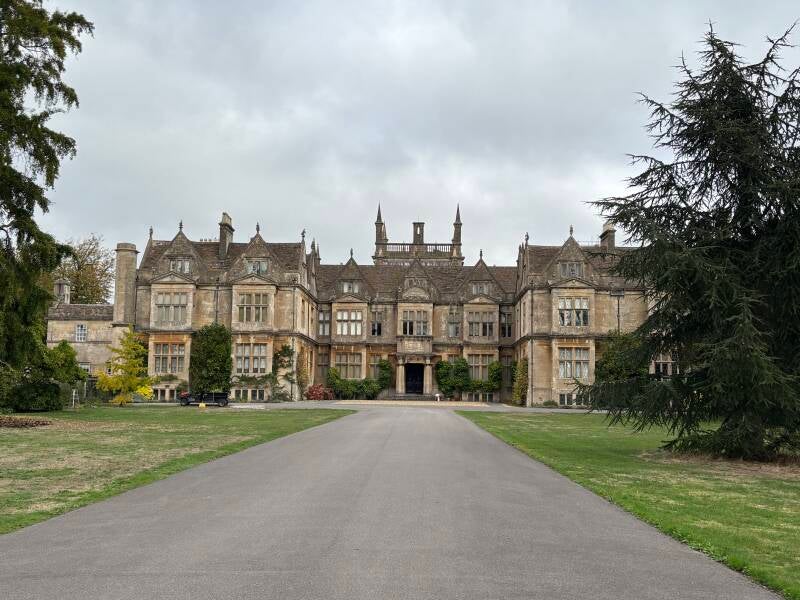
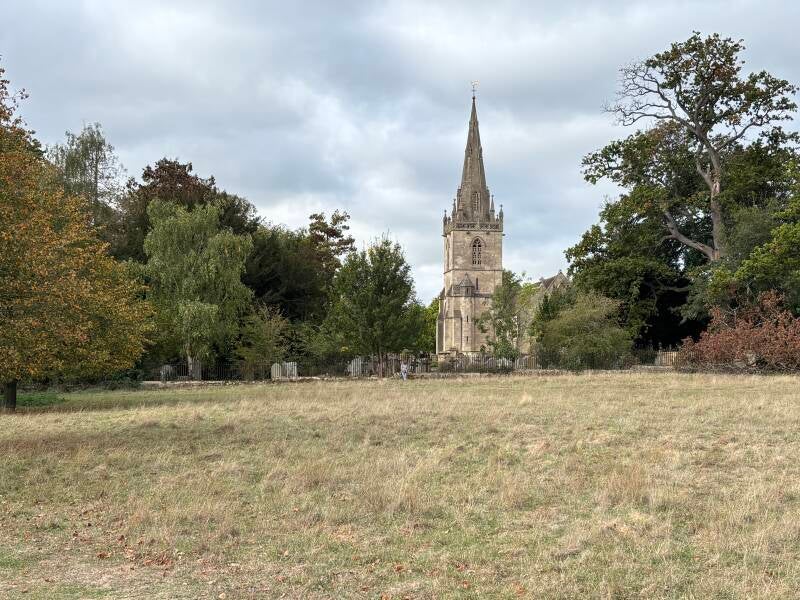
This is a gentle journey through more than a millennium of Corsham’s history. The route sets off right at the historic heart of the town, near the Flemish Weavers’ Cottages before dropping down to Church Street, the oldest part of Corsham. Here you’ll find the grand, guarded gates of Corsham Court, and the ancient St Bartholomew’s Church.
The walk opens out into the expanse of Corsham Park, formerly a royal deer park passing the tranquil waters of Corsham Lake on its southern bank and leaving the park near a charming stone cottage, once an estate boathouse. The route then follows fields and quiet lanes past ancient farmsteads of Westrop and Easton.
Re-entering Park past the giant stone pillars of the old turnpike carriage drive, the path cuts back across the grounds along a sunken trench that once bounded the historic deer park.
Joining an avenue of rare surviving elms, you exit through magnificent, towering gates onto Lacock Road—coming face-to-face with Lady Margaret Hungerford’s 1668 Almshouses. From there, pass The Methuen Arms to return up the historic High Street.




Walk Key Information
| START/FINISH | Flemish Weaver, 63 High Street, SN13 0EZ |
| PARKING | Post Office Lane Car Park, Newlands Road, SN13 0BS |
| GRID REFERENCE | ST 874 706 for pub start |
| WHAT3WORDS | ///myth.breathed.poses for pub start |
| DISTANCE/TIME | 4.3 miles / 6.9 km; approx 2 hours |
| ASCENT | 145 feet / 45 metres |
| PATHS/TERRAIN | Pavements, lanes, field edges, parkland paths |
| DIFFICULTY | Easy |
| PUBLIC TRANSPORT | On bus route between Bath & Chippenham. Chippenham is nearest train station. |
| TOILETS | Various options in Corsham town |
| OTHER PUBS TO VISIT | The Methuen Arms (SN13 0HB) is the flagship Butcombe Inn. The Three Brewers (SN13 0AS) is excellent too. |
Walk Instructions: Choose what works for you
There are multiple ways to consume the route described below.
- Either follow the online Walk Directions below, or download and print a copy of the route.
- If you have the OS Maps App, you can follow a saved route directly in the OS App.
- Or download the GPX file for use with your chosen GPS-based tracker App, like Strava. Upload the file when you Create a New Route in the App.

Walk Directions
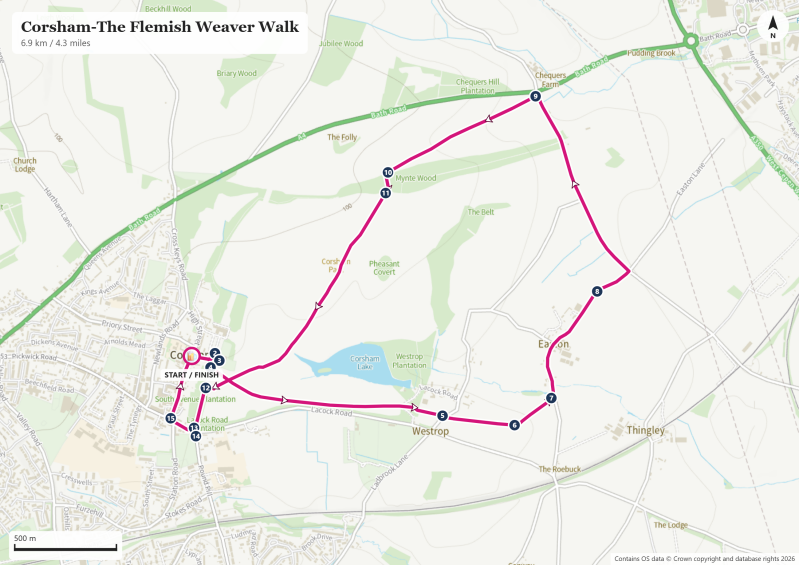
- From The Flemish Weaver you’ll see the old Town Hall, a former Market Hall, to your immediate left, and further along the Flemish Weavers Cottages. Cross the road towards the Post Office to advance down Church Street in the direction of Church Square, home to Corsham Court and St Bartholomew’s Church. (Waymarks #2 and #3).
- Corsham Court is now a privately owned stately home. It is open to the public on certain days, less frequently in Winter. Check their website for details. The church of St Bart’s dates back to Saxon times and has been much altered since. It’s a fascinating place to visit, and to help to understand the history of Corsham.
- There’s a parking area in Church Square, and a metal gate beyond it into a tree-lined avenue. Pass through the gate, then immediately go left to cross a stile into Corsham Park, with St Bart’s now to your left. (#4).
- Set out slightly right in a diagonal direction on a parkland grassy path through the trees. The path soon transitions to a narrower stony track as it heads towards a hedge boundary, and soon curves to run in parallel to Corsham Lake, which comes in to view on your left and the Lacock Road over the hedge boundary to your right.
- At the furthest end of the lake is a cottage that was once a boat house. Following the boundary to the right, find a footpath kissing gate, with a route clearly signposted straight ahead between two private properties, where we leave Corsham Park and head towards the hamlet of Westrop.
- Pass through a wooden kissing gate into a field (#5) and continue straight ahead to a visible exit in the hedge on the other side of the field. Exit through a kissing gate onto the quiet lane near Park Farm, and crossover to continue the public footpath over an old stone style into the next field.
- The OS route guides you across this field, roughly in the line of a row of telegraph poles, although there’s no visible path to follow here. Instead, I chose to follow the field boundary around the field to the left, following fences and then a fabulous example of dry-stone walling until the field exit emerges to the left. This looks more like the accepted route, and you soon see the waymarked footpath route again: a wooden stile by a metal farm gate into the corner of the adjacent field. (#6)
- A grass track is distinguishable diagonally across the field here, to a gateway in the far corner.(#7)
- Exit the field via an improvised stile to the right-hand side of the metal gate and arrive onto a lane in the hamlet of Easton. Turn left. There’s a 1-mile section of easy tarmac walking for this part of the walk. Pass the gorgeous Easton House on your left. It’s a Grade II* listed building with 16th Century origins. Continue straight on along the lane to pass Easton Court Farm on your right, and further along the lane to pass Easton Farm on your left.
- Continue for a further 400 metres to reach a road junction. Turn left here and continue for ½ mile, eventually passing the eastern boundary of Corsham Park and the old gates of what would have been a carriage driveway to Corsham Court. Continue to the junction with the A4. (#9)
- Here, pass through a metal kissing gate into the northern section of Corsham Park to the left and continue on a distinctive path to the right of the large tree immediately in front of you as you enter the Park.
- The grassy track is a very gentle uphill route, passing through an old metal kissing gate into the next section of the Park. Continue straight ahead.
- Exit the pasture area into woodland (#10). Pass over an old bridge, which carries the public path over what was a private walkway for the Methuens of Corsham Court beneath. The path soon emerges from the woodland and cuts to the right slightly towards a metal kissing gate (#11). Cross into the sheep pasture in this section of the Park, continuing straight ahead as you make your way back to Corsham.
- The field track continues, and starts to follow the line of a ditch on the right. This was an old ‘ha-ha’ boundary separating the deer park from the main park.
- Pass through another of the old metal kissing gates. Corsham Lake becomes visible once again on your left-hand side as we continue ahead along the line of the ditch. Corsham Court comes into view, and later St Bartholomew’s shows itself too.
- Continue straight ahead passing the church to your right, crossing the path we originally set out on in when entering Corsham Park. Exit the Park onto an avenue of elm trees (#12) - aim for a metal footpath gate that has numerous white sign boards on it. Turn left on the wide gravel drive to exit through tall ornamental formal gates, once the southern exit of Corsham Court (#13).
- Corsham’s war memorial is to the left, and the 17th Century Almshouses and School House, set up by Lady Margaret Hungerford, are across the road (#14). The visitor centre is supported by volunteers - a visit is highly recommended. From the ornamental gates, turn right back towards Corsham town centre. At The Methuen Arms, turn right (#15) follow the pedestrianised High Street to make your way back to The Flemish Weaver.
Additional Notes
The Story of Corsham: A Wiltshire Gem & Keeper of National Secrets
If the historic High Street feels like an extraordinarily preserved time capsule, it is because Corsham’s survival is no accident. While other market towns sacrificed their medieval footprints and ancient lanes to 20th-century road-widening schemes, Corsham quietly bypassed modernity. What remains today is a multi-layered tapestry stretching back over a millennium—a town that grew from a Saxon royal estate into an industrial powerhouse, before disappearing underground to protect the realm.
Saxon Manor & Royal Bloodlines (c. 900–1582)
Long before golden stone houses lined the High Street, Cosa’s Ham ("Cosa’s Homestead") was a royal estate of immense importance. By the late 10th century, King Ethelred the Unready held a royal residence here, a tradition carried on by his son, Edward the Confessor. The Domesday Book of 1086 records Corsham as a thriving Royal Manor held directly by the Crown.
Granted weekly market rights by medieval kings, the manor was frequently bestowed upon Queen Consorts as part of their dower lands. This regal origin gave birth to the parish church of St Bartholomew’s, which stands as the historic anchor at the head of the town today.
In an amusing echo of history, royal ties to Corsham's surrounding estates have persisted into the modern era. Just across the A4 from Corsham at Middlewick House—a former estate residence—lived Andrew and Camilla Parker Bowles (now Queen Camilla) in the 1980s and early 90s. In a uniquely Corsham blend of high royalty and rock royalty, in 1995 the house was sold to Nick Mason, drummer for Pink Floyd, who still lives there today.
Great Estates, Civil War & The Methuen Legacy (16th–18th Century)
As the Royal Manor dispersed in the Elizabethan era, the landscape transformed into a tapestry of grand country estates. Encircling the central township were manorial seats like Middlewick, Hartham Park, and Pickwick Manor—agricultural hamlets and grand residences that defined the surrounding countryside. Slicing directly through this rolling estate land was the main London-to-Bath turnpike road (now the A4), bringing a steady stream of stagecoaches, trade, and wealthy travellers through Pickwick and Corsham.
During this era, two great dynasties forged the identity of modern Corsham:
- The Hungerfords & The Civil War: Sir Edward Hungerford of Corsham Court commanded Parliamentarian forces in Wiltshire during the English Civil War, turning the area into a focal point of conflict against Royalist forces. Following the war, his devout widow, Lady Margaret Hungerford, endowed the magnificent 1668 Almshouses and Free School—a stunning Jacobean complex that still stands today at the town’s western approach.
- The Methuen & Global Influence: In 1745, Paul Methuen acquired Corsham Court, commissioning Lancelot "Capability" Brown and Humphry Repton to surround the mansion with a sweeping masterwork of landscape design. The Methuen family became synonymous with the town:
- The Diplomatic Legacy (Textiles, Port & Brazilian Gold): In 1703, Sir John Methuen negotiated the legendary Methuen Treaty (famously dubbed the "Cloth and Wine Treaty") with Portugal. It was a geopolitical masterstroke: Portuguese ports were opened exclusively to English woollens—much of it crafted right here by Corsham’s Flemish weavers. In return, Britain slashed import duties on Portuguese wine by one-third below French rates, instantly scuppering the nation's long-standing love affair with French red and launching Britain's great, centuries-long romance with Port wine. Even better for London financiers, the trade imbalance was settled in Brazilian gold bullion flowing from Portugal’s colonies, providing the liquid capital that helped bankroll the newly established Bank of England.
- Their Local Footprint: Step into St Bartholomew’s Church and you will find the breathtaking Methuen Chapel, a grand family mausoleum adorned with elaborate memorials. At the opposite end of the High Street stands The Methuen Arms—originally built and owned by the estate as a grand 18th-century coaching inn to serve travellers on the road to Bath. While the freehold passed into private hands (and is now owned by Butcombe as their flagship pub), the inn still proudly bears the family name.
- Remarkably, this lineage remains an active part of Corsham's daily life: James Methuen-Campbell—the eighth generation of the family to live at the estate—maintains the ancestral seat at Corsham Court, preserving both the Elizabethan mansion and its world-class collection of Old Master paintings.
Brunel, Bath Stone & Industrial Metamorphosis (1830s–1910s)
Beneath Corsham’s honey-toned topsoil lay a vast fortune: Bath Stone (Oolitic limestone). While small-scale quarrying had occurred since Roman times, extracting it in vast industrial quantities was nearly impossible until the arrival of Isambard Kingdom Brunel.
In 1841, Brunel pushed the Great Western Railway (GWR) through the two-mile Box Tunnel, piercing the hills just west of Corsham. The excavation exposed vast, untouched beds of high-grade stone. Over the next fifty years, Corsham became the quarrying capital of Britain. Miles of subterranean chambers—such as Tunnel Quarry and Cathedral Quarry—were hand-sawn underground. Golden stone was hauled up by steam cranes and loaded straight onto GWR trains to construct civic architecture across the British Empire.
Underground Corsham: Subterranean Fortress & Nuclear Citadel (1930s–2000s)
By the 1930s, the stone trade had waned, leaving behind a dark, silent underworld of abandoned galleries. With World War II looming, the British government realized these bomb-proof caverns were priceless national assets.
Corsham was secretly drafted into national defence:
- World War II: The caverns became the Central Ammunition Depot (CAD), the largest underground military arsenal in the world, equipped with subterranean railway platforms, power stations, and an underground aircraft engine factory for the Bristol Aeroplane Company.
- The Cold War Citadel ("Burlington Bunker"): In the 1950s, a 35-acre site 100 feet beneath Corsham was converted into Site 3 / Burlington—a fully functional subterranean city built to house the Prime Minister, the Cabinet, and 4,000 key government personnel during a nuclear attack. It featured 60 miles of underground roads, a subterranean lake, a phone exchange, and a BBC studio, remaining a top-secret operational backup until its declassification in 2004.
The Modern Tapestry
Today, Corsham’s geography reflects a remarkable triumph of preservation. While modern residential neighbourhoods and light industrial hubs have expanded onto former estate fields, and the Ministry of Defence still operates securely beneath the surface, the historic core remains untouched.
It is a rare place where you can trace a line from Saxon kings and Flemish artisans to Civil War commanders, Cold War bunkers, and GWR trains—before settling into a cozy corner at The Flemish Weaver to absorb it all.
Other Pubs to try in Wiltshire
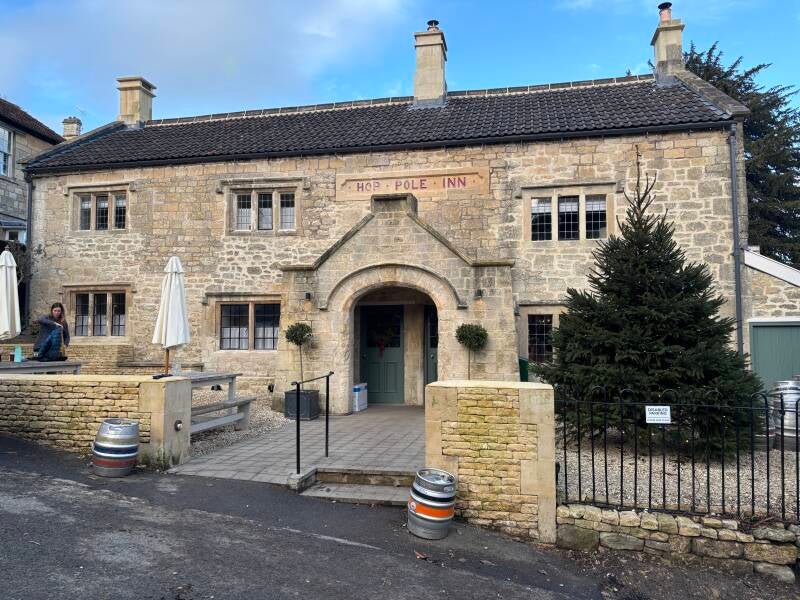
Along the Kennet & Avon Canal, walking from Bradford-on-Avon to Bath.
11 miles
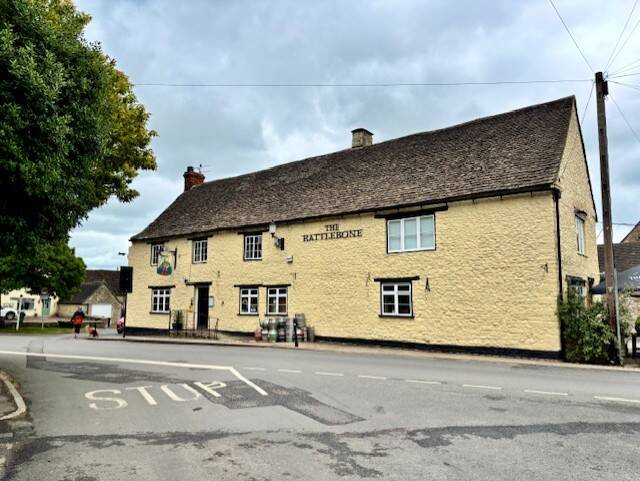
Circular walk from Sherston to Easton Grey on the fringe of the Cotswolds
6.3 miles